Sé Cathedral of Angra do Heroísmo: Cathedral of the Diocese of Angra
Site at a Glance
- Rating
- 4.5
- Popularity
- Low
- Country
- Portugal
- Primary era
- Early Modern
- External website
- Open
- Eras represented
- Medieval, Early Modern, Modern
- Civilizations
- Portuguese
- Site type
- Religious
- Remains
- Cathedral
On this page27 sections
History
Sé Cathedral of Angra do Heroísmo is the principal church of the Diocese of Angra in Portugal, whose jurisdiction extends across the Azores. The diocese was created by Pope Paul III through the bull Aequum reputamus on 3 November 1534, when the Church of São Salvador in Angra became its cathedral. The present building is a large Mannerist cathedral, later adapted in the restrained Portuguese Chã tradition, and developed from an earlier parish church founded in the fifteenth century.
The first Church of São Salvador
Álvaro Martins Homem, founder of Angra, began the first Church of São Salvador in 1461. It was probably completed by 1496, when its first vicar was appointed. Little is known about that building, although its former high altar survives beneath the present chapel. As Angra’s population grew and the settlement became the seat of a diocese, the earlier church could no longer meet its needs.
The municipal council petitioned for a new cathedral in 1534 and reminded King John III of Portugal in 1536 that the diocesan seat should be established in the city. The request was renewed in 1557, when the council explained that local resources could not finance the work. On 10 January 1568, during the reign of Cardinal-King Henry, the Crown decided to construct a new cathedral at its own expense on the same site.
Construction of the present cathedral
The project received an annual allocation of 3,000 cruzados from royal revenues derived from woad on São Miguel Island. The new cathedral occupied most of a city block bounded by Rua da Sé, Rua Carreira dos Cavalos, Rua da Rosa, and Rua do Salinas. The architect Luís Gonçalves Cotta came from mainland Portugal to design the building. Later professionals, including João de Carvalho, adapted the project within the Portuguese Chã tradition, which favored strong massing, practical planning, and restrained decoration.
Construction was integrated with the wider defensive development of Terceira. The old Church of São Salvador remained in use while work began from the principal facade. The foundation stone was laid ceremonially on 18 November 1570. Building continued for approximately half a century, with at least one interruption during the Portuguese succession crisis of 1580. The exterior was completed around 1618, while gilding and chapel decoration continued afterward. Successive masons, carpenters, sculptors, and stoneworkers included Manuel de Lima, Manuel Martins, Luís Mendes, Bartolomeu Fernandes, and António Rodrigues Madeira.
Four side chapels were established through private and brotherhood funding. A cloister was built at the beginning of the seventeenth century and later served as a cemetery. It disappeared during the 1950s. During the eighteenth century, the Grand Sacristy and the Hall of the Ecclesiastical Tribunal were added at the rear of the cathedral. The building was reconsecrated in 1808.
War, loss, and religious continuity
During the Portuguese Civil War of 1828 to 1834, a conflict between royalist and liberal forces over the country’s political order, Te Deum services were held in the cathedral by both sides. In 1829, the Provisional Junta ordered church silver and bells, apart from those needed for worship, to be taken to the Casa da Moeda in the Fortress of São João Baptista and converted into 80-réis coins. The cathedral consequently lost its smaller bells and much historic silver. The Brotherhood of the Most Holy Sacrament saved the principal silver altar frontal by paying its value.
The cathedral also remained a place for important religious ceremonies. Gungunhana, a late-nineteenth-century ruler of the Gaza Empire in southeastern Africa, and his fellow exiles were baptized and confirmed there on 16 April 1899 by Bishop Francisco José Ribeiro de Vieira e Brito. Leading island notables acted as sponsors.
Earthquake, fire, and restoration
The earthquake of 1 January 1980 caused extensive damage. During the ensuing restoration, one bell tower collapsed on 5 July 1983. A major fire on 25 September that year destroyed the gilded altar woodwork, pipe organs, and coffered ceiling. Much Baroque artistic material was lost, but the cathedral was rebuilt and restored to religious use. The restored building was blessed on 3 November 1985.
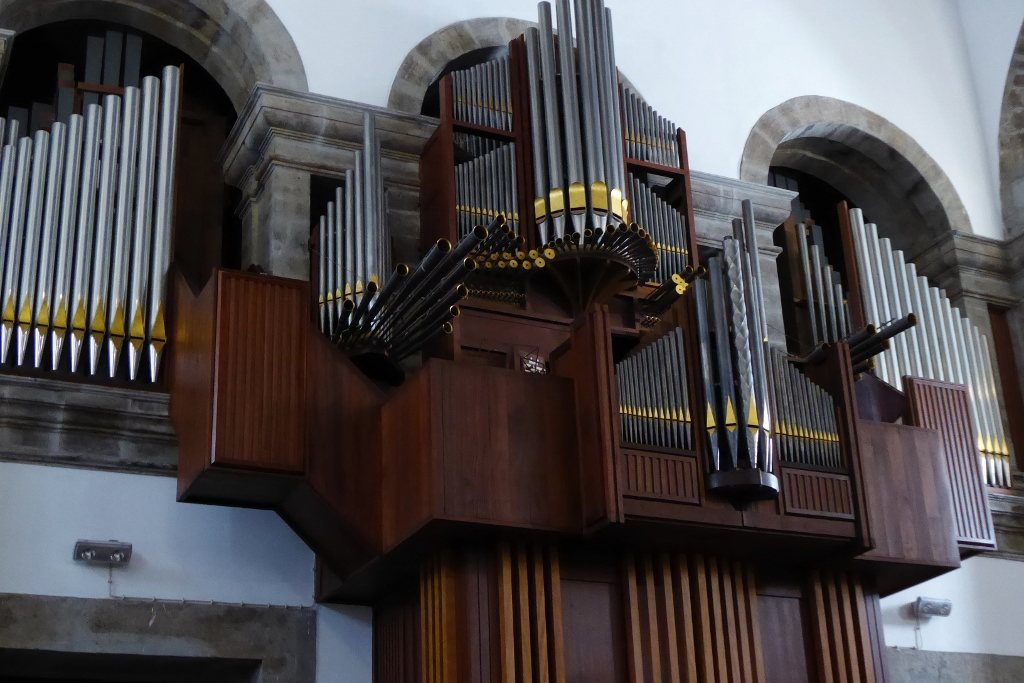
The cathedral was classified as a Regional Monument by Resolution 41/80 of 11 June 1980. It also forms part of the protected historic centre of Angra do Heroísmo under Regional Legislative Decree 29/2004/A. A new organ replaced the destroyed instrument during the 1990s, while paintings, statues, furnishings, and other movable possessions were progressively restored and inventoried. The Treasury of Sacred Art was remodeled as a museum and reopened in 2005.
Recent ecclesiastical history
The cathedral became part of the Angra pastoral zone in 1990, a grouping of parishes and ecclesiastical communities coordinated for shared administration. Pope John Paul II prayed there on 11 May 1991, during the first papal visit to the Azores. A commemorative statue was later installed in the churchyard, and the cathedral retains the chair and chasuble used by the pope in Angra. Ownership passed from the Portuguese state to the Sé Church Factory, the body responsible for church property and practical affairs, in 2000.
The Diocese of Angra’s 475th anniversary and the cathedral’s post-earthquake reopening were commemorated in 2010 by the installation of a 19-bell carillon in the western tower. The bells, representing the municipalities of the diocese, were installed by the Braga Bell Foundry of Serafim da Silva Jerónimo. A permanent exhibition of the old bells and clock was established in the churchyard in 2006.
Remains
Plan and exterior
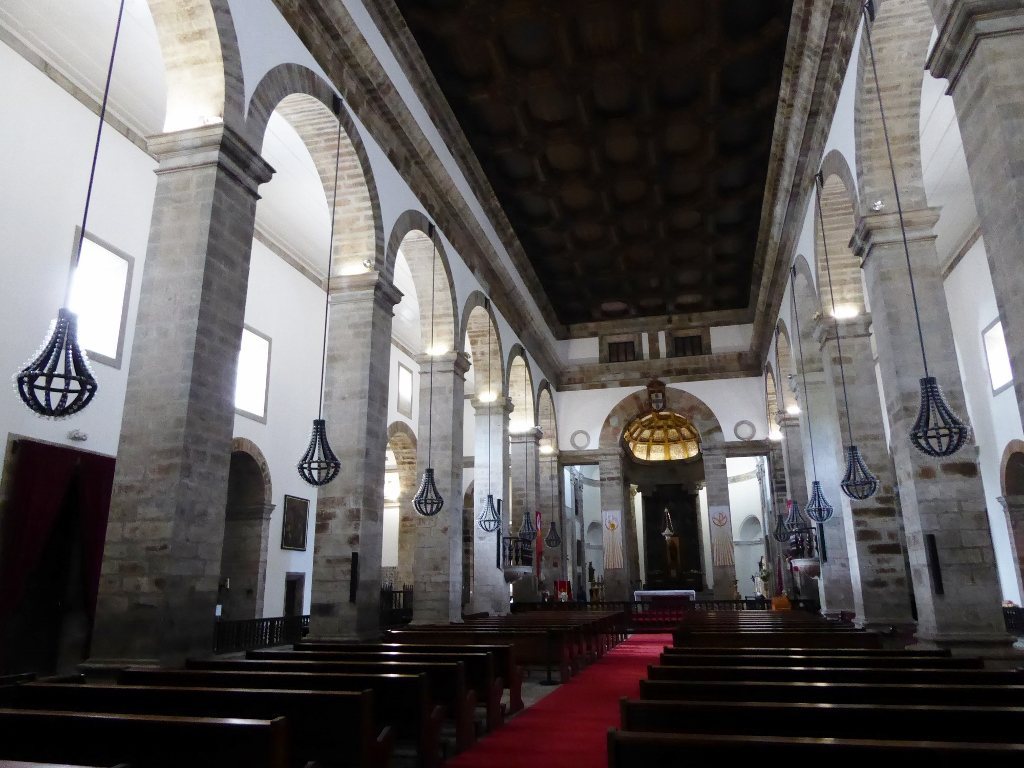
Sé Cathedral is the largest religious building in the Azores. It has a rectangular Renaissance plan in the Mannerist and Portuguese Chã traditions, measures approximately 66.75 metres in length and 43 metres in width, and occupies a large urban block. Unlike the usual eastward orientation of many churches, it faces north. The orientation resulted from the restricted site available when construction began and from land donated by Estevão Cerveira Borges.
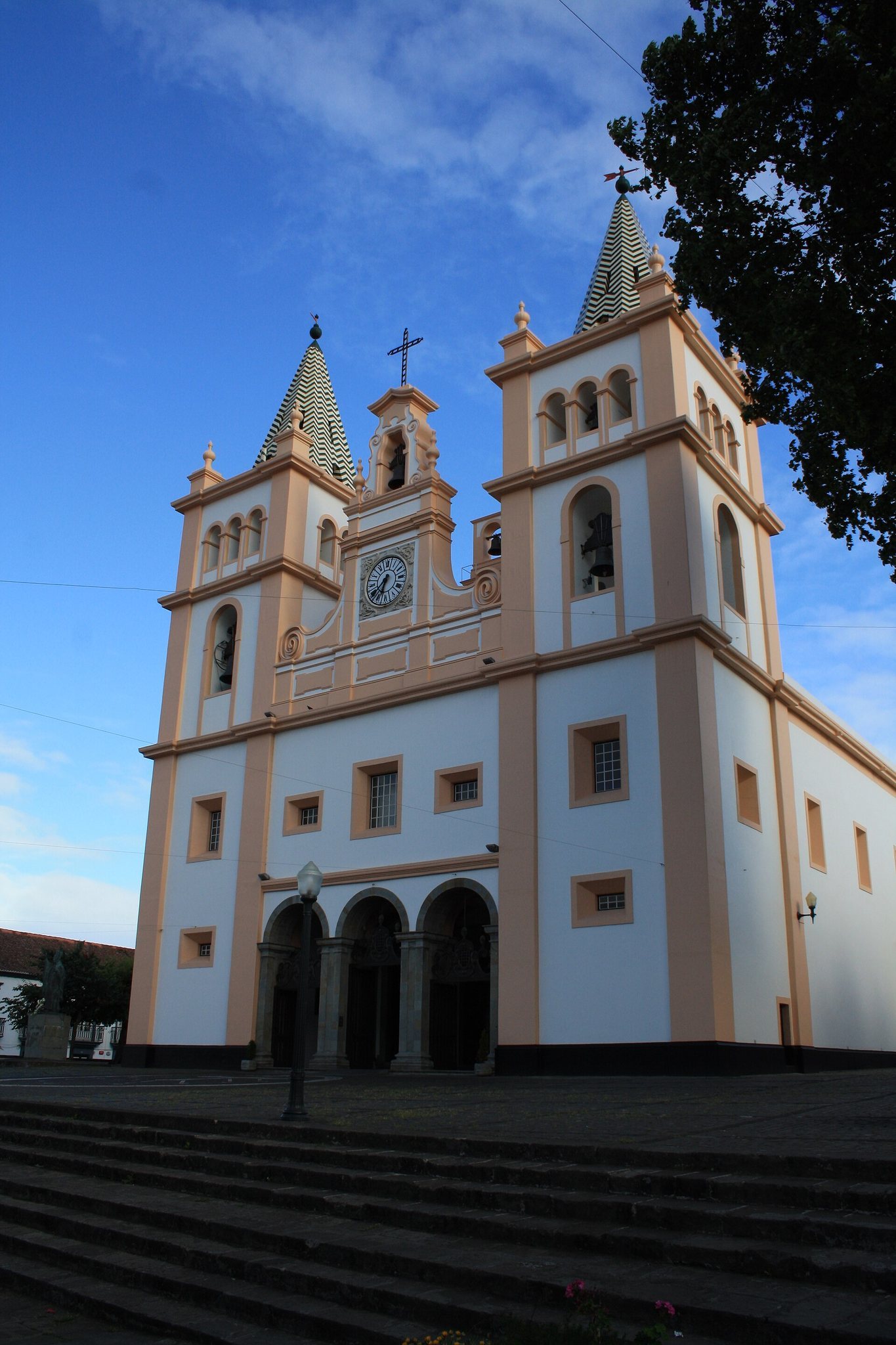
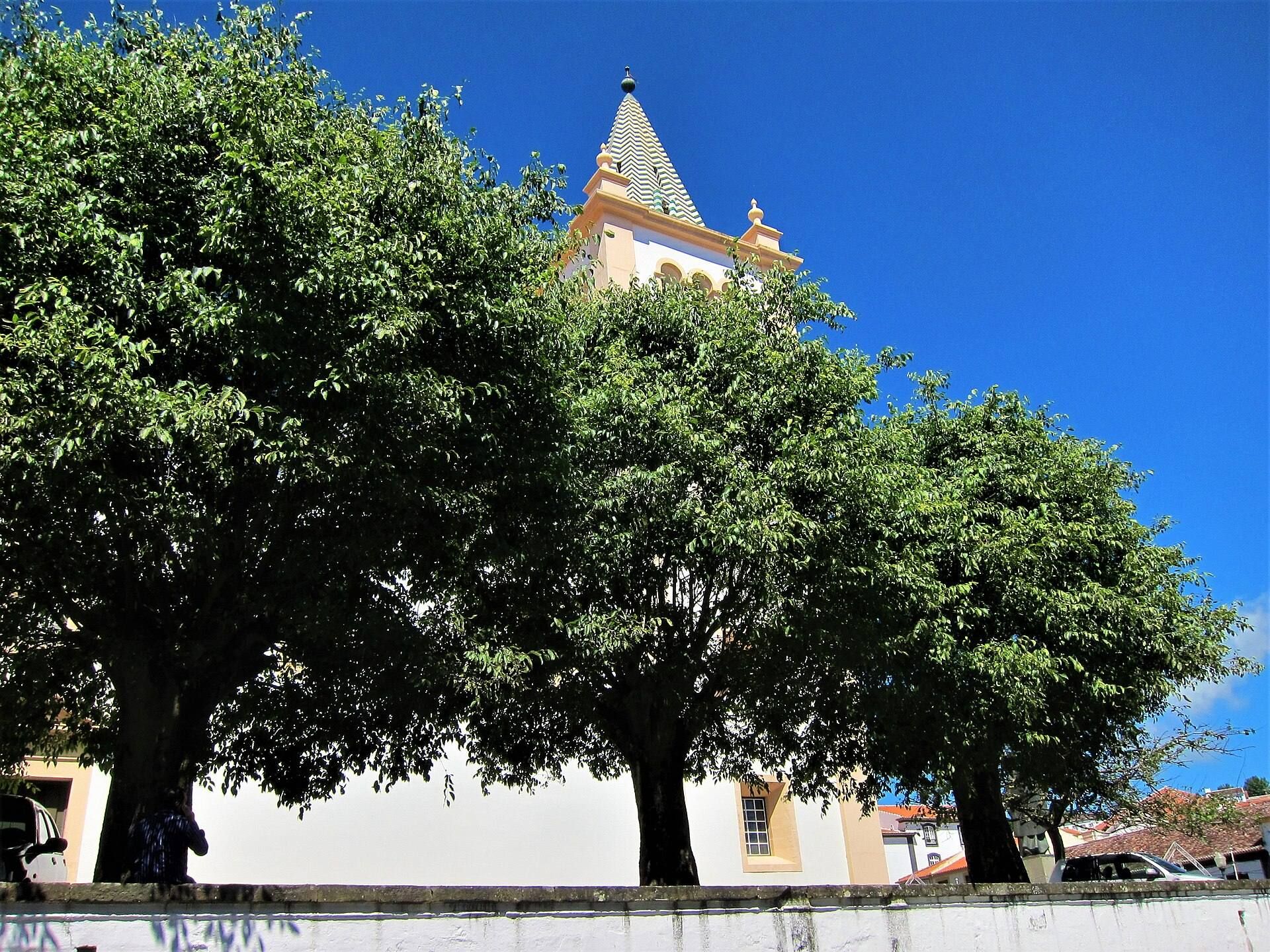
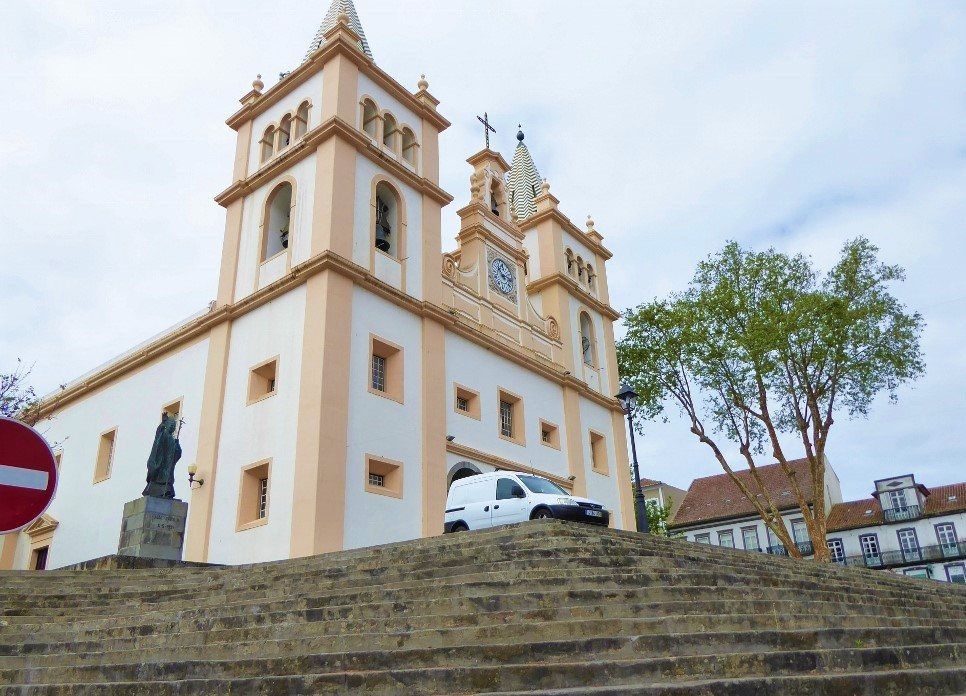
The symmetrical principal facade has two bell towers, each arranged in two orders of openings capable of accommodating 32 bells in total. A clock templete was installed between the towers in 1782. The main entrance is formed by a three-arched portico. Two bronze plaques commemorate Pope John Paul II’s visit and the rebuilding and blessing of the cathedral after the 1980 earthquake. The central doorway has a glass windbreak inaugurated in 1996 through a collaborative design involving José Nuno da Câmara Pereira and Cristina Dores.
An extensive churchyard lies before the cathedral, with a staircase leading toward Rua da Sé. It was improved toward Rua do Salinas in 1845. The churchyard contains the former bells and clock displayed beside Rua da Rosa, as well as the statue commemorating John Paul II.
Interior arrangement
The church has three broad naves divided by stone pillars and a single overall roof. Large stone columns support the ceiling, and there is no transept. At the eastern end, a deambulatory, or passage around the rear of the sanctuary, gives access to three radiating chapels. The apse, the rounded or polygonal end of the sanctuary, is covered by a dome supported by Doric columns. This end has a Gothic-revival character and is relatively constricted compared with the main body of the cathedral.
The baptistery contains the historic baptismal font and two Mannerist paintings depicting the Circumcision of Christ and the Adoration of the Magi. Its baptismal tradition is associated with Blessed João Baptista Machado, who was later martyred in Japan. The lateral nave leading toward the bell towers and former high choir contains paintings of the Last Supper and the Holy Trinity. The present pipe organ was made by Dinarte Machado and installed during the 1990s after the earlier instruments were destroyed. It is prepared for concerts.
Bells and clock
Bell towers
The cathedral’s bells are arranged in four principal groups. Two clock bells occupy the central facade, four service bells are in the eastern tower, 19 carillon bells are in the western tower, and three former bells are displayed in the churchyard. The eastern-tower bells date from 1714 to 1984. The oldest is a large bell from 1714 bearing an image of the crowned Our Lady of the Conception. Two smaller bells date from 1834 and 1918.
Former bells and carillon
The three former bells displayed near Rua da Rosa are cracked and no longer in service. Two were cast in 1782 and 1843, while the third has no inscription. Two clock bells installed in 2005 occupy the central steeple. The western-tower carillon contains 19 tuned bells played together as a musical instrument. They represent the municipalities of the Diocese of Angra, including Angra do Heroísmo, the principal Azorean cities, the most populous towns, medium-sized towns, and smaller municipalities. Each bears the municipality, island, and patron saint in bronze.
Sanctuary and principal chapels
Chapel of the Most Holy Sacrament
The Chapel of the Most Holy Sacrament contains a silver tabernacle and a notable silver altar frontal dating from the beginning of the eighteenth century. Part of the chapel’s silver collection is displayed there, while other pieces are kept in the cathedral treasury.
Main chapel
The main chapel, or presbytery, contains the bishop’s cathedra, the official seat of the bishop, and the capitular choir stalls. Established with the diocese in 1534, the chapter originally comprised five dignitaries and twelve canons. The triumphal arch bears the Royal Arms over the Cross of Christ, expressing the agreement among the papacy, the Portuguese Crown, and the Order of Christ in the expansion of Catholicism.
The principal retable, an elaborate structure behind an altar, is made of painted cedar and dates from the seventeenth century. It depicts episodes from the Gospels and includes an image of the Holy Saviour from a local workshop associated with the Masters of the Sé. The ambulatory contains three altars, with an eighteenth-century crucifix at the centre and images of Saint Louis of France and Saint Elizabeth of Portugal at the sides.
Altars of Souls and Our Lady of the Angels
The Altar of Souls was established in 1640 by the Brotherhood of Souls under Canon Leonardo de Sotto Mayor. Its painting represents the salvation of souls, the Holy Trinity, the Virgin Mary, and Saint Dominic. The Altar of Our Lady of the Angels contains a seventeenth-century image of Our Lady of the Conception transferred from the former Convent of São Francisco da Praia. The second Count of Praia da Vitória, Jácome de Ornelas Bruges de Ávila Paim da Câmara, presented the image to the cathedral during celebrations connected with the proclamation of the dogma of the Immaculate Conception in 1854.
Side chapels and devotional spaces
Chapel of the Lord of the Afflicted
The Chapel of the Lord of the Afflicted originated in the first church founded by Diogo Álvares Vieira and Beatriz Anes Camacho. It contains the tombstone of Francisco Dias do Carvalhal and an altar group ordered from Lisbon in 1706 by Bishop António Vieira Leitão. The group depicts Christ crucified, the Virgin Mary, and Saint John.
Chapel of Our Lady of the Rosary
The Chapel of Our Lady of the Rosary was transferred from the earlier church and is associated with the historic Brotherhood of the Rosary. It contains an image of Our Lady of Fátima placed there during the 1948 pilgrimage of the image, together with images of Saint Joseph and the Sacred Heart of Jesus acquired in 1920.
Chapel of Our Lady of Lourdes
The Chapel of Our Lady of Lourdes was built by the Canto and Castro family. It contains the tombstone of Pero Anes do Canto, who died in 1556, while the arms of the Canto and Castro families appear beside its arch. Devotion to Our Lady of Lourdes was established beside the chapel in 1891 by Monsignor Canon Ferreira.
Chapel of Saint Stephen
Estevão Cerveira Borges instituted the Chapel of Saint Stephen in 1570 and donated land for the cathedral. It contains an image of Saint Stephen dressed as a deacon and an Indo-Portuguese choir lectern made of rosewood with ivory inlay. The lectern was transferred from the Convent of São Francisco in Angra.
Chapel of Saint Peter in Chains
Canon Luís de Almeida founded and furnished the Chapel of Saint Peter in Chains and died in 1631. His tombstone remains there, together with a Baroque image of Saint Peter in Chains, a rosewood screen, and an adjoining sacristy. The Brotherhood of Saint Peter in Chains of the Poor Clerics was established in the chapel in 1604 and commissioned its furnishings and sacristy fittings during the eighteenth century. The chapel is used for reconciliation and catechetical activities.
Altars of Saint Anthony and Saint Blaise
The Altar of Saint Anthony is associated with a fifteenth-century Brotherhood of Saint Anthony, which continues the practice of distributing blessed bread on the thirteenth day of each month. The altar contains an image of its patron. The Altar of Saint Blaise contains a sixteenth-century image of Blaise of Sebaste with Flemish influence.
Sacristies and surviving art
Sacristies
The Rosary, or Chaplains’ Sacristy, contains portraits of Angra’s bishops from 1534 to 1870. The larger sacristy contains portraits dating from 1872 onward. Its furnishings include large Baroque rosewood cupboards for vestments, other artistic furniture, a stone altar with traces of gilding, a Baroque crucifix, and a Baroque Nativity scene. The floor contains the tombstone of Dean Francisco Burquó Del Rio, who died in 1745.
Cathedral collection
The cathedral preserves a substantial but reduced collection of sacred and historical art. Surviving groups include silverwork from Angra, silver lamps and the frontal from the Chapel of the Most Holy Sacrament, hardwood furniture, eighteenth-century glazed ceramic tiles, a pontifical vestment set that belonged to John V of Portugal, a Chinese vase from the Ming dynasty, a Nativity scene from the Machado de Castro school, and portraits of the bishops of Angra.
Sixteenth-century paintings on cedar panels depicting the life of Christ originally belonged to the high altar of the earlier Church of São Salvador. The cathedral also preserves an Indo-Portuguese rosewood lectern with ivory details, made by Angran artisans associated with the Masters of the Sé, local religious-image makers known for carving cedar and applying gilding and painted decoration.
Treasury and Museum of Sacred Art
The Treasury and adjacent Museum of Sacred Art contain liturgical vestments, books, crosses, reliquaries, chalices, censers, processional objects, silver vessels, episcopal furnishings, religious sculptures, and other church equipment. The collection includes seventeenth-century cedar sculptures associated with the Masters of the Sé, eighteenth-century silver liturgical objects, episcopal vestments, large liturgical books, an eighteenth-century silver processional cross, a seventeenth-century gilded silver reliquary cross, a silver bishop’s crozier, a silver tabernacle, and images of saints and the Virgin.
Other holdings include a seventeenth-century cedar image of Saint Peter in Chains; images of Saint Blaise, Saint Luke, Saint Gregory, Saint Benedict, Saint Augustine, Saint Ivo, Saint Francis Borgia, Saint Joachim, Saint Anne, Saint Rita, and Saint Quiteria; a nineteenth-century image of Our Lady of the Conception; and a twentieth-century silver-gilt rosary and crown associated with Our Lady of the Rosary. The collection also contains silver vessels used for baptism, anointing, and the Eucharist, eighteenth-century liturgical books, a sixteenth-century cowhide lectern, eighteenth- and nineteenth-century vestments, a nineteenth-century bishop’s chair, a chair associated with Bishop João Maria, eighteenth-century chapter furniture, and a chair and decorative element associated with former organs.
Many Baroque sculptures, altar frontals, and gilded carvings were lost through the 1829 seizure of silver and the earthquake and fire of 1980 and 1983. The surviving collection is displayed partly in the cathedral and partly in the adjacent Museum of Sacred Art and Treasury.