Kunín Castle: A Baroque Rural Seat and Educational Landmark in Czechia
Site at a Glance
- Rating
- 4.7
- Popularity
- Medium
- Country
- Czechia
- Primary era
- Early Modern
- External website
- Open
- Eras represented
- Early Modern
- Civilizations
- Habsburg, Holy Roman Empire
- Site type
- Domestic
- Remains
- Castle
On this page11 sections
History
Kunín Castle is a Baroque rural seat in Kunín, Czechia, built between 1726 and 1734 for Bedřich August of Harrach-Rohrau and his wife, Eleonora of Liechtenstein. Designed by the Austrian architect Johann Lukas von Hildebrandt, it was reconstructed from an earlier fortress or small manor house and served chiefly as a place of relaxation for the family rather than as its principal residence.
The building’s resemblance to another of Hildebrandt’s works sometimes led to the informal comparison “the small Moravian Mirabell.” Its principal historical importance, however, came through the activities of the couple’s granddaughter, Marie Walburga, Countess of Waldburg-Zeil. An aristocratic landowner and educational reformer, she established the Philanthropinum at the castle, following German models of philanthropic education. The institution became an important center of learning in this part of Moravia.
Marie Walburga and the Philanthropinum
The Philanthropinum admitted children from widely differing backgrounds, including children of serfs, orphans, townspeople, officials, and nobles. Catholics, Protestants, and Jews could study there, while boys and girls between five and fifteen attended together. Teaching took place in both Czech and German. František Palacký, the historian and political thinker from nearby Hodslavice who later became a leading figure in the Czech national revival, received part of his education at the castle.
The school followed an unusually demanding schedule, with lessons from 5 a.m. to 7 p.m. from Monday to Saturday. Mathematics, natural sciences, languages, history, local studies, music, drawing, and gymnastics formed part of the curriculum. Instruction could take place outdoors, and excursions to Helfštýn, Radhošť, and Lysá Hora introduced pupils to the surrounding landscape. Some excursions included sleeping outdoors. The institution also promoted healthy nutrition and practices intended to strengthen physical endurance. On her estate, Marie Walburga carried out the first public vaccination of children in Moravia.
Her personal life was marked by severe losses. Her marriage failed, three of her young children died, and her last son was taken by his father to distant Swabia, where he died at the age of eighteen. Brno Freemasons and secret Illuminati circles introduced her to philanthropic ideas. An examination of her remains later indicated Paget disease, a chronic disorder affecting bone structure. During the last ten years of her life, she could not walk and was transported in a large wicker basket.
Successive owners
Near the end of her life, Marie Walburga adopted Friedrich Emil Schindler, the son of her secretary, and raised him as her successor. She left him the castle. Schindler continued her philanthropic work and built an Empire-style family tomb at her burial place, designed as an open colonnaded hall. His children sold the castle in 1870, three years after his death.
The next owners came from the Austrian tertiary branch of the Fürstenberg family. Cardinal and Archbishop of Olomouc Bedřich Fürstenberg bought the property for Ernst Egon Fürstenberg. The castle then served as the family’s summer residence, while the family spent winters in Vienna. Ernst Egon’s son Josef Friedrich Fürstenberg, known as Fritz, became a prominent rider in the Austrian army, but debts forced him to sell the castle in 1895.
The Bauer family of Brno acquired the property and used it mainly as a summer and holiday residence. The last private owner, Dr. Victor Bauer, died there in August 1939. He promoted the idea of a united Europe and maintained a relationship with the architect Adolf Loos, who was intended to redesign the castle interiors. Bauer also had a villa built at Hrušovany near Brno and commissioned alterations to his residence in the grounds of the Brno Exhibition Centre.
War damage and reconstruction
During the final phase of the Second World War, Soviet soldiers caused extensive damage inside the castle. They rode horses up the main staircase, damaged paintings with bayonets, threw furniture from the windows, and burned furniture and books. Local people then looted the unprotected building. The remaining collections were gathered in a first-floor room, whose ceilings later collapsed. Paintings recovered from the rubble were transferred by the army to repositories in castles and manor houses.
After the war, the building served successively as accommodation for an agricultural estate, a communal kitchen, and a medicine store. In the 1970s, the University of Veterinary Medicine in Brno acquired it and adapted it for student accommodation in ways that disregarded its historic character. By the beginning of the 1990s, the castle had the appearance of a ruin.
The municipality of Kunín acquired the damaged building in 1999 and began its reconstruction with the Nový Jičín Museum. The work aimed to restore the historical collections and open the castle to the public, with support from state and European Union funds as well as substantial municipal investment. In September 2001, members of the Bauer family travelled from the United States and supplied photographs showing the pre-war furnishings of every castle room. The images allowed some original furnishings to be returned. The castle opened to the public in 2003 and also became home to part of the family gallery of the Counts of Hohenems.
In May 2004, Franz-Joseph Waldburg-Zeil, descendants of the last owner, and members of other old families attended a large Mass in the adjacent Church of the Exaltation of the Holy Cross. Bishop František Václav Lobkowicz celebrated a Te Deum, a Christian hymn of thanksgiving, for the castle’s restoration. A destructive flash flood inundated the building during the night of 24–25 June 2009. Kunín Castle is protected as a cultural monument of the Czech Republic, and the municipality of Kunín is its current owner.
Remains
Castle and connected buildings
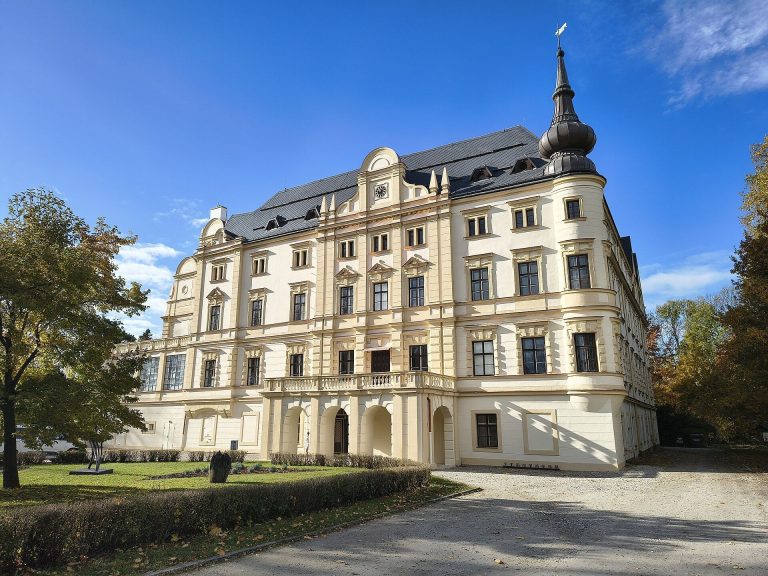
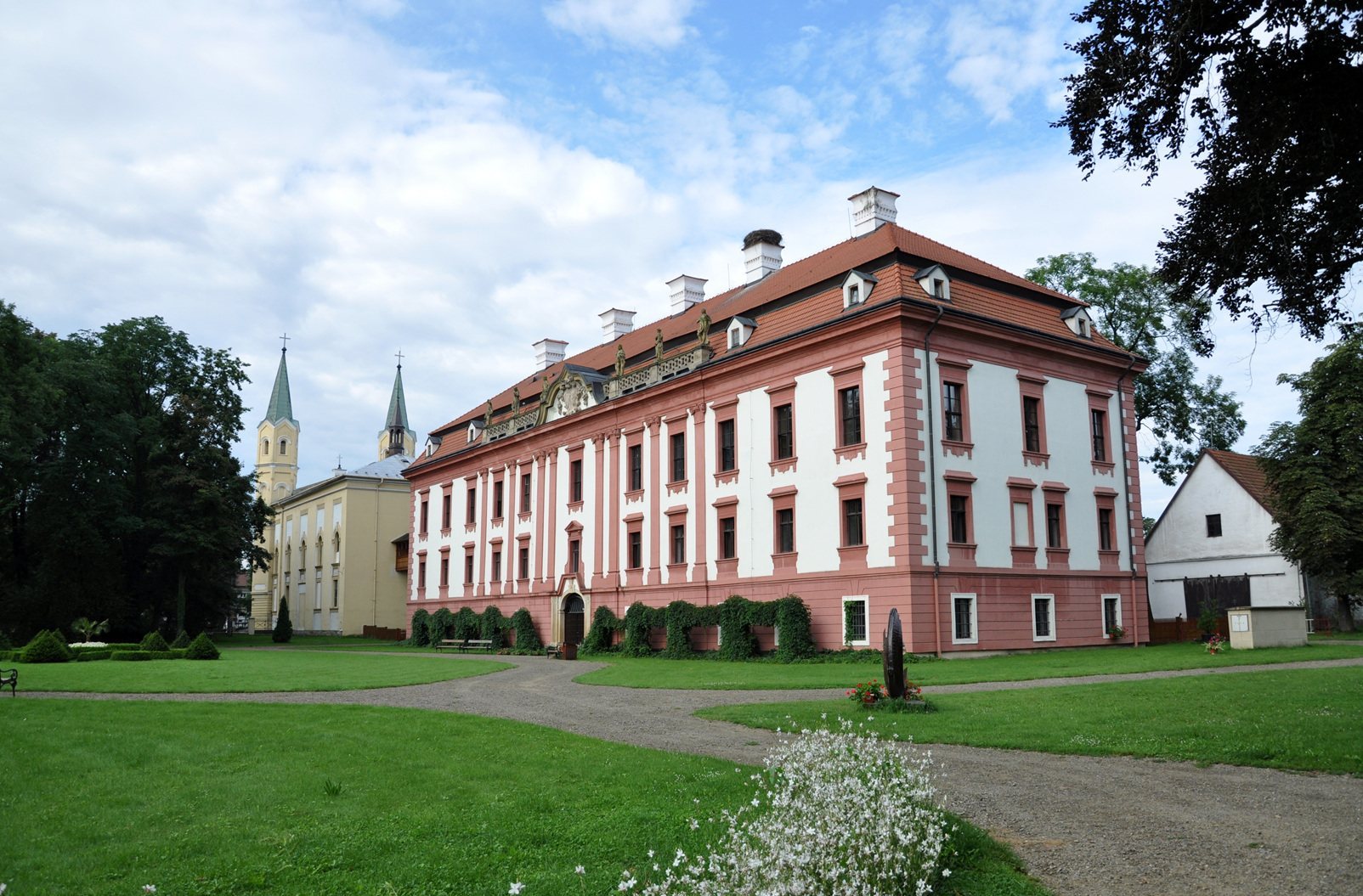
Kunín Castle has a rectangular plan, a ground floor, two upper floors, and a mansard roof. This roof has two slopes on each side, with the lower slope steeper than the upper one. The Baroque building incorporates an earlier single-storey structure and follows Johann Lukas von Hildebrandt’s design. Its principal façade faces the park and is organized by pilasters. A raised attic wall, topped by a balustrade and statues, emphasizes the upper edge of the façade.
Baroque façade
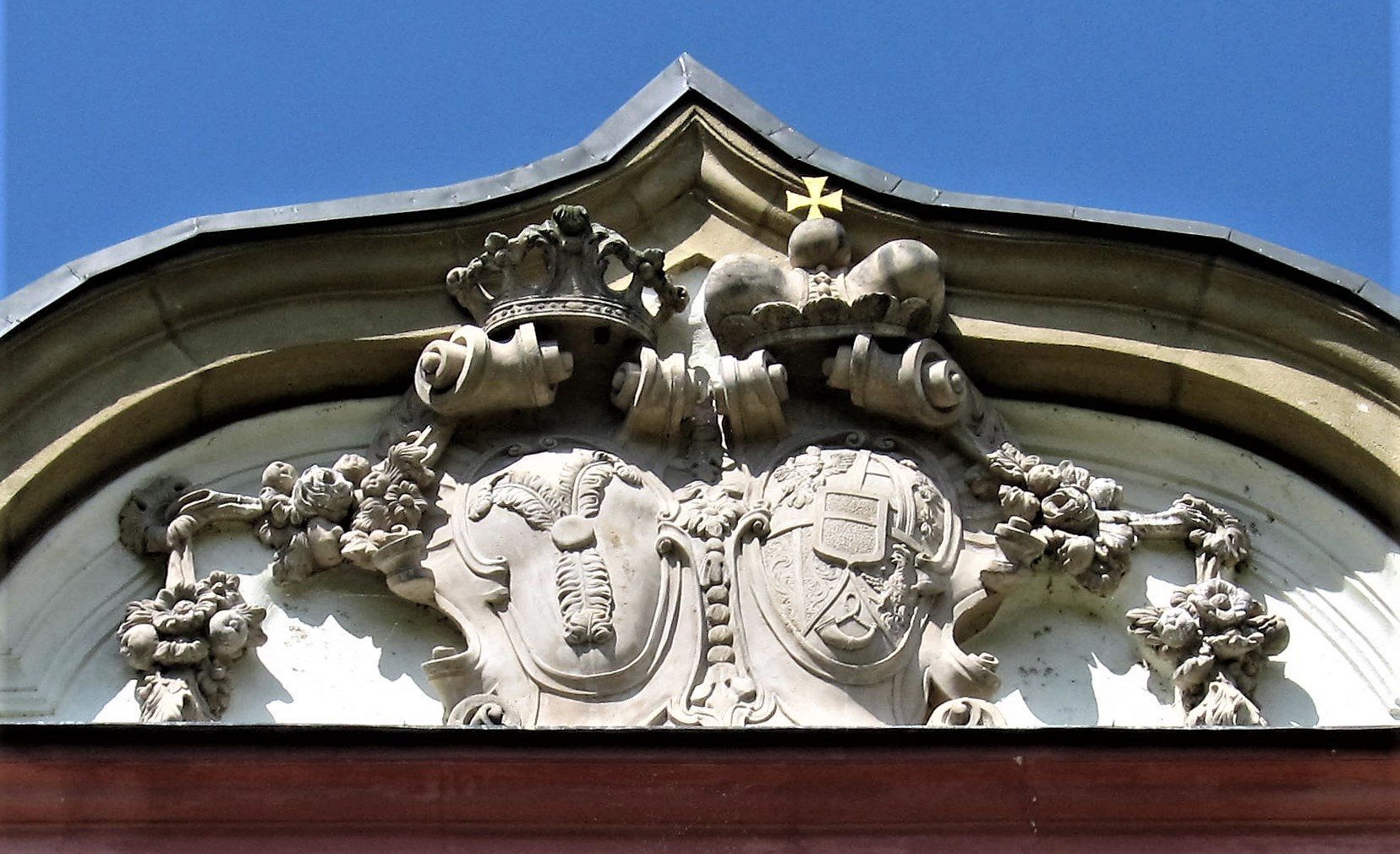
The curved Baroque gable carries the coats of arms of the Harrach and Liechtenstein families, who commissioned the building. The ground-floor and first-floor rooms have barrel vaults, formed by continuous curved ceilings, with lunettes, or smaller curved openings and vault sections that intersect them. The second floor contains a formal reception hall, and the floors are joined by a monumental staircase with a balustrade, a railing made from a row of small supporting posts. The castle also retains a distinctive chimney system.
Church of the Exaltation of the Holy Cross
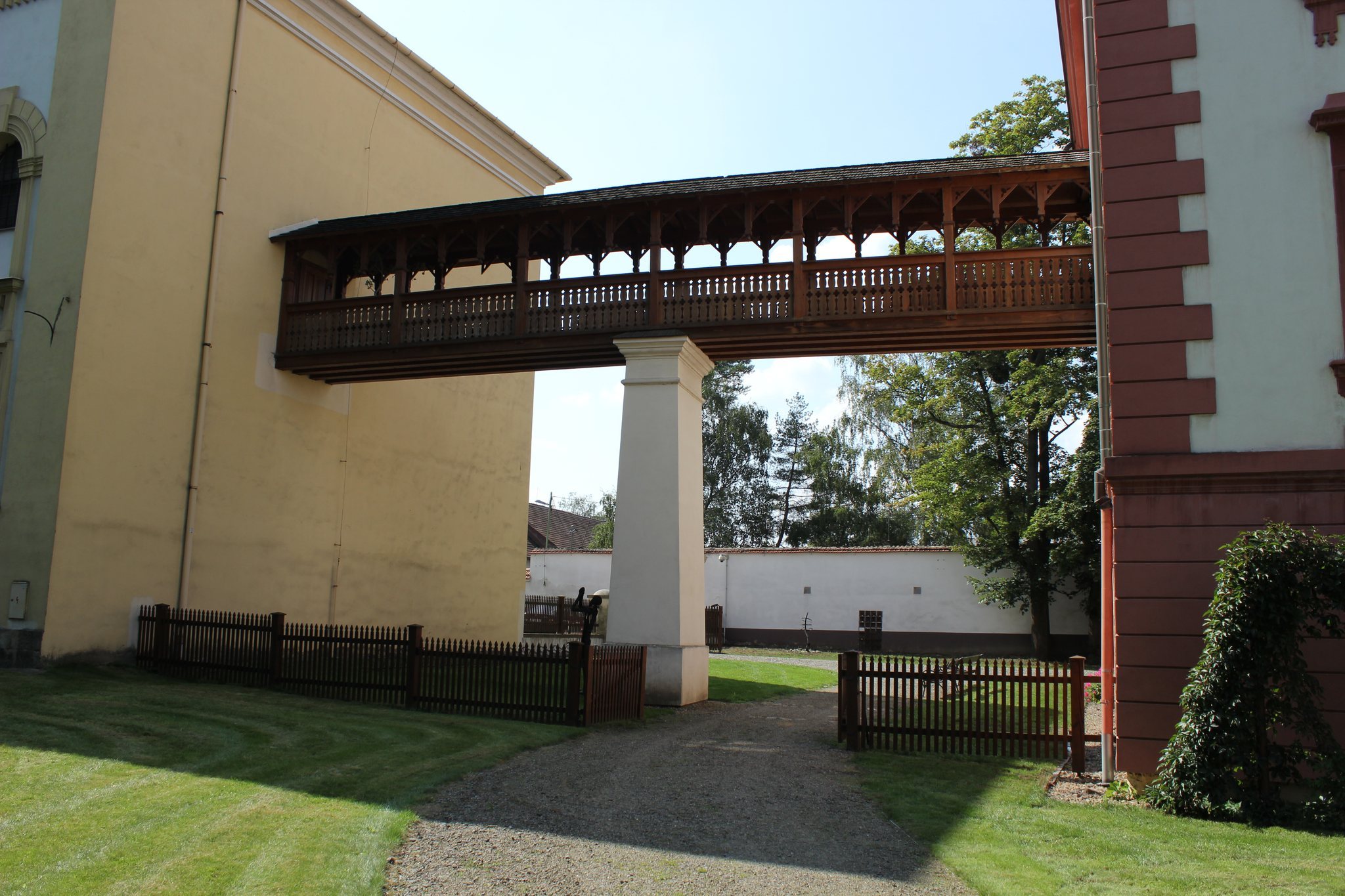
A covered wooden passage connects the second floor of the castle with the adjacent Church of the Exaltation of the Holy Cross. The church began as the castle chapel and was built in 1758.
Park and collections
Castle park
The park has changed repeatedly since its creation. After falling into near-neglect during the second half of the twentieth century, it was revitalized after 2000 as an English landscape park representing the period around the turn of the nineteenth and twentieth centuries. It contains a replica of a wooden skittle alley, a lane used for the traditional bowling game of rolling a ball at standing pins.
Historical furnishings and gallery
Bauer family collections were moved to the family’s other castle at Spálov in the Nový Jičín region and to its principal residence in Brno. Some original furnishings were subsequently returned to Kunín with the help of pre-war photographs supplied by the Bauer family. Part of the family gallery of the Counts of Hohenems is also housed in the castle.