St Magnus-the-Martyr, City of London: A Historic Parish Church beside London Bridge
Site at a Glance
- Rating
- 4.6
- Popularity
- Low
- Country
- United Kingdom
- Primary era
- Early Modern
- External website
- Open
- Eras represented
- Medieval, Early Modern, Modern
- Civilizations
- British, English
- Site type
- Religious
- Remains
- Church
On this page20 sections
History
St Magnus-the-Martyr is an Anglican parish church in the United Kingdom, founded in the eleventh century beside the approach to London Bridge and rebuilt in English Baroque style after the Great Fire of London. It served the growing community of craftsmen, traders, fishmongers, and waterfront workers around the bridgehead, and remains the ward church of Bridge and Bridge Without.
Foundation and medieval parish
The area around the church had been largely unoccupied from the early fifth century until the early tenth century. Occupation expanded after Alfred the Great reoccupied London in 886, followed by the establishment of a wooden bridge by the early eleventh century. St Magnus was founded to serve the settlement developing around the bridge, its landing places, renewed overseas commerce, and the route linking the City with Southwark.
A supposed grant of the church to Westminster Abbey by William I in 1067 is generally regarded as a later forgery, although it may preserve genuine evidence of an eleventh-century foundation. The church appears in a further record of 1128 to 1133. In the late twelfth century, Westminster Abbey and Bermondsey Priory disputed its advowson, the legal right to present a candidate for a church benefice. The Curia Regis, the medieval royal court of England, divided that right equally between them on 23 April 1182. Their joint presentation led to the institution of Simon de Valenciis as rector on 14 April 1208.
In 1234, land was granted to the parson so that the church could be enlarged. The parish occupied a narrow waterfront area on both sides of the old bridge and included Fish Wharf, an important centre for the fishmongers. In 1446, a tenement at the wharf was left to the rector and churchwardens.
The parish was closely bound to London Bridge and its religious life. The medieval bridge was completed in stone in 1209 under Peter of Colechurch. Its chapel of St Thomas Becket, used by pilgrims travelling to Canterbury, stood partly within the parish. Disputes over offerings made to the chapel were settled by an annual payment to St Magnus. The chapel later became a house and then a warehouse before being demolished in 1757 and 1758.
St Magnus Corner, at the northern end of the bridge, served as a medieval meeting place where notices and proclamations were displayed and wrongdoers were punished. From the fifteenth to the seventeenth centuries, the Bishop of London also used the church for general meetings of clergy from the diocese.
Dedication and religious life
The church’s dedication has two competing interpretations. It is now dedicated to Magnus Erlendsson, Earl of Orkney, a Scandinavian nobleman remembered as a Christian martyr who was killed on Egilsay in 1116 or 1117 and unofficially canonised in 1136. The original church probably predates that canonisation, and increasing scholarly opinion identifies its first patron as Magnus of Anagni, an early Italian bishop and martyr whose feast was celebrated on 19 August. The Bishop of London formally confirmed the dedication in favour of Magnus of Orkney in 1926, followed by a patronal festival on 16 April.
Medieval religious life included a perpetual chantry founded by Hugh Pourt and his wife Margaret in the early fourteenth century, a confraternity of Salve Regina recorded by 1343, and a group of singing children maintained from the 1470s to the 1550s. In 1388 and 1389, the Salve Regina confraternity and the guild associated with St Thomas Becket’s chapel agreed to unite and use their resources to restore and enlarge St Magnus.
Henry Yevele, the royal master mason responsible for major works at Westminster Hall and Westminster and Canterbury cathedrals, was a parishioner and a warden of London Bridge. He rebuilt the bridge chapel between 1384 and 1397, gave land south of the church in 1400, and was later buried at St Magnus. John Hert left £40 in 1413 for a new south aisle, while John Hale donated a second adjoining plot in 1426.
Reformation, fire, and rebuilding
The Reformation changed the church’s institutional and religious character. St Magnus remained Roman Catholic until 1538. After the suppression of the monasteries, patronage passed from Westminster Abbey and Bermondsey Priory to the Crown, and Mary I granted it to the Bishop of London in 1553. The rood, a representation of Christ’s Crucifixion, and other fittings were destroyed in 1559, while the altar stones were ordered to be broken in 1562. The church is now Church of England and has a traditional Catholic, or Anglo-Catholic, tradition.
The ancient parish was united with St Margaret, New Fish Street, in 1670 and with St Michael, Crooked Lane, in 1831. St Michael was demolished when the new approaches to London Bridge were built. St Magnus also became the guild church of the Worshipful Companies of Fishmongers and Plumbers, while the Coopers’ Company continues to maintain an annual service there.
St Magnus narrowly escaped a fire in 1633 but was destroyed early in the Great Fire of London in 1666. The fire began on 2 September in Thomas Farriner’s bakery in Pudding Lane, less than 300 yards from the church, and destroyed much of the City. George Dowdeswell began rebuilding St Magnus in 1668, and Christopher Wren directed the work from 1671 to 1687. The rebuilding cost £9,579 19s 10d. St Margaret, New Fish Street, was not rebuilt and was united with St Magnus.
A further fire on 18 April 1760 destroyed most of the roof and damaged the fabric. Bridge improvements in 1762 and 1763 required the removal of the west vestry rooms and opened the lower arches of the tower as a pedestrian passage. The church was repaired and redecorated in 1825 and 1826, but services were suspended after another serious fire in July 1827 until January 1828.
Changing surroundings and modern worship
The opening of John Rennie’s new London Bridge in 1831, upstream from the medieval bridge, ended St Magnus’s role as the principal gateway to London. The church’s surroundings were later reshaped by the widening of Lower Thames Street, the construction of new bridges and warehouses, and redevelopment beside the river.
A proposal in 1920 to demolish St Magnus as one of nineteen City churches was defeated after opposition from parishioners and the public. Martin Travers restored the church in 1924, reinforcing its neo-Baroque and Anglo-Catholic character. Henry Joy Fynes-Clinton, rector from 1921 to 1959, refounded the Fraternity of Our Lady de Salve Regina in 1922, promoted devotion to Our Lady of Walsingham, and arranged pilgrimages to its shrine.
During the Blitz in 1940, a bomb falling on London Bridge blew out all the windows and damaged the plasterwork and north-aisle roof. St Magnus received Grade I listed status, the highest category of statutory protection for buildings of exceptional architectural or historic interest in England, on 4 January 1950. Laurence King supervised repairs in 1951, when much of the plasterwork was reproduced, and the church reopened for worship in June that year. Further restoration followed a fire on 4 November 1995, and exterior stone cleaning was completed in 2010.
Since 2004, St Magnus and Southwark Cathedral have held an annual Blessing of the Thames at the middle of London Bridge. The church also hosted ceremonies involving relics of St Thomas Becket in 2011 and 2016. These practices continue the church’s religious connection with London Bridge, the Thames, and medieval pilgrimage traditions.
Remains
Setting and exterior
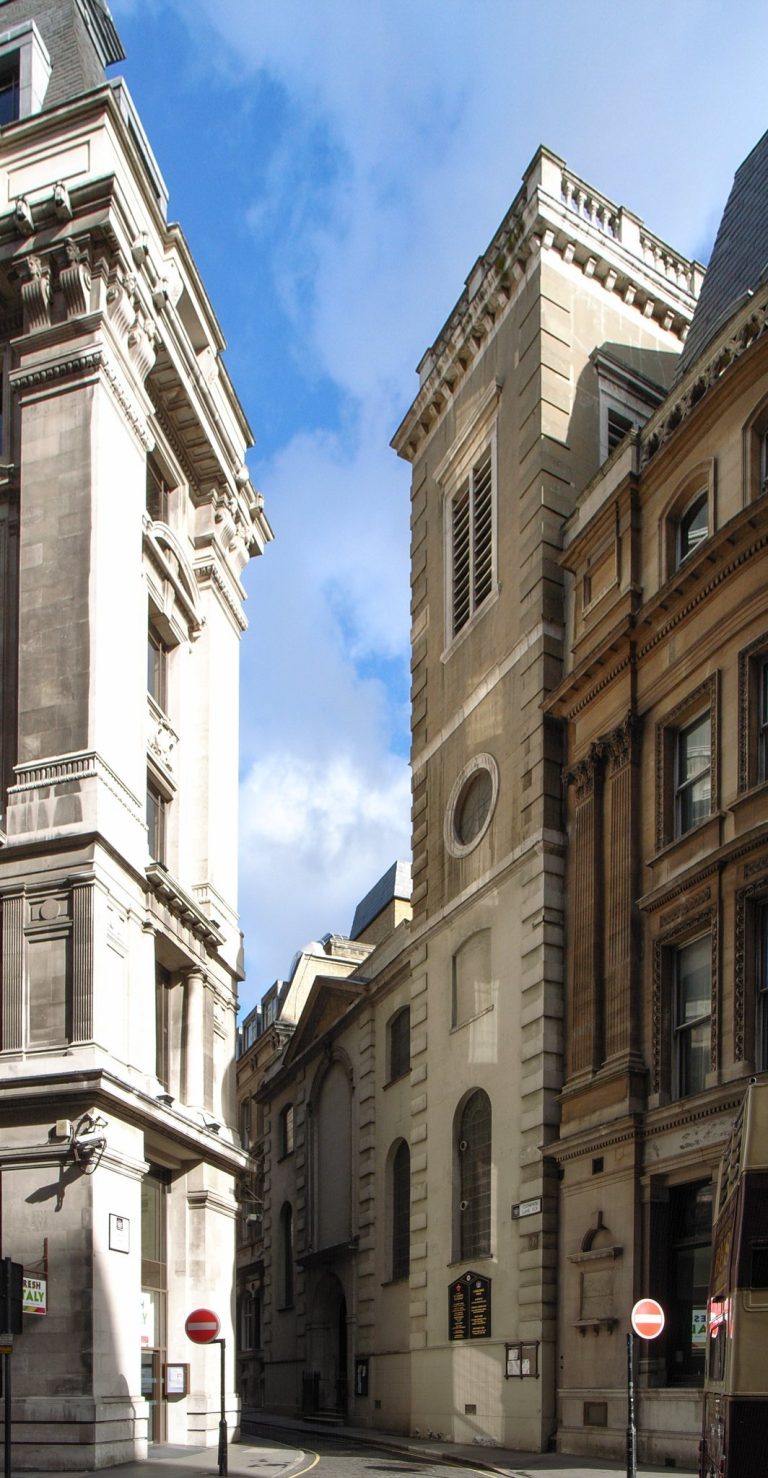
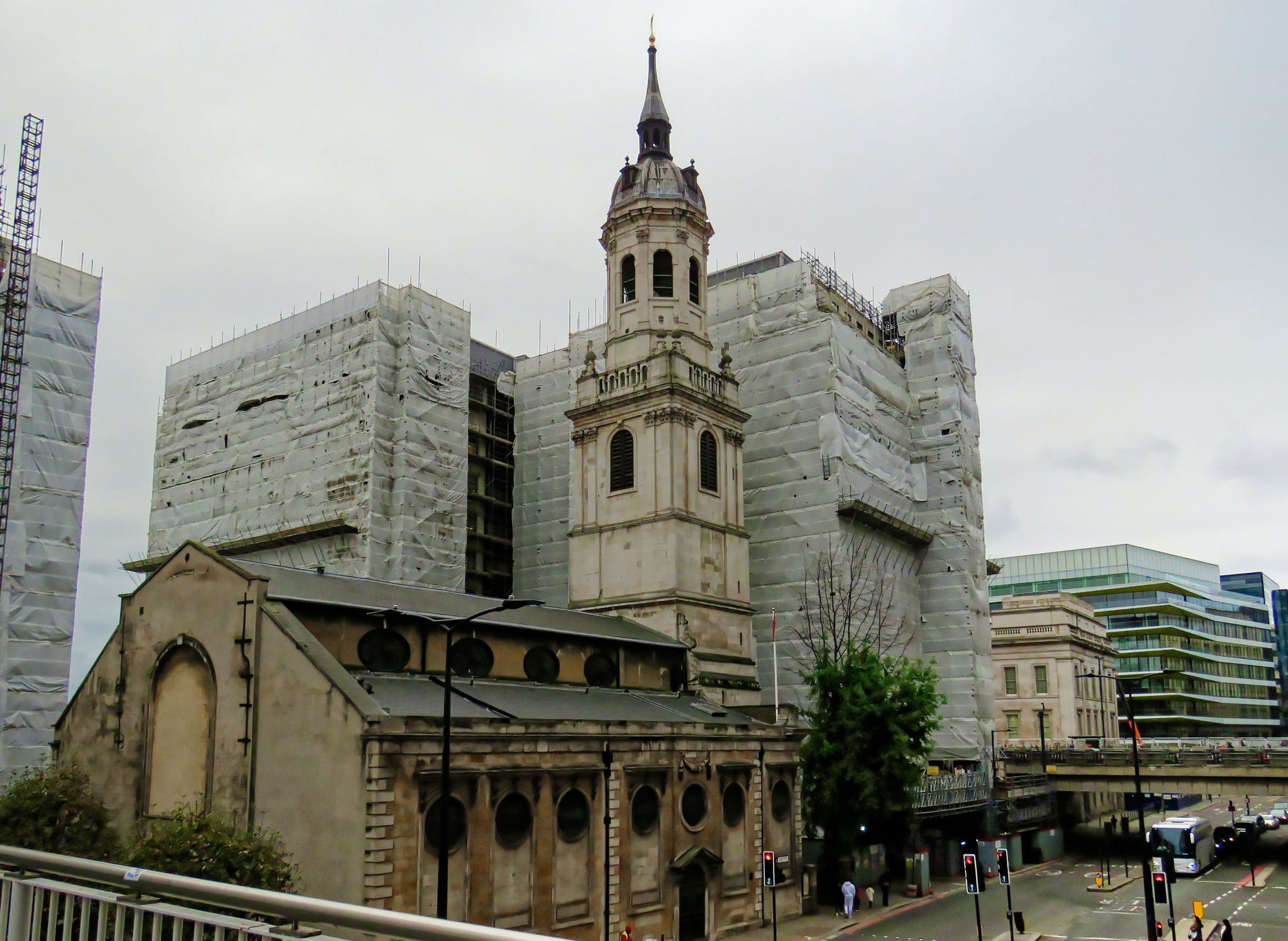
St Magnus occupies the historic alignment of London Bridge on the south side of Lower Thames Street, near the Monument. The former northern bridge approach passed immediately west of the tower, and the church originally stood beside the principal route between the City and Southwark. The present building is Wren’s three-aisled basilica, with flat-roofed aisles flanking a higher nave. Ionic columns carry the nave, whose barrel vault has transverse lunettes above a continuous architrave. Shallow three-bay projections on the side elevations contain the side entrances.
Tower and pedestrian passage
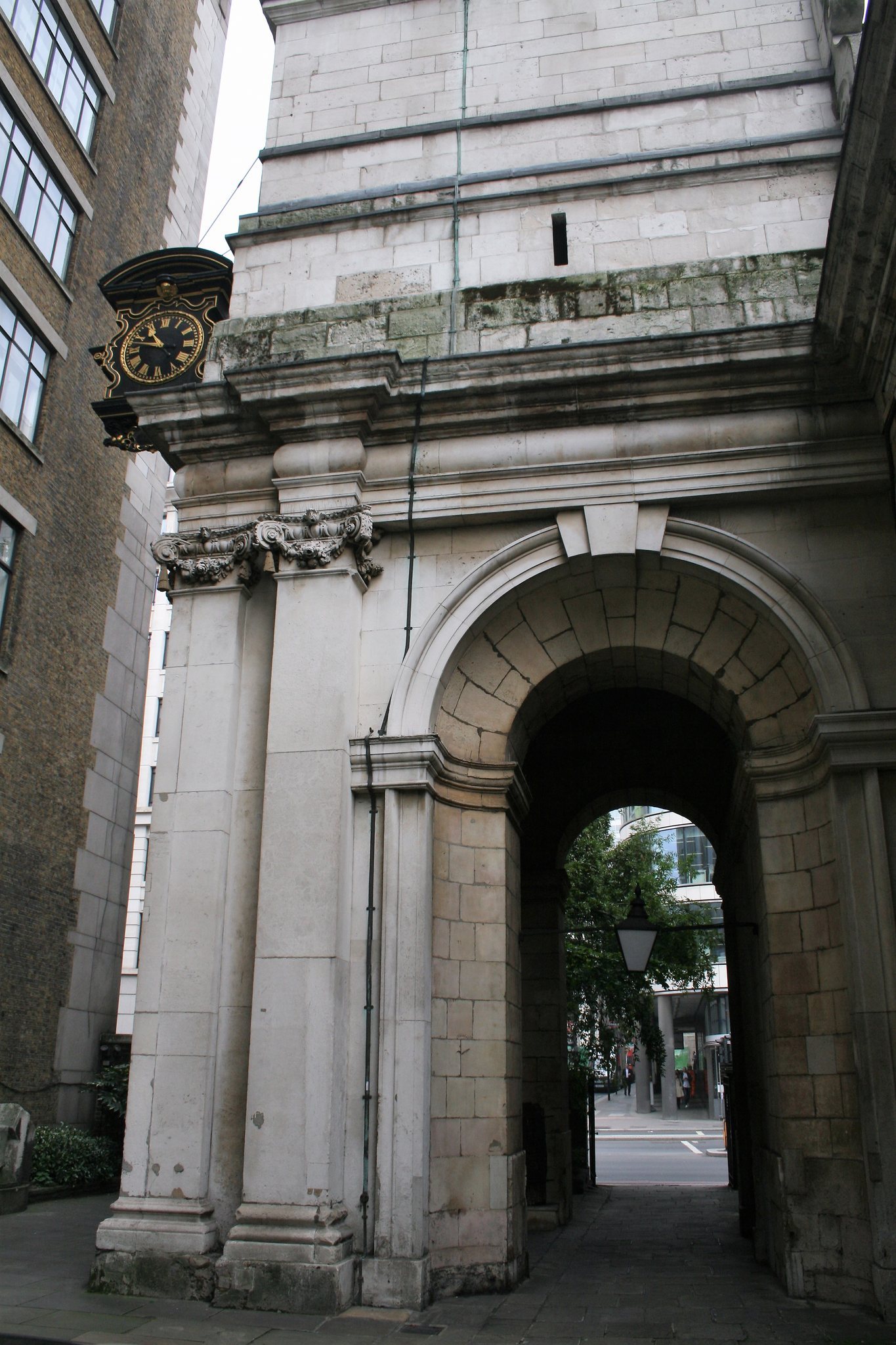
The tower combines Ionic and Corinthian pilasters and rises to an octagonal stage crowned by a dome and cupola. Its lantern and cupola were added between 1703 and 1706 and closely modelled on the steeple of St Carolus Borromeus in Antwerp. In 1762 and 1763, the lower storey was opened as a pedestrian passage, turning it into an external porch.
Windows and paving
The north side originally had large round-arched windows. Most were blocked in 1782 because noise from Billingsgate Fish Market had become intolerable, leaving high circular openings. The present clerestory, an upper range of windows above the main rooflines, has oval windows with fluted and coffered plasterwork and was constructed sometime between the 1760s and 1814. Freestone flags pave the nave and aisles, while the chancel has a chequered marble floor, a marble ascent and steps to the communion table, and Sussex wrought-iron altar rails.
Interior and devotional furnishings
High altar and sanctuary
The interior retains substantial Baroque fabric and was remodelled by Martin Travers in 1924. He restored the seventeenth-century high-altar reredos, an ornamental structure behind an altar, with paintings of Moses, Aaron, and the Ten Commandments, reconstructed its upper storey, and added a painted and gilded rood. A carved gilded pelican and a Baroque roundel showing a nimbus, a descending dove, and cherubim occupy the centre of the reredos.
Travers installed a new altar and console tables, moved the communion rails outward to enlarge the sanctuary, removed the old box pews, and inserted new pews with shortened ends. He also added two nave columns to regularise the internal lines. The former Wren-period pulpit by William Grey was opened up and fitted with a soundboard and crucifix.
Side chapels and images
Two old door frames were reused to form side chapels set diagonally across the north-east and south-east corners. The Lady Chapel was dedicated to the rector’s parents in 1925, while the other chapel was dedicated to Christ the King. A Baroque aumbry, a recessed cupboard for sacred objects, originally held the Blessed Sacrament. After a tabernacle was installed on the Lady Chapel altar, the aumbry housed a relic of the True Cross.
Travers designed the statue of St Magnus of Orkney in the south aisle and the statue of Our Lady of Walsingham. A Russian Orthodox icon painted in 1908 hangs on the north wall. The modern Stations of the Cross are made from honey-coloured Japanese oak by Robert Randall and Ashley Sands.
Stained glass
One north-wall stained-glass window dates from 1671 and came from Plumbers’ Hall in Chequer Yard, Bush Lane. The hall was demolished in 1863 for Cannon Street railway station. Other north-wall windows, made by Alfred L. Wilkinson between 1952 and 1960, display the arms of the Plumbers’, Fishmongers’, and Coopers’ Companies, together with the arms of William Wand as Bishop of London, Geoffrey Fisher as Archbishop of Canterbury, and the badge of the Fraternity of Our Lady de Salve Regina.
South-wall windows made by Lawrence Lee between 1949 and 1955 depict saints and churches associated with former parish communities. Their subjects include Magnus and the ruined church on Egilsay, Margaret of Antioch and the lost church in New Fish Street, Michael and the demolished church of Crooked Lane, and Thomas Becket with his chapel on Old London Bridge.
Objects, crypt, and civic furnishings
Bridge model and stones
The church possesses a detailed model of Old London Bridge, including a small figure of the model-maker, David T. Aggett, in a policeman’s uniform. Two stones from Old London Bridge, discovered across the road in 1921, are displayed in the churchyard.
Fire engines and burials
Two historic parish fire engines once belonged to St Michael, Crooked Lane. One is displayed in the narthex, an entrance hall at the western end of a church. The other was sold at auction in 2003, and its whereabouts is unknown. Burials in the crypt were partly cleared in 1894, when many bodies were reinterred in the church’s plot at Brookwood Cemetery.
Clock and sword rest
The clock projected over the roadway of Old London Bridge. Presented by Sir Charles Duncombe in 1709 and made by Langley Bradley, it became a prominent City landmark. The church also retains a sword rest made in 1708 for the Lord Mayor’s sword and mace during ceremonial worship.
Organ and bells
Organ
Charles Duncombe commissioned the organ shortly before his death. Built by Abraham Jordan and inaugurated on 14 February 1712, it was the first organ with a swell box, an enclosed section fitted with shutters that regulate the volume of sound. Its surviving five-part case has fine wood carving associated with the school of Grinling Gibbons. The instrument was restored in 1760, 1782, 1804, 1855, 1861, 1879, 1891, 1924, 1949, and 1997.
Bells
Before the Great Fire, the old tower contained five bells, a small saints’ bell, and a clock bell. In 1672, forty-seven hundredweight of bell metal recovered after the fire was used to cast three bells by William Eldridge of Chertsey. Hodson cast a further saints’ bell. The bells later increased to eight and then ten between 1713 and 1718, and the tenor weighed 21 hundredweight.
The ten bells were removed for safekeeping in 1940. Four were found to be cracked in 1951, and the ring was sold for scrap in 1976. Its metal was used for bells installed in the Old Post Office Tower in Washington, D.C. A new ring of twelve bells was cast by the Whitechapel Bell Foundry in 2008 and 2009. The tenor weighs 26 hundredweight, 3 quarters, and 9 pounds. The bells were consecrated on 3 March 2009 and dedicated for ringing on 26 October 2009. They are named Michael, Margaret, Thomas of Canterbury, Mary, Cedd, Edward the Confessor, Dunstan, John the Baptist, Erkenwald, Paul, Mellitus, and Magnus. Their first peal, a formally completed performance of change-ringing, took place on 29 November 2009.