Namakkal Fort: A Historic Watchtower and Garrison in India
Site at a Glance
- Rating
- 4.4
- Popularity
- Medium
- Country
- India
- Primary era
- Early Modern
- Eras represented
- Early Modern
- Civilizations
- Unclassified
- Site type
- Military
- Remains
- Fort
On this page11 sections
History
Namakkal Fort is a seventeenth-century fort in Namakkal, India, built by the Madurai Nayaks during the reign of Thirumalai Nayak. Its construction is attributed to Ramachandra Nayakar, a Poligar, or local military and administrative chief, of Sendamangalam. Rising above the town from the summit of Namagiri, the fort served successive regimes as a watchtower and garrison.
Madurai Nayak and Mysore Rule
The fort was captured by the British in 1768, but was later lost to Hyder Ali, ruler of the Kingdom of Mysore. His son and successor, Tipu Sultan, used it as an arms depot and watchtower. Tipu Sultan was closely associated with Mysore’s military resistance to the British East India Company.
British Military Use
Under the Treaty of Srirangapatnam, a late-eighteenth-century settlement that transferred territory and forts from Mysore to the British East India Company, Namakkal Fort passed to the Company with four other forts. The British used it to store food grains and arms and continued its use as a watchtower. During the Peninsular War, Lieutenant Fehrszen used the fort as a garrison.
The fort was later declared a monument of national importance. The Archaeological Department of the Government of Tamil Nadu controls and administers it, while the Archaeological Survey of India is also identified with its maintenance.
Religious Traditions
Hindu tradition identifies the hillock with Namagiri and Saligramam. According to the tradition, Hanuman carried it while transporting Sanjeevi Paravatha from the Himalayas to Sri Lanka. After stopping to worship at the Kamalalayam tank, he placed the sacred stone there. It grew to its present size after a divine voice instructed him to leave it in place.
Another tradition connects the site with Narasimha, the man-lion avatar of Vishnu. After Narasimha destroyed the asura, or powerful demon-like being, Hiranyakasipu, Hanuman is said to have brought him to the place where Mahalakshmi, Vishnu’s wife, was performing penance.
Remains
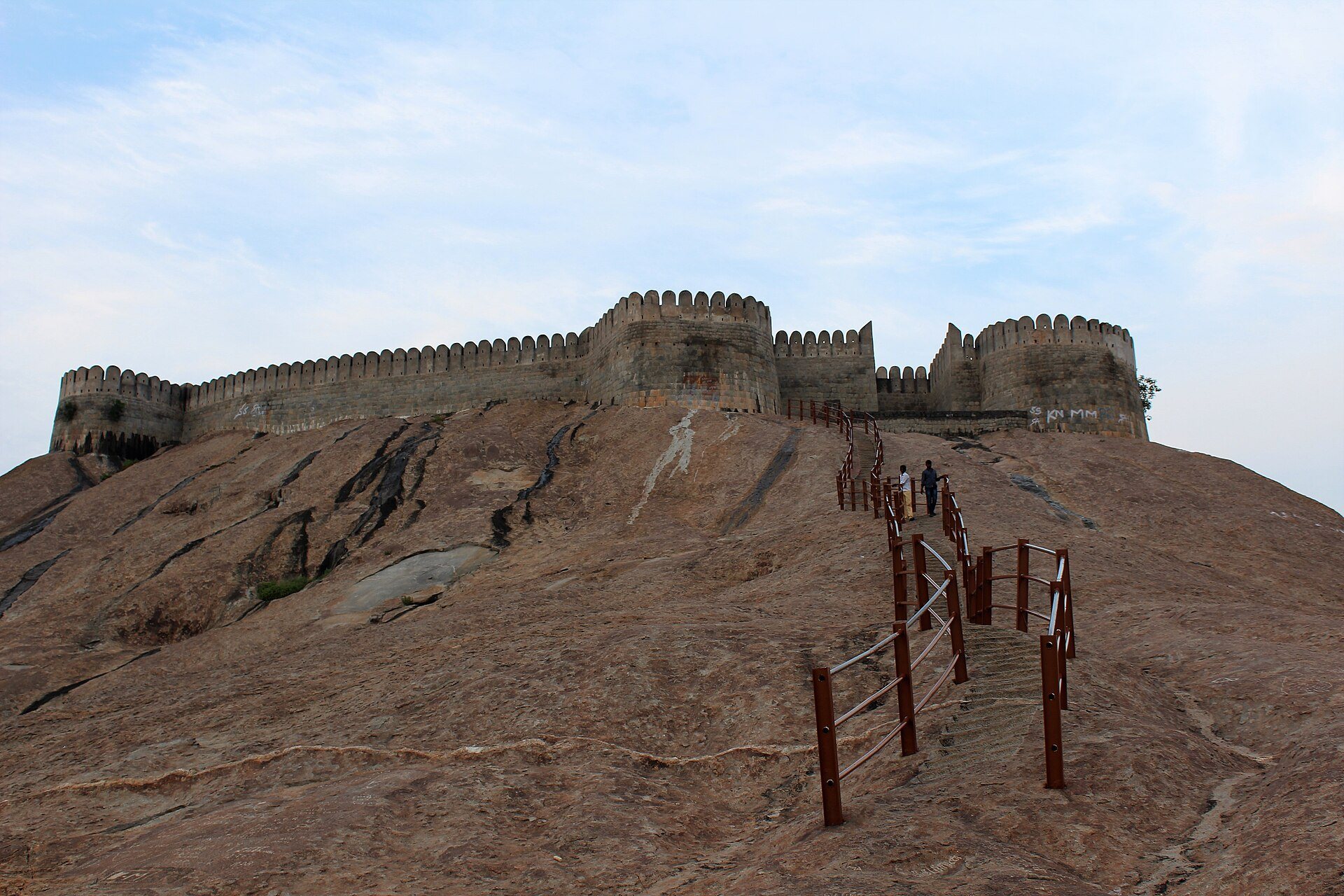
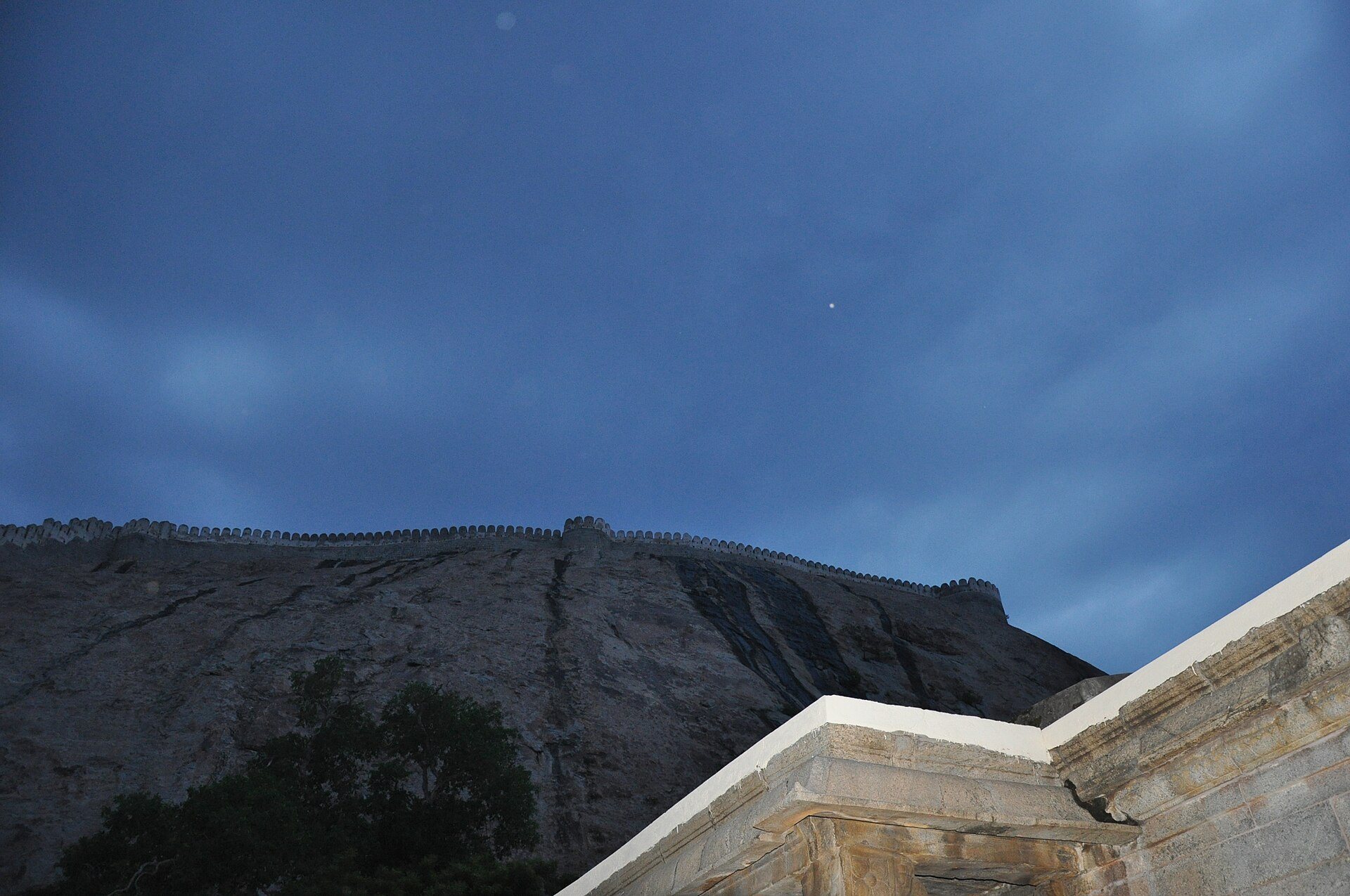
Namakkal Fort occupies the summit of Namagiri, a single-rock hillock in the centre of Namakkal town. The rock rises approximately 75 metres, or 246 feet, and the fortified area on the summit covers about 1.5 acres, equivalent to roughly 6,100 square metres. The fort’s position on the rock defines its compact summit layout.
Fort Construction
The walls were built from accurately cut blocks of the same stone as the hill. Mortar bonds the blocks to the rock, while the higher portions are held in place by their own weight and by precise fitting. This construction technique ties the surviving fort directly to the summit’s natural stone.
Religious Structures
Narasimha Temple
A Narasimha temple stands within the fort at the summit. Its presence preserves the religious association between the hillock and the tradition of Narasimha’s arrival with Hanuman.
Mosque
A mosque also stands within the fort, forming part of the surviving religious architecture on the summit.
Hanuman Image
An eight-foot image of Hanuman was reinstalled on the fort. It faces the Narasimha image at the summit.
Kamalalayam Tank
The Kamalalayam tank lies at the foot of the hillock. Hindu tradition associates the tank with Hanuman’s stop to worship while carrying Sanjeevi Paravatha.