Sankt Blasien Abbey in the Black Forest: A Benedictine Monastery and Neoclassical Church
Site at a Glance
- Rating
- 4.7
- Popularity
- Medium
- Country
- Germany
- Primary era
- Early Modern
- External website
- Open
- Eras represented
- Early Modern
- Civilizations
- Habsburg, Holy Roman Empire
- Site type
- Religious
- Remains
- Monastery
On this page13 sections
History
Sankt Blasien Abbey in Germany is a former Benedictine monastery in St. Blasien, in the southern Black Forest. Its institutional history probably began around 948, when a religious foundation developed at an earlier settlement associated with the relics of Saint Blaise. The abbey became a major reform monastery, an extensive territorial power, and an important center of learning before its dissolution in 1806.
Early foundation and medieval expansion
The origins of Sankt Blasien are uncertain. A small ninth-century cell known as cella alba, meaning “white cell,” was dependent on Rheinau Abbey, but the connection between that settlement and the later monastery cannot be established with certainty. A portion of Saint Blaise’s body was transferred from Rheinau to the cell in the later ninth century, giving the community the religious identity from which Sankt Blasien developed. The settlement may have been destroyed during the Magyar incursions of the tenth century, while the loss of early archives left its beginnings poorly known.
Tradition attributes the foundation to Reginbert of Seldenbüren, who is said to have lived as a hermit at the earlier cell, made substantial donations, and entered the Benedictine order. The abbey was probably founded around 948, and its first abbot, Beringer, introduced the Rule of Saint Benedict, the code governing Benedictine monastic life. Reginbert died around 962 or in 964. A stone church was built around 950 and consecrated by Gaminolf, Bishop of Constance.
In 983, Emperor Otto II confirmed Reginbert’s donations and probably granted the high valleys of Bernau and Menzenschwand, the bailiwick of Blasiwald, and the villages of Urberg and Höchenschwand. These possessions formed the territorial jurisdiction called the “Zwing und Bann.” Construction of the three-aisled Old Minster began in 1013 and continued until 1036. Under Abbot Uto of Kyburg, a new church dedicated to Saint Stephen was built in 1084 and consecrated in 1085 by the future Pope Urban II. Uto also enlarged the monastery between 1068 and 1086.
Reform and territorial growth
During the Investiture Controversy, the medieval dispute over who controlled the appointment of bishops and other church officials, Sankt Blasien supported the papal side and adopted Cluniac practices. Contacts with the reform monastery of Fruttuaria in northern Italy between about 1070 and 1073 brought the Fruttuarian reform, a movement seeking stricter Benedictine discipline and closer organization. The monastery also introduced lay brothers, non-ordained religious members who performed practical and economic work, and probably established a double monastery containing communities of monks and nuns. The nuns appear to have been transferred to Berau before 1117.
Sankt Blasien became one of the leading reform monasteries of Swabia, alongside Hirsau and Allerheiligen. It founded or reformed religious houses including Muri, Ochsenhausen, Göttweig, Stein am Rhein, and Prüm, as well as numerous priories and monasteries in the Black Forest and beyond. A prayer fraternity list from about 1150 records its links with many male and female religious communities.
During the twelfth century, the monastery increasingly concentrated on acquiring and administering land. Donations and purchases secured estates around the abbey, at Schluchsee, in the Wiesental, throughout the southern Black Forest, and beyond the Upper Rhine. Administration was divided among offices including the Waldamt, Wutenamt, Baaramt, Breisgauamt, and offices for Alsace, Basel, Zurich, and Klingnau. Sankt Blasien held or influenced priories, parish churches, dependent religious houses, and estates at places such as Klingnau, Wislikofen, Oberried, Gutnau, Weitenau, Bürgeln, and Sitzenkirch.
The monastery’s protective lordship was contested during the twelfth and thirteenth centuries. A charter dated 8 January 1125 confirmed imperial protection and the right to choose the secular protector, after the earlier protective role of the bishops of Basel had been challenged. The Zähringers subsequently held this protective lordship. After their extinction in 1218, it passed under imperial authority, and King Conrad IV transferred it to Rudolf of Habsburg in 1250.
From the mid-thirteenth century, Sankt Blasien belonged to the Habsburg sphere of Upper Austria and became a Further Austrian prelatic monastery in the County of Hauenstein. Further Austria was the Habsburg designation for scattered territories in southwestern Germany and nearby regions. The abbey retained ties with the Holy Roman Empire, appearing in imperial registers between 1422 and 1521, although an attempt in 1549 to recognize it as an imperial abbey failed.
Four imperial lordships acquired by the abbey by the end of the thirteenth century, including Blumegg, Bettmaringen, Gutenburg, and Berauer Berg, formed the core of the imperially immediate lordship of Bonndorf, established in the early seventeenth century. Imperial immediacy meant direct dependence on the emperor rather than on an intermediate territorial lord. The abbots therefore held the position of landgraves of Bonndorf, and in 1746 Emperor Francis I Stephen elevated Abbot Franz II Schächtelin to the rank of Imperial Prince.
Destruction, war, and rebuilding
A fire on 1 May 1322 destroyed the entire monastic complex. Reconstruction began at once according to the earlier plan, and the Gothic monastery buildings were completed by 1348. During the Waldshut War in 1464, Confederate forces approached Sankt Blasien and burned farms in the surrounding area. Abbot Christoph von Greuth met the force and offered hospitality, saving the monastery from destruction.
The German Peasants’ War, a sixteenth-century uprising involving demands over lordship, taxation, and customary rights, brought renewed violence. Insurgents from the Stühlingen area, joined by inhabitants of the Hauenstein forests and peasants from Fürstenberg, plundered Sankt Blasien. Parts of the complex were destroyed on 11 April 1526 in retaliation for the execution of the insurgent leader Kunz Jehle. Under Abbot Caspar I, the buildings were renewed in their earlier style and repeatedly enlarged until the early eighteenth century.
From 1629, apart from a short interruption, the monastery of Lorch was placed under Sankt Blasien through the Restitution Edict of Emperor Ferdinand II. This 1629 measure, issued during the Thirty Years’ War, sought to restore certain ecclesiastical properties to the Catholic Church. Lorch remained connected to Sankt Blasien until 1648. Swedish troops severely damaged the abbey in 1638, but Abbot Franz I continued the study of Oriental languages and enlarged the library through new acquisitions.
Baroque reconstruction and the age of Martin Gerbert
The monasteries of Sion at Klingnau and Mengen were acquired in 1725, while Oberried remained a Benedictine priory of Sankt Blasien from 1725 to 1806. Between 1727 and 1742, Abbot Franz II had the medieval complex completely demolished and rebuilt in the Baroque style. Johann Caspar Bagnato directed the construction of the chancellery buildings and inn. The monastery also maintained offices in Waldshut, Freiburg, Kaiserstuhl, Zurich, Basel, and Schaffhausen, as well as the pleasure house called the Tusculum above the Alb, which existed from 1761 to 1824.
Martin Gerbert, Prince-Abbot from 1764 to 1793, presided over a major intellectual and architectural flowering. After a great fire in 1768, the extensive Baroque complex and a new early Neoclassical church were rebuilt. The planned monumental crypt for the ceremonial transfer of Habsburg remains was not completed, but the transfer itself took place on 14 November 1770. The first Mass in the new domed church was celebrated on 11 November 1781, and the church was consecrated in 1784.
Gerbert also strengthened the abbey’s scholarly life. Its library held important manuscripts, including the Ramsey Psalter, and the monastery operated a significant printing press during the eighteenth century. Repeated fires damaged parts of the library at different times. Gerbert conceived the research project later known as Germania Sacra, which aimed to record the history of monasteries and dioceses in Germany. Librarians, historians, teachers, and correspondents from religious and academic centers across central Europe contributed to the abbey’s intellectual community.
Dissolution and industrial transformation
Secularization dissolved Sankt Blasien Abbey in 1806. This process involved the state confiscation or dissolution of ecclesiastical institutions and their property and followed the policies of Josephinism, the program of state control over the Catholic Church associated with Emperor Joseph II. Prince-Abbot Berthold Rottler and most of the monks moved first to the dissolved provostry of Spital am Pyhrn and then, in 1809, to Saint Paul Abbey in the Lavanttal. The monks took major works of art with them, including the Adelheid Cross and the remains of fourteen Habsburgs buried at Sankt Blasien. The surrounding area passed to the Grand Duchy of Baden in 1807.
After secularization, the church and monastery buildings deteriorated, but the complex was converted for industrial use from 1808. Johann Georg Bodmer arrived in 1809 with machinery, tools, and household goods and began producing machines for cotton spinning and weaving. He later operated the Baden Rifle Factory, established in 1810 with financial participation by David von Eichthal. After Bodmer withdrew, von Eichthal bought the complex in 1821 and created a cotton-spinning mill. By 1835, it operated about 28,000 spindles, roughly one quarter of Baden’s cotton-spinning capacity, but the enterprise failed during the banking crisis and the revolutions of 1848 and 1849.
The buildings were auctioned in 1852 to the textile manufacturer Carl Wilhelm Grether and the Augsburg banker Obermaier. Under Grether’s son-in-law Ernst Friedrich Krafft, a prosperous cotton-spinning mill was established from 1853 and rebuilt after a fire in 1874. The business finally went bankrupt in October 1931 during the global economic crisis.
Modern preservation and use
The dome was restored in 1910 and the church interior in 1913 after the 1874 fire. Since 1934, the surviving monastic buildings have housed Kolleg St. Blasien, a Jesuit educational institution and boarding school. Another major fire in 1977 led to comprehensive renovation. The complex continues to serve religious and cultural functions, including worship, organ and cathedral concerts, and exhibitions.
After secularization, the printing equipment went first to the University of Freiburg and was later leased to the publisher Bartholomä Herder. Most of the rebuilt art collection was transferred to Saint Paul Abbey in the Lavanttal, where it is preserved in the abbey museum. Other works, including a silver votive tablet from the pilgrimage church at Todtmoos, are held in the Kunsthistorisches Museum in Vienna, while manuscripts and books are preserved in the Saint Paul Abbey archives and the Baden State Library in Karlsruhe.
Remains
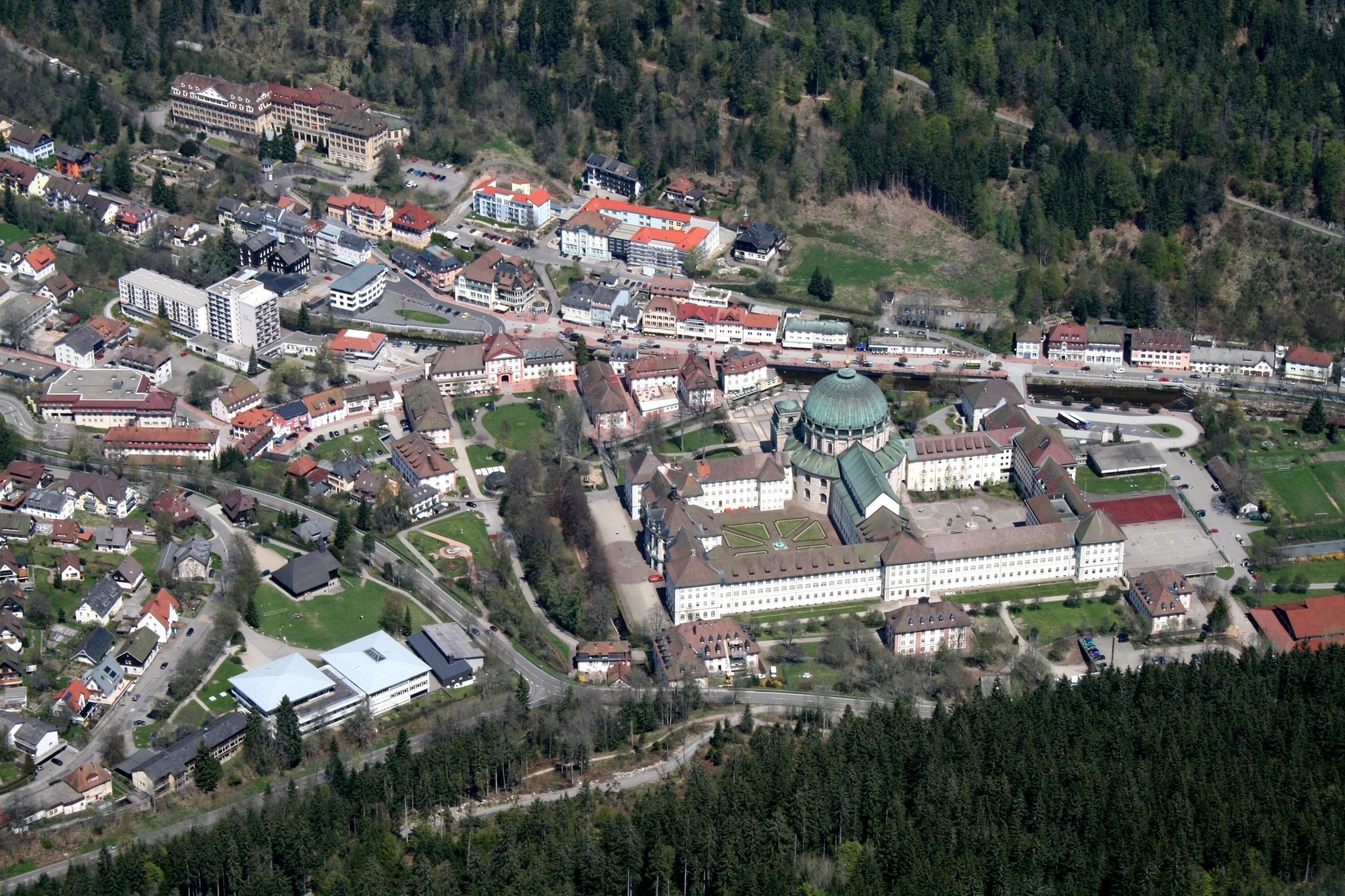
The visible complex is principally the result of the Neoclassical rebuilding begun after the fire of 1768. Its central architectural feature is the circular domed church, accompanied by surviving monastery buildings that were later adapted for industrial production and educational use. The earlier medieval and Baroque phases survive mainly through their historical associations and the objects and records preserved in other institutions.
Domed church
The abbey church, Dom St. Blasius, is also called Saint Blaise’s Cathedral because of its size and magnificence, not because it is the seat of a bishop. Designed by Pierre Michel d’Ixnard, it was built from 1771 under Martin Gerbert in the Neoclassical style. Nicolas de Pigage served as architectural director from 1775, while Franz Joseph Salzmann supervised the building work.
The church is dominated by a monumental wooden dome made by the local master carpenter Joseph Müller. It measures approximately 36 metres in diameter and rises 63 metres, making it one of the largest domes in Europe north of the Alps. The interior and dome were restored after the 1874 fire, with work completed in stages during the early twentieth century and the effects of the fire finally remedied during the 1980s.
Sculptors Joseph Hörr and Johann Christian Wentzinger, stucco artists Johann Kaspar Gigl and Lodovico Bossi, and model-makers Carlo Luca Pozzi and Giuseppe Pozzi contributed to the decoration. Surviving stucco work includes decoration in the staircase and the Habsburg Hall. The choir grille was made by the Baden court locksmith Johann Jacob Carl Hugenest, and the bells were cast by Franz Joseph Benjamin Grieninger of the Villingen Grüninger bell-foundry dynasty. Paintings were produced by Simon Göser, Johann Anton Morath, and other artists.
Monastery buildings and library
Baroque administrative complex
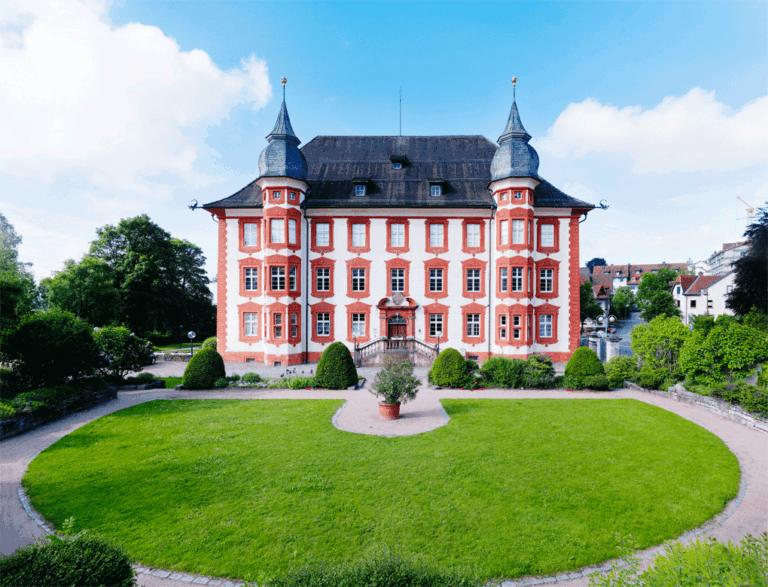
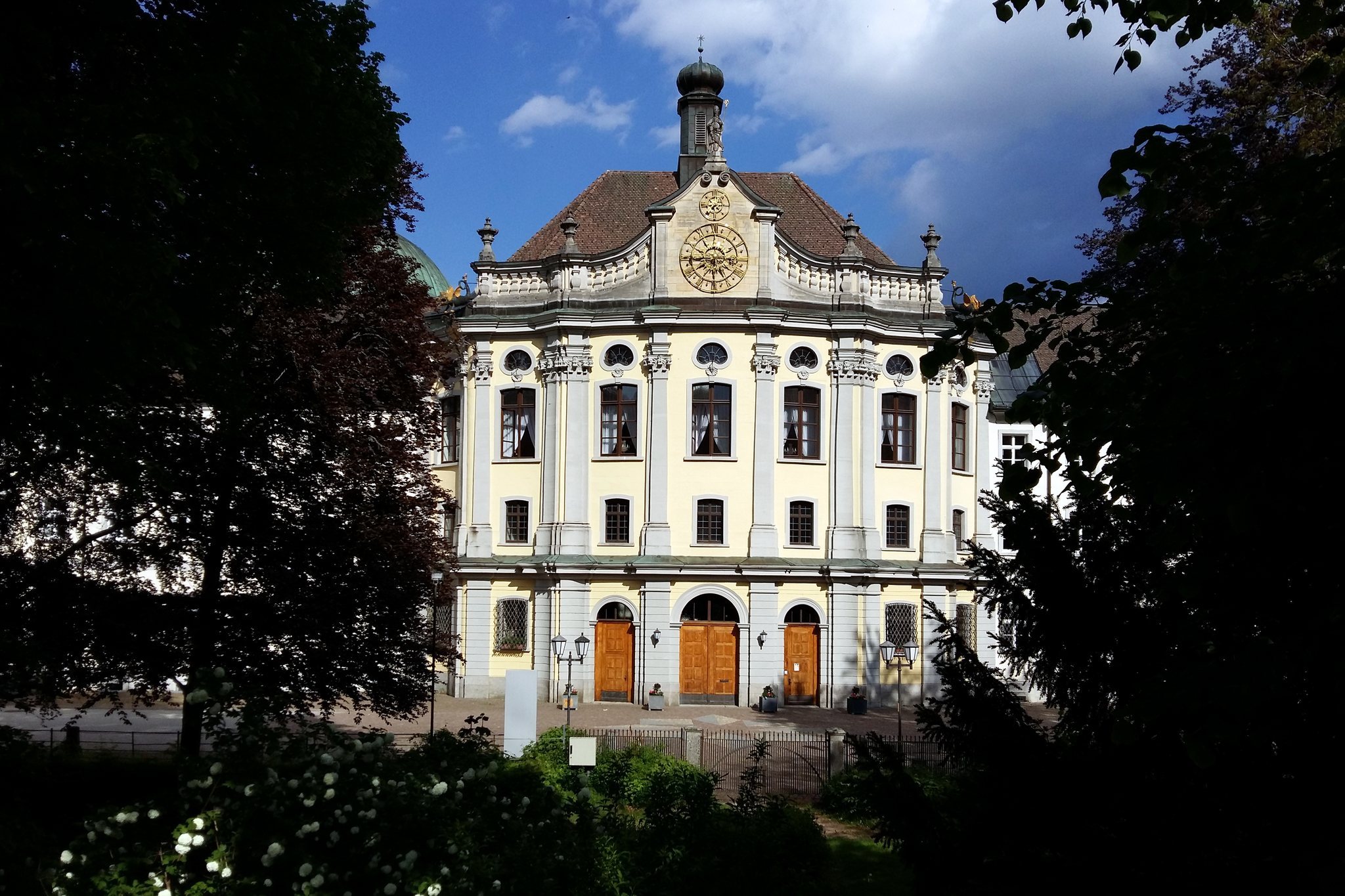
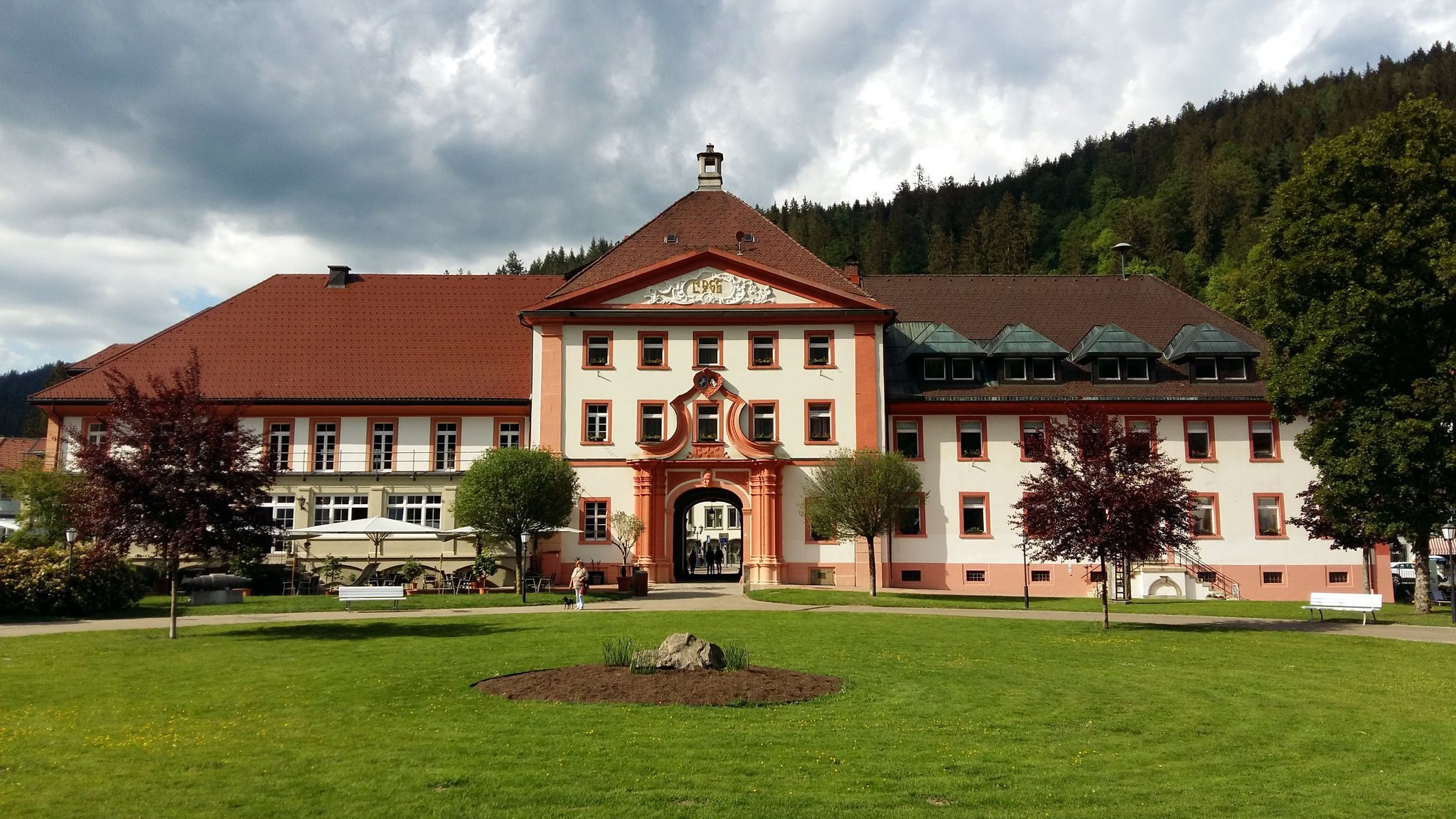
The former monastic complex included Baroque chancellery buildings, an inn, administrative offices, a theatre hall, and a library. The Tusculum, a pleasure house above the Alb, belonged to the wider eighteenth-century estate. The buildings were later modified for mechanized production, and the surviving complex now accommodates Kolleg St. Blasien.
Library and printing press
The library hall of the third monastery complex was decorated between 1729 and 1732 by Giovanni Battista Clerici and his son, while Dominikus Zimmermann worked at the monastery from 1732. After the 1768 fire, Martin Gerbert commissioned a large and comparatively plain library room. Described in 1779 and 1781 as a three-storey Italian-style hall with a continuous gallery, it apparently had renewed stair structures by 1806.
The monastery printing press produced books distributed through booksellers. Some works from the press are displayed in a museum in Sankt Blasien, while manuscripts and printed books from the former library are preserved at Saint Paul Abbey and the Baden State Library. The Ramsey Psalter and other works reflect the scholarly and artistic resources once assembled at the abbey.
Industrial and educational reuse
From 1808, the monastery buildings were adapted for industrial production. Cotton-spinning and weaving machinery, a cotton-spinning mill, and the Baden Rifle Factory occupied parts of the complex. Textile production continued until the spinning mill’s bankruptcy in 1931. Damage from the 1977 fire was followed by comprehensive renovation, after which the buildings continued in educational use as part of Kolleg St. Blasien.