Glastonbury Abbey: A Benedictine Monastery in Somerset
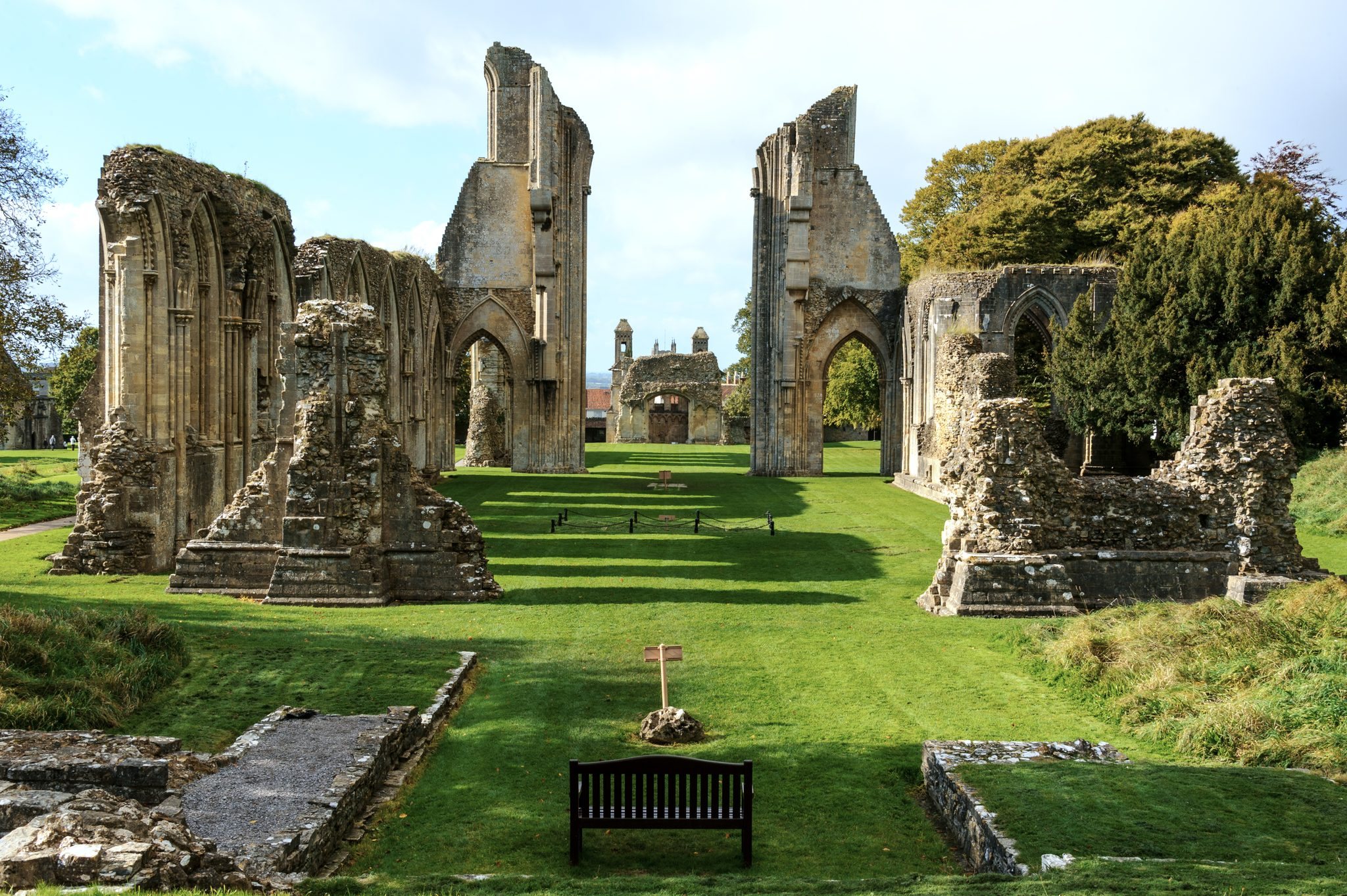
Site at a Glance
- Rating
- 4.6
- Popularity
- Medium
- Country
- United Kingdom
- Primary era
- Medieval
- External website
- Open
- Eras represented
- Medieval, Modern
- Civilizations
- Anglo-Saxon, British, English
- Site type
- Religious
- Remains
- Monastery
On this page21 sections
History
Glastonbury Abbey is a former Benedictine monastery in Glastonbury, United Kingdom, founded by Britons with origins at least in the early 7th century. Its long history includes Roman and Saxon occupation, an Anglo-Saxon expansion, major medieval rebuilding in Romanesque and Gothic styles, and a final suppression during the 16th-century Dissolution of the Monasteries.
British and Anglo-Saxon beginnings
Archaeological investigations have identified Roman and Saxon occupation at the site. Claims that Glastonbury already possessed Celtic or pre-Celtic religious importance remain doubtful. A glassworks operated here during the 7th century, showing that the settlement had productive activity as well as a religious function.
The abbey was founded by Britons. After Glastonbury came under Saxon control following the Battle of Peonnum in 658, the British abbot Bregored remained in office. When he died in 669, the Anglo-Saxon Berhtwald became abbot, although British monks continued at the monastery for many years.
King Ine of Wessex enriched the community and is traditionally associated with ordering a stone church in 712. The abbey’s foundation is also placed in the 8th century, and the institution was enlarged in the 10th century. Danish incursions disrupted Glastonbury during the 9th century, and the settlement may itself have been attacked.
Dunstan and the growth of the monastery
Abbot Dunstan enlarged the church during the 10th century, introduced the Benedictine Rule, and built the cloisters, which were covered walkways around an open monastic courtyard. The Benedictine Rule organized communal prayer, work, obedience, and governance under an abbot. Dunstan later became Archbishop of Canterbury in 960.
Glastonbury also became associated with royal burials. King Edmund was buried at the abbey in 946, and King Edmund Ironside was buried there in 1016. A charter issued by King Cnut in 1032 came from the abbey’s wooden church.
From the 10th century onward, the monastery developed extensive transport and drainage systems. Its canal connected the abbey with the River Brue, while later channels improved connections with surrounding estates and the Bristol Channel. Through these works, the abbey controlled and reclaimed parts of the Somerset Levels, a low-lying wetland region whose agricultural use depended on canals, ditches, embankments, and other water-management measures.
Norman rule and medieval wealth
After the Norman Conquest, William the Conqueror appointed Turstin abbot in 1086. Turstin began a new church east of the older Saxon church and away from the ancient cemetery, shifting the consecrated area. His successor, Herlewin, replaced this arrangement with a larger church. The Domesday Book, William’s late 11th-century survey of landholding and taxable resources, described Glastonbury Abbey as the richest monastery in England.
Around 1125, Abbot Henry of Blois commissioned William of Malmesbury to write a history of Glastonbury. Compiled between 1129 and 1139, the work supported the abbey’s claim to precedence over Westminster. It incorporated forged charters and early legends, and later additions concerning Arthur and other figures are suspected.
The abbey’s estates supported extensive drainage, farming, and fishing. Reclaimed land near Westonzoyland grew from about 722 acres in 1234 to about 972 acres by 1240. In a typical year, the fisheries could provide as many as 5,000 eels. Disputes with Wells Cathedral reflected the importance of fish to the monastery’s religious diet and economy.
Fire, rebuilding, and Arthurian tradition
A major fire destroyed the monastic buildings in 1184. Reconstruction began almost immediately. The Lady Chapel was consecrated in 1186, parts of the new church were completed by 1189, and services began in the reconsecrated Great Church on Christmas Day 1213, probably before construction had fully ended.
From at least the 12th century, the monks promoted an identification between Glastonbury and Avalon, the legendary island associated with King Arthur in medieval literature. Christian tradition also attributed the foundation of the abbey to Joseph of Arimathea, who is said in the Gospels to have arranged the burial of Jesus. The Glastonbury tradition expanded his role by claiming that he founded the monastery, but this is a legend rather than an archaeologically established foundation history.
In 1191, a search commissioned by Abbot Henry de Sully was said to have discovered the tomb of King Arthur and Queen Guinevere in the cemetery. The reported find consisted of two skeletons placed in a hollowed oak trunk about 16 feet deep, with a lead cross naming Arthur as buried on the Isle of Avalon. Historians generally regard the discovery as inauthentic. It has been connected with efforts to attract pilgrims and funds for rebuilding after the fire, as well as with possible political and propagandistic purposes.
In 1197, Savaric FitzGeldewin, Bishop of Bath and Wells, exchanged the city of Bath with the king for control of Glastonbury Abbey. He sought to make the abbey the seat of his bishopric while retaining the abbacy. The monks resisted, elected William Pica as abbot, and appealed to Rome. Savaric later established episcopal authority at Glastonbury under King John, but the bishops abandoned the title Bishop of Bath and Glastonbury in 1219.
King Edward I and Queen Eleanor attended the reburial of the remains attributed to Arthur at the foot of the High Altar in 1278. The alleged remains were therefore incorporated into the abbey’s royal and religious ceremonies, although the identification remained a medieval claim rather than a securely authenticated historical event.
Late medieval power and dissolution
By the 14th century, Glastonbury was one of the richest and most powerful monasteries in England, surpassed in wealth only by Westminster Abbey. Political instability during the Wars of the Roses led to the construction of a defensive wall around the abbey precinct.
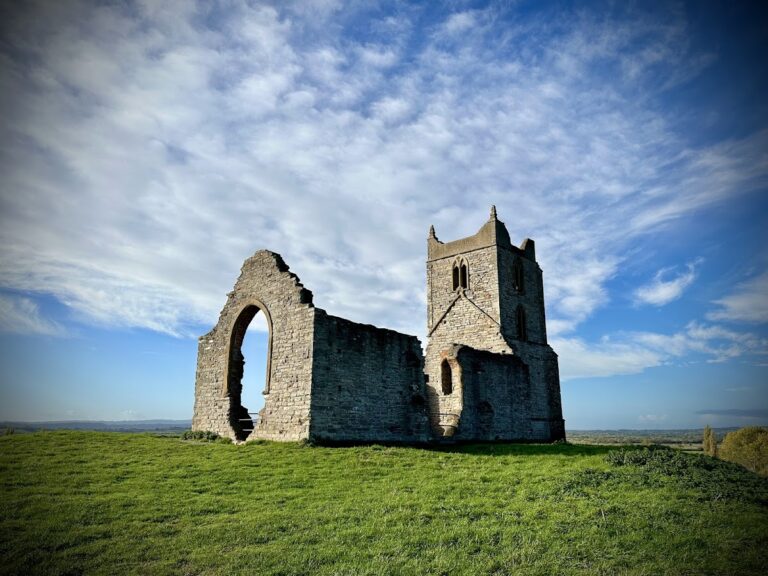
The abbey was suppressed during the Dissolution of the Monasteries, Henry VIII’s 16th-century suppression of England’s religious houses. In September 1539, its valuables were removed. The last abbot, Richard Whiting, was executed as a traitor on Glastonbury Tor on 15 November 1539.
After the Dissolution, lead and dressed stone were stripped from the buildings for reuse. Edward VI granted the site to Edward Seymour, 1st Duke of Somerset, who established a colony of Protestant Dutch weavers there. After Seymour’s attainder in 1551, the property returned to the Crown, and Elizabeth I granted it to Peter Carew in 1559. The ruins remained privately owned until the early 20th century.
Ruins, archaeology, and continuing religious life
Further stone removal, the use of gunpowder to dislodge masonry in the early 19th century, and quarrying reduced the abbey to ruins. The Ancient Monuments Protection Act of 1882 halted further damage and led to the first historical and archaeological surveys.
The Bath and Wells Diocesan Trust purchased the ruins in 1908. They are now owned and managed by the Glastonbury Abbey Trust. Frederick Bligh Bond directed archaeological investigations after the purchase and identified the Edgar Chapel, North Porch, and St Dunstan’s Chapel. He was dismissed in 1921 after publishing interpretations based partly on seances and alleged communications through a psychic medium.
A local pilgrimage took place in 1924, and Anglican, Roman Catholic, and Eastern Orthodox pilgrims continue to associate the ruins with religious observance. The site also continues to host religious services. The Great Church and Lady Chapel ruins are Grade I listed buildings and a scheduled monument, a site protected under British heritage law because of its archaeological or historical importance. The abbey occupies about 36 acres of parkland.
The abbey library was damaged by the fire of 1184 but remained an important collection until the Dissolution in 1539. John Leland described unique copies of early English histories and early Christian documents, and about 40 Glastonbury manuscripts are known to have survived the dispersal.
Remains
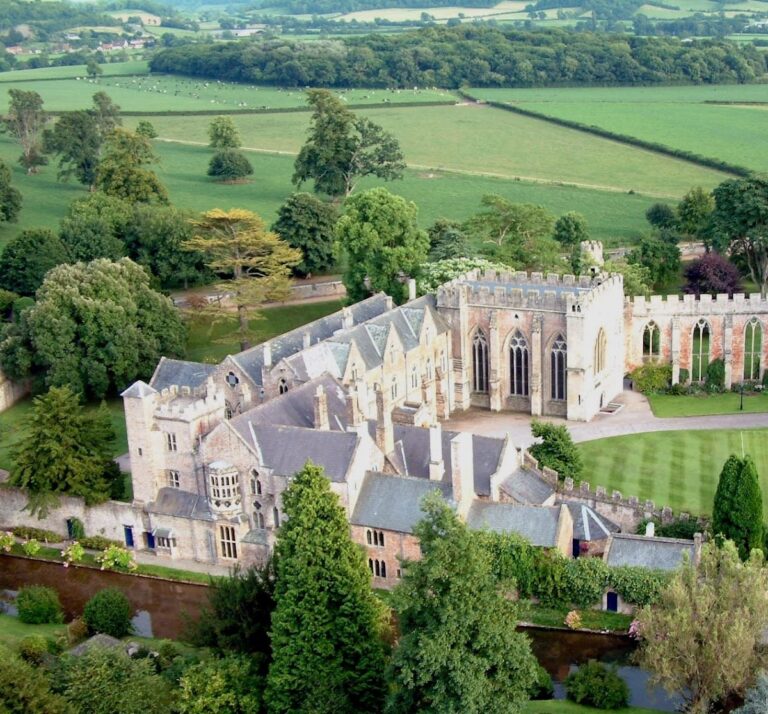
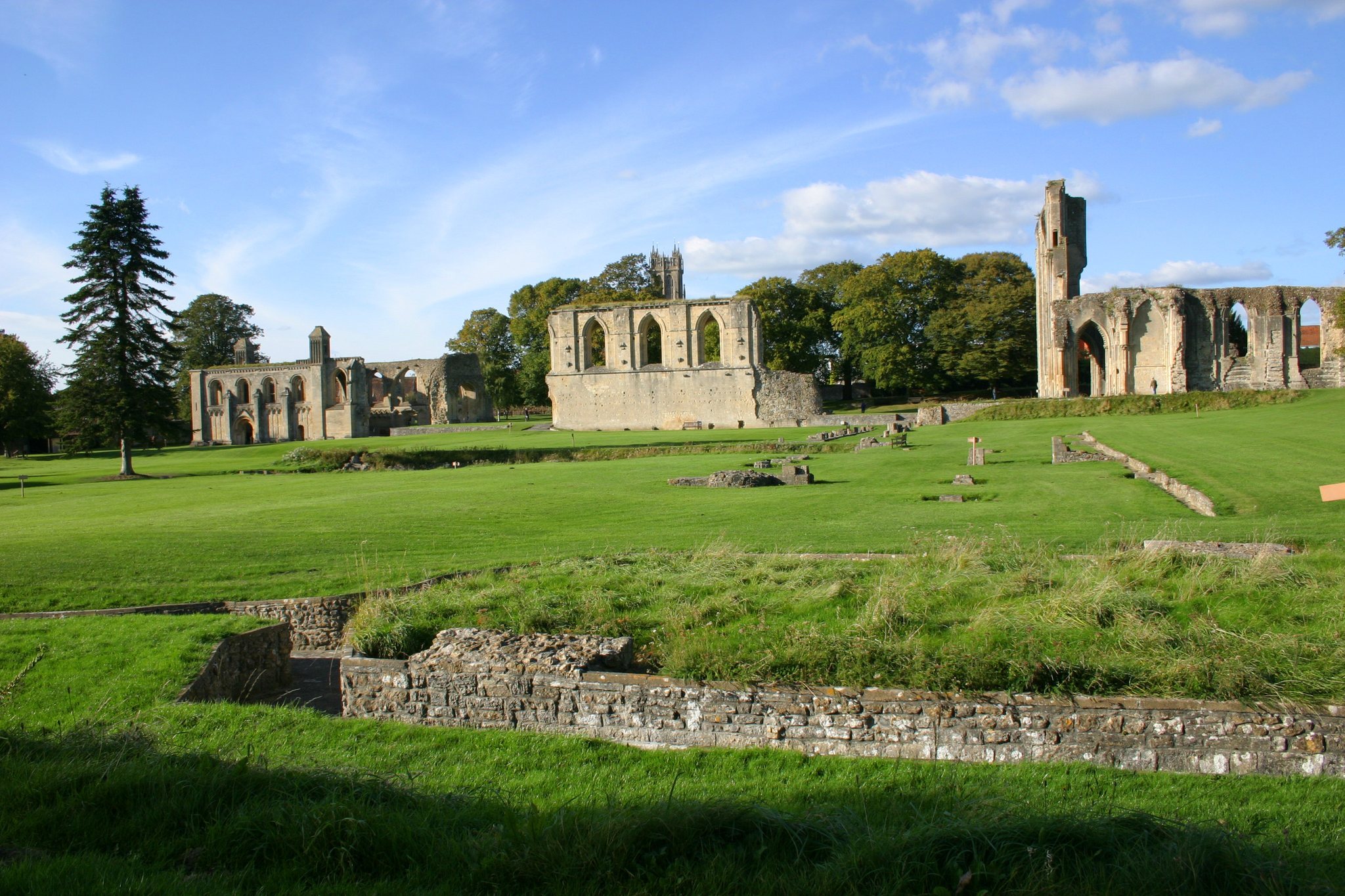
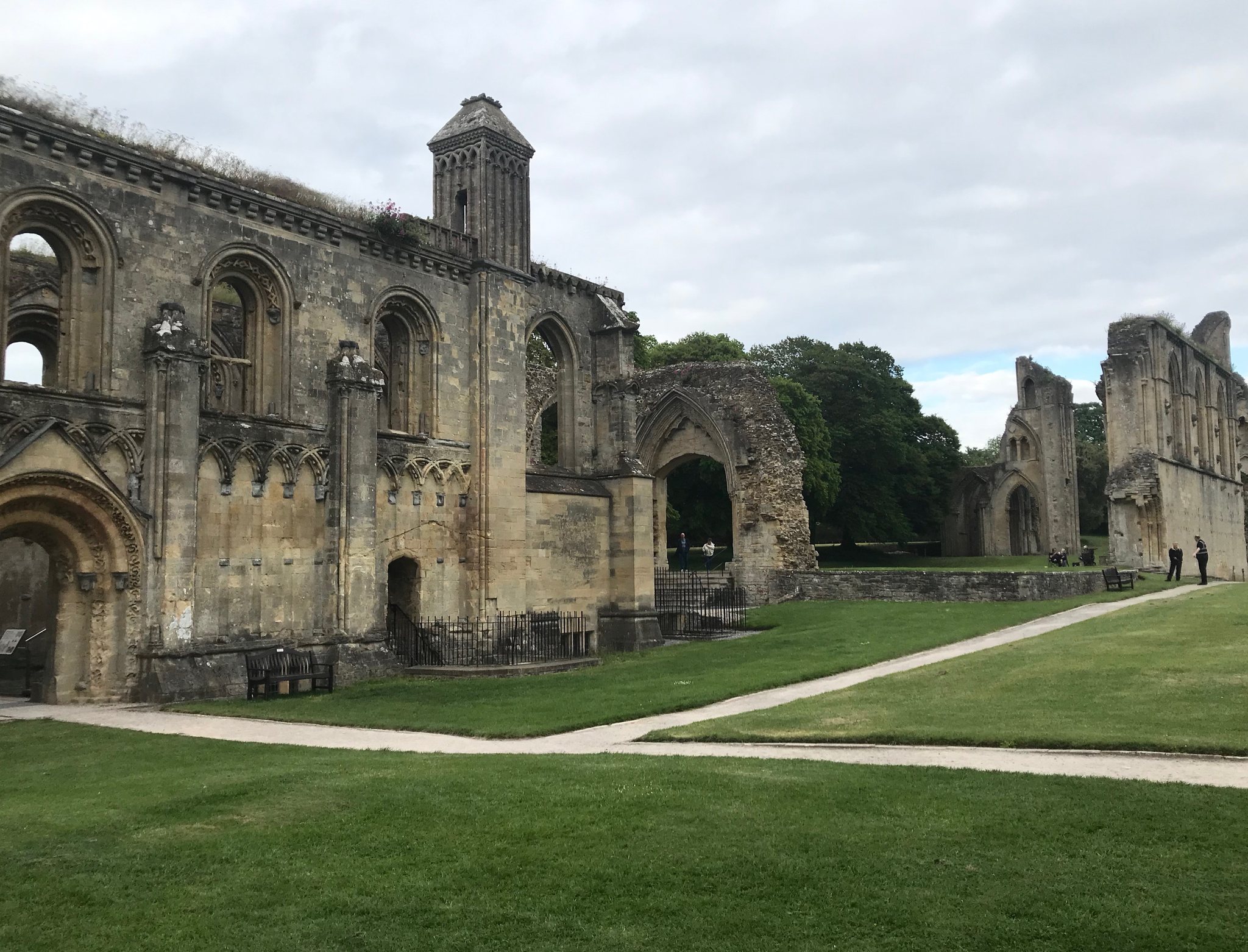
The surviving complex is arranged around the ruins of the Great Church and Lady Chapel, with the Abbot’s Kitchen, gatehouse, abbey barn, remains of the abbot’s house, walls, and other precinct structures forming associated groups. Romanesque and Gothic elements reflect the abbey’s successive medieval building phases. Archaeological and geophysical investigations have also examined the earlier occupation and the changing layout of the monastery.
The principal churches
Great Church
The Great Church measured about 220 feet in length and 45 feet in width. Its choir was approximately 155 feet long, while the transept, the crosswise arm of the church, measured about 160 feet. Surviving fabric includes sections of the clerestory and triforium arcades, respectively the upper window level and the passage above the main arcade. These structures supported the central square tower.
Other remains include parts of the chancel-aisle walls, the 14th-century retrochoir, the space behind the high altar, the south nave-aisle wall, the west front, and the Galilee with its crypt linked to St Mary’s Chapel. Together, these fragments define the scale and arrangement of the rebuilt medieval church.
St Joseph’s Chapel and Lady Chapel
St Joseph’s Chapel measured about 110 feet long and 24 feet wide. The walls of the Lady Chapel also survive. In 1478, the chapel was described as about 34 yards long and 8 yards wide, and it incorporated the well associated with its consecration in 1186.
Domestic and precinct buildings
Abbot’s Kitchen
The Abbot’s Kitchen is a substantially surviving 14th-century octagonal building. Curved buttresses rise to a cornice decorated with grotesque gargoyles. Inside, four large arched fireplaces have smoke outlets above them, and another outlet rises at the centre of the pyramidal roof.
The kitchen formed part of the abbot’s house, begun under Abbot John de Breynton between 1334 and 1342. The abbot’s hall stood about 80 feet high, although only a small section of its wall survives. Excavation identified a special apartment at the southern end of the house, constructed for Henry VII’s visit.
Gatehouse and abbey barn
The abbey gatehouse was built in the mid-14th century and completely restored in 1810. Outside the walls, the 14th-century abbey barn forms part of the Somerset Rural Life Museum. Tithe barns associated with the monastery stood at Doulting, Mells, and Pilton, where agricultural produce was stored.
Abbey House
Abbey House stands within the abbey wall. John Buckler built the Tudor Gothic house between 1829 and 1830 for John Fry Reeves, using stone taken from the abbey ruins. It was altered and extended between 1850 and 1860 and again in 1957. From 1931 to 2018, it served as a retreat house for the Diocese of Bath and Wells.
Waterworks and economic landscape
Glastonbury Canal
The medieval Glastonbury Canal extended about 1.75 kilometres from the abbey to the River Brue. It was probably first constructed to carry building stone and later transported grain, wine, fish, and other produce. Much of the stone came from the abbey’s quarries at Doulting. The canal formed part of the wider system through which the monastery managed movement, drainage, and agricultural production.
Meare Fish House
The 14th-century Fish House at Meare was used by the abbey’s chief fisherman and also provided space for salting and preparing fish. Its construction reflects the importance of the monastery’s fisheries within the surrounding wetland economy.
Earlier occupation and religious traditions
Roman and Saxon evidence
Archaeological investigations have found Roman-British pottery in the western part of the cloister, together with evidence of Roman and Saxon occupation. Later excavation and geophysical work have examined the development of the monastic layout and its relationship to earlier activity.
Glastonbury Thorn
The Glastonbury Thorn is a hawthorn associated with the abbey’s religious traditions. It was described as flowering twice each year, in spring on older wood and in winter on new growth. Propagated forms are known as Biflora or Praecox.
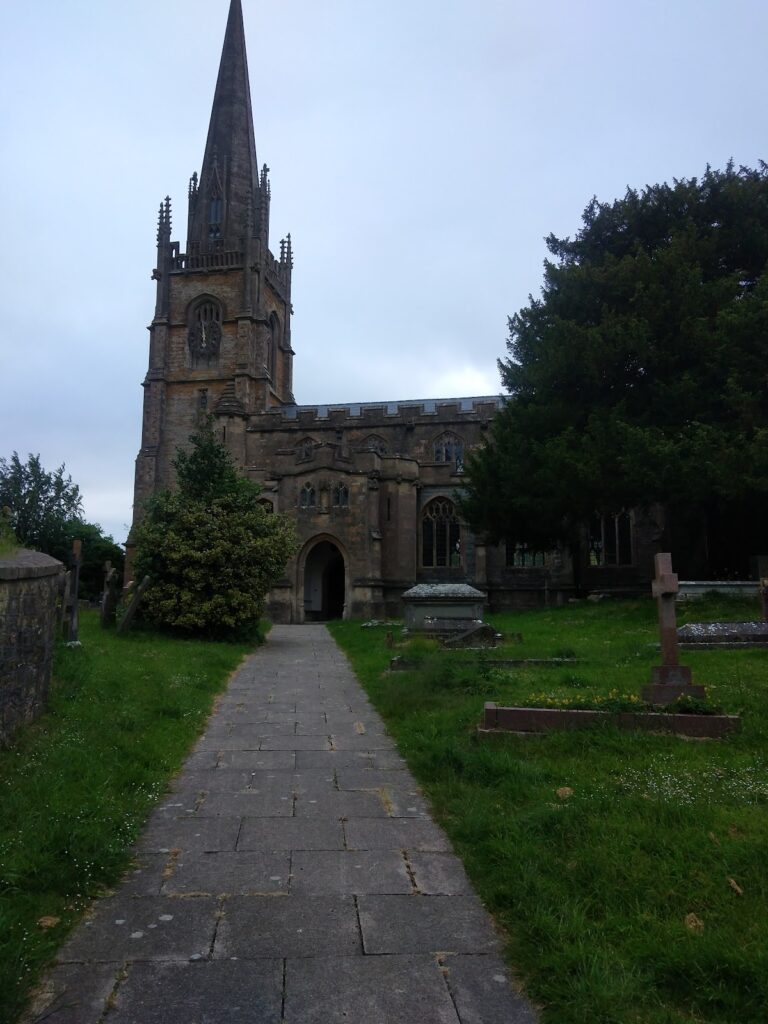
The custom of sending a budded branch to the queen at Christmas began when James Montague, Bishop of Bath and Wells, sent a branch to Queen Anne during the reign of James I. Trees descended from earlier grafts survive, including two Holy Thorns in the grounds of St John’s Church in Glastonbury.