Abbey of Echternach: A Benedictine and Imperial Abbey in Luxembourg
Site at a Glance
- Rating
- 4.5
- Popularity
- Medium
- Country
- Luxembourg
- Primary era
- Medieval
- External website
- Open
- Eras represented
- Medieval, Early Modern
- Civilizations
- Carolingian, Holy Roman Empire, Merovingian
- Site type
- Religious
- Remains
- Monastery
On this page18 sections
History
The Abbey of Echternach in Luxembourg was founded around 698 by Willibrord, a Northumbrian missionary bishop and bishop of Utrecht, with the support of Irmina of Oeren. It developed from earlier monastic establishments on the site of a Roman estate and became a major centre of Christian mission, manuscript production, and pilgrimage in the early medieval Frankish world.
Foundation and the Mission of Willibrord
Irmina granted land at Echternach to Willibrord from property belonging to herself and her daughter Plektrudis. A small monastery, traditionally linked with Irish monks, was already present there, and a community had existed under the authority of the Diocese of Trier by the sixth century. Willibrord’s foundation was therefore treated as a refoundation rather than an entirely new beginning.
In 700, Willibrord opened the first church at Echternach with financial support from Pepin of Herstal, a leading Frankish official and an early patron of his mission. Willibrord also received help from Wilfrid, bishop of York, and from Irish monks connected with Ripon. These links strengthened Echternach’s role in the Christianization of the surrounding regions.
Willibrord served as the monastery’s first abbot and remained in office until his death at Echternach on 7 November 739. He chose the monastery as his burial place, and his grave soon drew pilgrims, especially after his canonization. The institution became closely associated with the cult of Saint Willibrord. At different times it was dedicated to the Trinity, the Virgin Mary, Saints Peter and Paul, and later Saints Peter and Willibrord.
Royal Protection and Early Medieval Expansion
Echternach received royal protection, ecclesiastical immunity, and the right to elect its abbot freely in 706. Pepin the Short elevated it to a royal abbey in 751 and confirmed its privileged position. Pepin, the first Carolingian king of the Franks, had himself been baptized at Echternach in 714. In 785, Charlemagne confirmed an earlier donation made by his brother Carloman, and after the death of Abbot Beornrad in 797 he took direct control of the abbey for about a year.
During the eighth century, Echternach served as an important base for missions in Frisia. Its missionaries also travelled to Neustria, Austrasia, Hesse, and Thuringia. The monastery helped carry Irish and Anglo-Saxon intellectual traditions into continental Europe and accumulated extensive landed property. A settlement grew around the abbey during the eleventh century and eventually developed into the town of Echternach.
Echternach was probably the first Insular or Anglo-Saxon monastery on the European mainland. Its scriptorium, a monastic workshop for copying and decorating books, became one of the leading centres of manuscript production in the Frankish realm, particularly from the ninth to the eleventh century. Its work contributed to the Carolingian intellectual revival and to the spread of Carolingian minuscule, a standardized early medieval book script.
Lay Abbots and Benedictine Reform
From the ninth century until 973, Echternach was governed for long periods by lay abbots, including members of the houses of Lorraine and Luxembourg. Around 850, under Abbot Adalhard, the community acquired a more collegiate organization. Political crises in the ninth century also displaced Benedictine monks and weakened regular monastic leadership.
In 973, at the direction of Otto the Great, Abbot Ravanger of Saint Maximin in Trier restored Benedictine life at Echternach with monks from that monastery. A Benedictine monastery followed the Rule of Saint Benedict, which regulated communal worship, discipline, property, and daily life. The institutional and intellectual relationship between Echternach and Saint Maximin continued into the seventeenth century. In 1028, Abbot Poppo of Stavelot introduced another reform based on the Lotharingian mixed observance, a regional form of monastic discipline combining established Benedictine practices.
Rebuilding and Imperial Independence
A fire destroyed the earlier church in 1016. Archbishop Poppo of Trier consecrated its replacement on 19 October 1031, beginning a new period of prosperity under imperial protection, particularly during the reign of Henry III. Echternach’s abbots supported the Salian emperors during the Investiture Contest, the medieval struggle over control of the appointment of bishops and other senior church officials between the papacy and the Holy Roman Emperors.
The abbey repeatedly defended its political and ecclesiastical independence. In 1192, the archbishop of Trier attempted to incorporate Echternach into his see in exchange for Nassau Castle, but the abbey resisted successfully. Its rights and liberties were defended in works such as the Liber aureus Epternacensis and a separate treatise on its freedom. From 1299, its abbots also held lordship over the town of Echternach.
Monastic discipline declined during the fourteenth and fifteenth centuries. Reform began in 1496 under Abbot Burchard Poszwin of Neuerburg, and Pope Julius II granted the monastery exemption in 1506. From 1562, the abbots were no longer selected from the nobility.
Early Modern Prosperity and Secularization
The Reformation caused Echternach to lose much of its property in Friesland and the northern Netherlands. Even so, the abbey still held estates in more than 125 places during the seventeenth century. It continued to receive substantial donations into the eighteenth century, although its resources no longer matched those of the Carolingian period.
Abbot Matthias Hartz began the construction of the surviving conventual buildings. Leopold Durand oversaw the French Baroque complex built between 1727 and 1736. Echternach remained an important independent institution in part because of the continuing cult of Saint Willibrord, and it did not undergo the same degree of decline as some other abbeys.
Abbot Emmanuel Limpach, the last abbot of Echternach, died on 6 September 1793 without a successor being elected. French revolutionary troops under General Colaud entered the town on 13 August 1794. The monks fled or were expelled, the abbey was plundered, and Willibrord’s tomb was desecrated. In 1797, the abbey and church were sold as national property. Jean-Henri Dondelinger subsequently converted the buildings into a faience and porcelain factory.
Restoration, War, and Continuing Religious Life
The church and adjoining conventual buildings continued to serve as a factory during the first half of the nineteenth century. After the basilica’s choir partly collapsed around the middle of the century and the building faced further deterioration, a restoration association was founded in 1862. The church was rebuilt in a Neo-Romanesque form and reconsecrated in 1868.
In 1906, the church became Echternach’s parish church, and Willibrord’s relics were ceremonially returned there from the parish Church of Saints Peter and Paul. The church received the status of papal minor basilica in 1939, a designation recognizing its particular historical, religious, and pilgrimage importance.
On 26 December 1944, during the Second World War, German troops blew up part of the church. Artillery fire destroyed much of what remained. Hubert Schumacher directed the reconstruction, which sought to recover the Romanesque character of the medieval church; its west facade was modelled on the Basilica of Paray-le-Monial. The basilica was reconsecrated in 1953, making the present complex the result of the sixth major church phase on the site.
Part of the former monastic complex now accommodates the Lycée classique d’Echternach and its boarding school. The abbey’s religious identity also survives in the annual Dancing Procession of Echternach, held on Whit Tuesday, the Tuesday after Pentecost, in honour of Saint Willibrord. First documented around 1100, the procession developed in connection with pilgrimage to his relics, especially by people suffering from paralysis or epilepsy. In 2010, it was placed on UNESCO’s Representative List of the Intangible Cultural Heritage of Humanity.
Echternach was a Benedictine institution and an imperial abbey within the Holy Roman Empire. Its abbot exercised both ecclesiastical leadership and territorial authority directly under the emperor. The former territory now lies chiefly in Germany, with smaller parts in Luxembourg and the Netherlands.
Remains
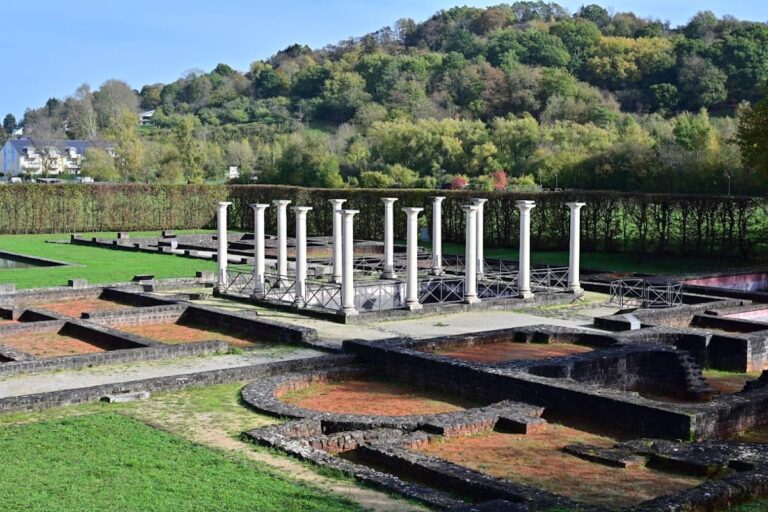
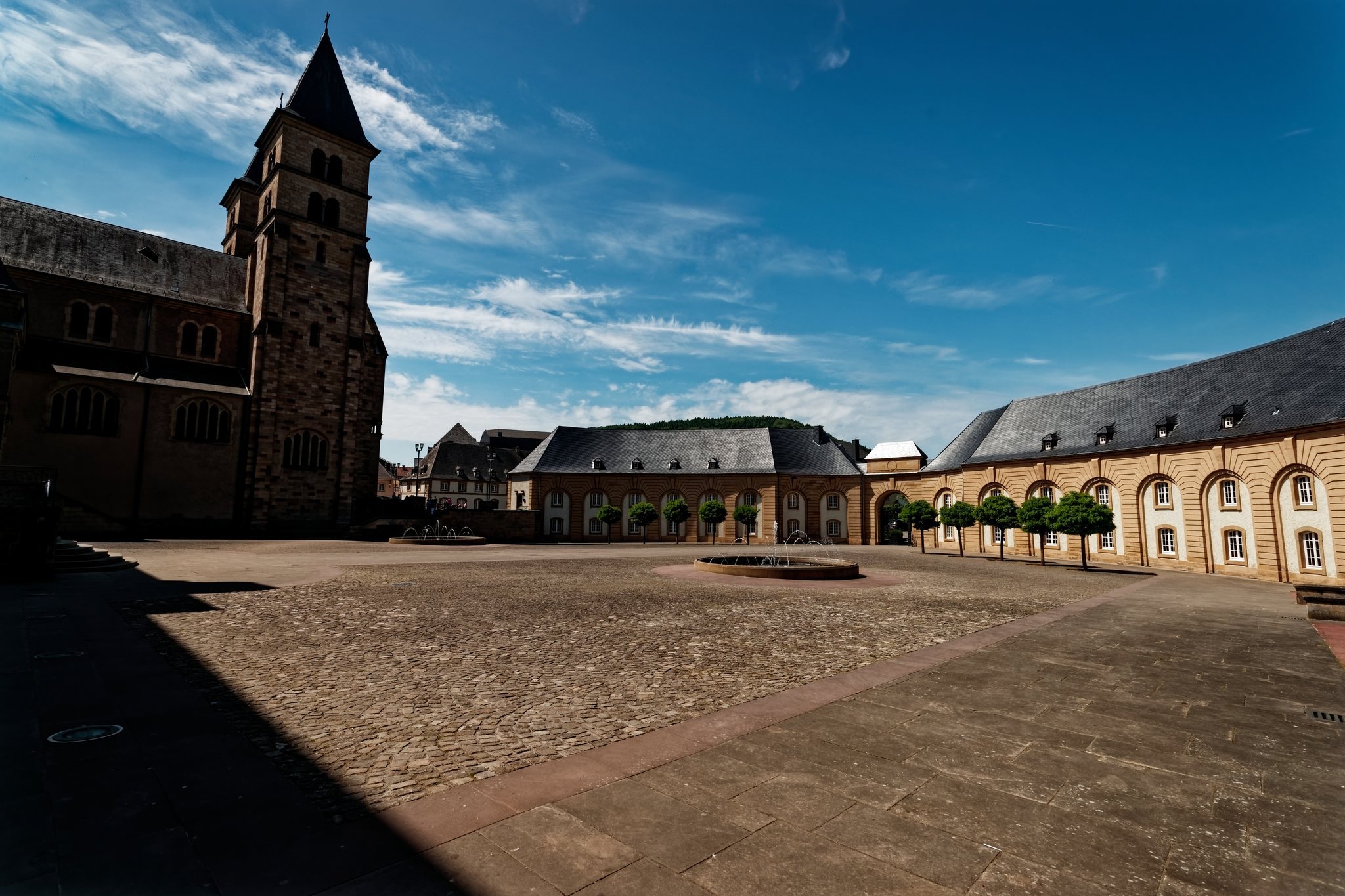
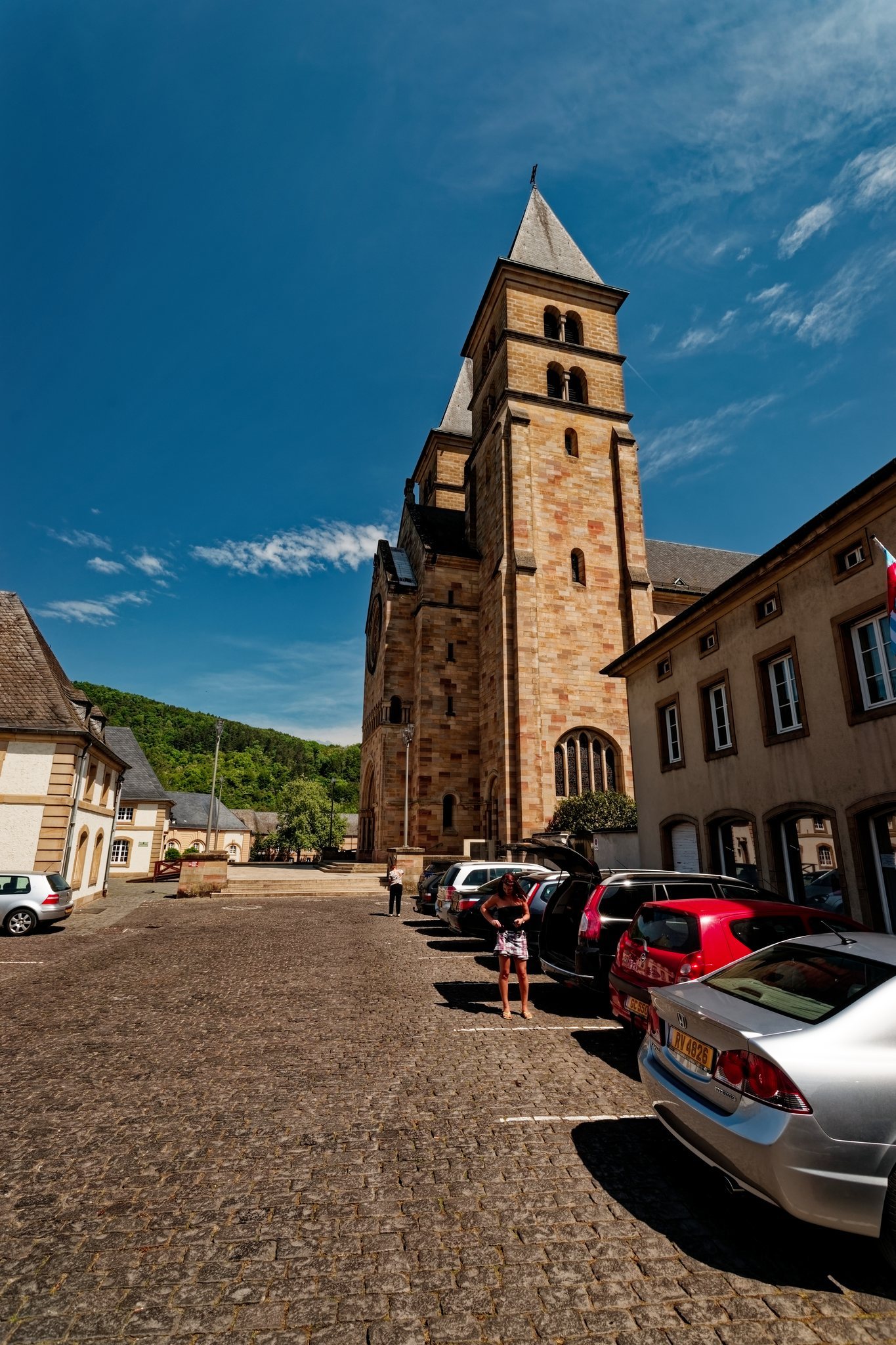
The surviving complex stands beside the River Sauer on the site of a Roman villa and earlier monastic establishments. Its principal remains are the reconstructed Basilica of Saint Willibrord, the crypt, the adjoining abbey palace, and substantial portions of the conventual buildings. Together, they preserve successive phases of church construction and the later transformation of the monastery into a Baroque and modern complex.
The Basilica and Its Medieval Structure
Six Church Phases
Six principal church phases are identified at Echternach. They comprise an early church from before 700, the church opened by Willibrord around 700, a larger Carolingian church built near the beginning of the ninth century, the Romanesque basilica consecrated in 1031, the Neo-Romanesque rebuilding of 1862 to 1868, and the modern reconstruction completed in 1953. The Romanesque church had approximately the dimensions of the present basilica and was later altered with Gothic elements added in the thirteenth and seventeenth centuries.
Nave, Aisles, and Windows
The central nave retains a severe Romanesque appearance and uses a distinctive arrangement of supports known as the Echternach system. The side aisles have Gothic treatment, with stained-glass windows depicting episodes from the life of Saint Willibrord. Windows in the unfinished transepts portray the Seven Sorrows and Seven Joys of the Virgin Mary.
Altars and Crypt
Two altars stand within the basilica. The lower confessionary altar is linked by a light well to Saint Willibrord’s tomb in the crypt. Renaissance confessionals and stained-glass windows also survive in the church.
The crypt dates from the Carolingian period and is described as an eighth-century structure. It survived the destruction of the twentieth century without major damage. Inside are Saint Willibrord’s white-marble tomb and a spring with a basin associated with miracles attributed to him. Excavations in 1949 revealed remains of the Merovingian monastic church, while the crypt preserves fragments of eleventh-century frescoes.
Conventual Buildings and Bells
Abbey Palace and Monastic Buildings
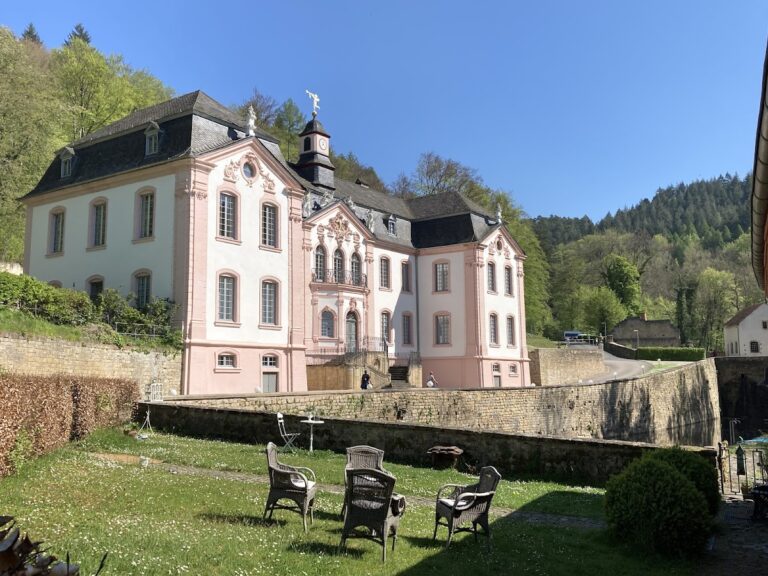
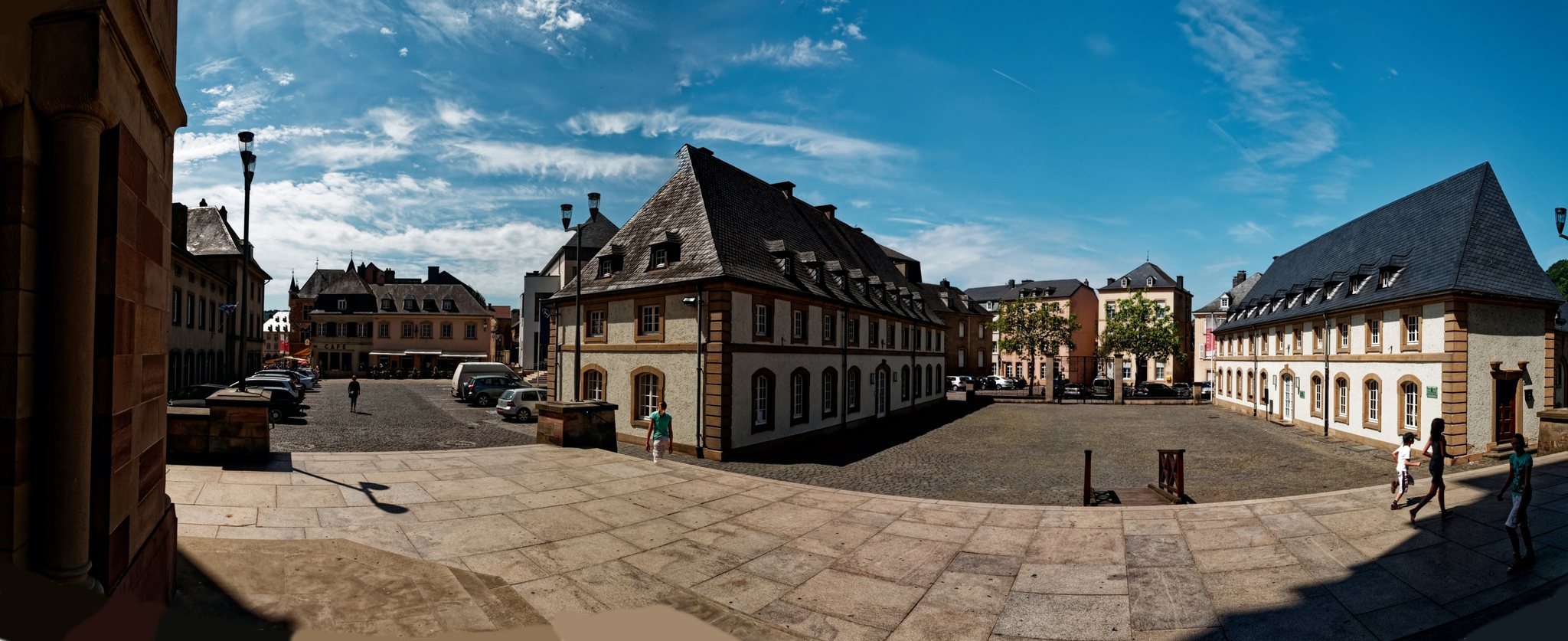
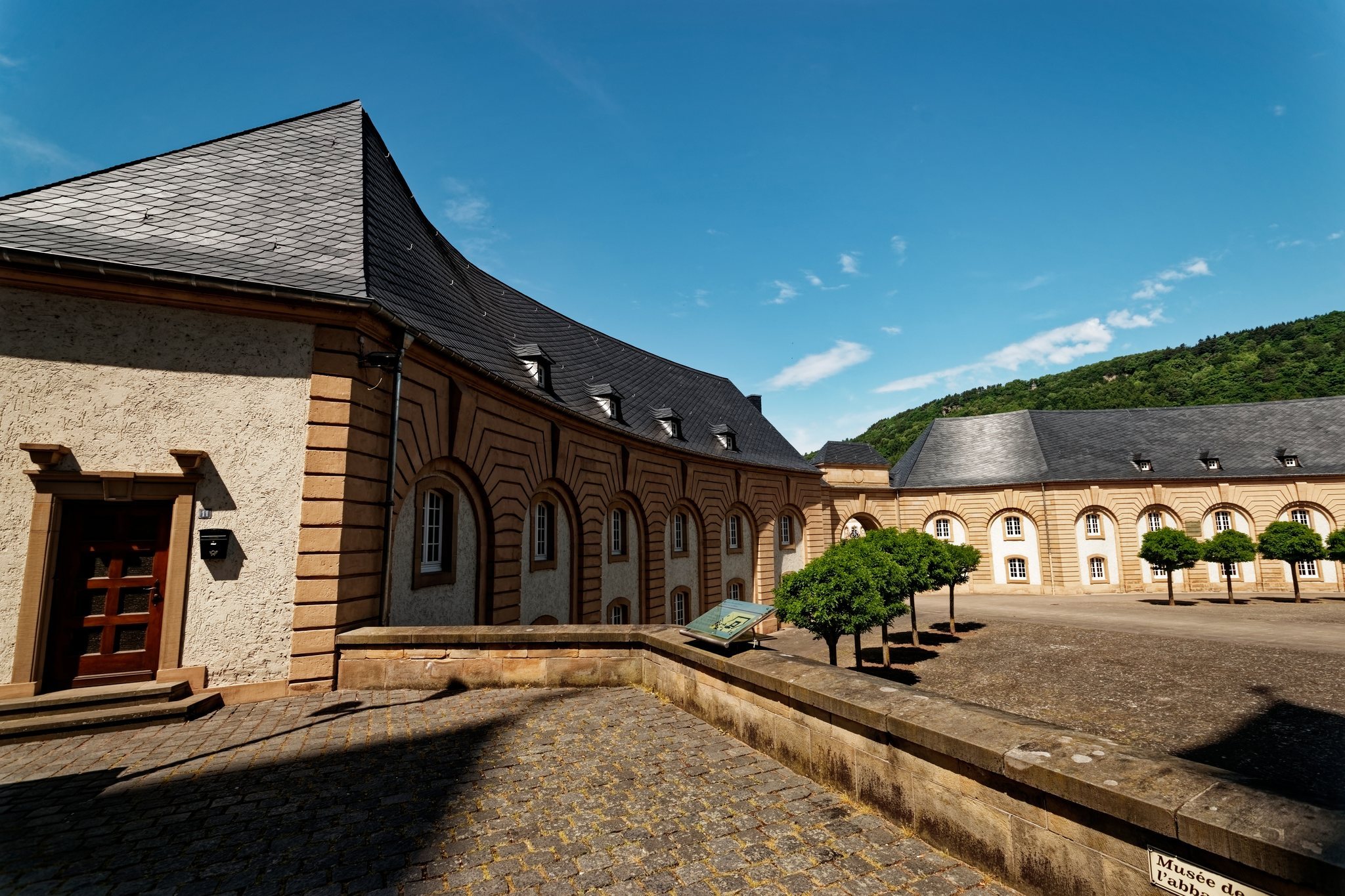
The abbey palace adjoins the church and was completed in 1727 to designs by Leopold Durand. The larger conventual buildings were repeatedly altered after the fire of 1016 and underwent major modernization in the eighteenth century. Following secularization, portions of the complex were also used as barracks. The former monastic courtyard now provides the starting point for the Dancing Procession before it proceeds to the basilica and Saint Willibrord’s tomb.
Towers and Bells
The basilica’s towers contain nine bells suspended from wooden headstocks. Two large bells hang in the north tower, while the south tower contains the other seven and also houses a carillon. The peal is described as the lowest-sounding in Luxembourg. Each bell carries decoration and a Latin inscription naming a patron saint and identifying its sacred purpose.
Organ and Manuscript Heritage
Basilica Organ
The basilica’s organ was built in 1953 by the Johannes Klais company of Bonn and enlarged in 1991. It has 74 stops, four manuals, a pedal, cone chests, electro-pneumatic action, and a separately couplable trumpet division.
The Echternach Scriptorium
Echternach’s medieval scriptorium produced richly decorated books in Insular, Roman half-uncial, and later Carolingian traditions. Important manuscripts associated with the workshop include the Willibrord Gospels, the Codex Aureus Epternacensis, the Speyer or Escorial Golden Gospels, the Goslar Gospels, and the Echternach Giant Bible, as well as other Gospel books and fragments.
The eleventh-century Codex Aureus Epternacensis, written entirely in gold ink, was produced at Echternach and is now held by the Germanisches Nationalmuseum in Nuremberg. The Speyer or Escorial Gospel book is preserved at El Escorial near Madrid. The Willibrord Gospels remained at the abbey until French officials seized it with other manuscripts in 1802; it is now held by the Bibliotheque nationale de France.
The abbey library contained theological, philosophical, and educational material dating from the seventh to the seventeenth century. Its surviving catalogued holdings include 89 manuscripts, 154 fragments, and 18 printed books, although only part of this material was produced at Echternach. The collection reflects Irish and southern European influences and includes a late-seventh-century leaf associated with Pope Gregory I, ninth-century fragments of the Hisperica Famina, and other illustrated and educational works.