Kloster Hedingen: A Former Monastery and Dynastic Burial Church in Sigmaringen
Site at a Glance
- Popularity
- Very Low
- Country
- Germany
- Primary era
- Early Modern
- External website
- Open
- Eras represented
- Early Modern, Modern
- Civilizations
- German, Holy Roman Empire, Kingdom of Prussia
- Site type
- Religious
- Remains
- Monastery
On this page13 sections
History
Kloster Hedingen is a former monastic complex in Sigmaringen, Germany, whose institutional history reaches back to the first half of the fourteenth century. The complex is associated with the Roman Catholic Hedinger Church, which later became the burial church of the Hohenzollern-Sigmaringen family. The convent was first mentioned in a document of 1338 and began as a women’s community following the rule of the Dominican Tertiaries, women who observed a Dominican religious rule without necessarily belonging to a fully enclosed convent.
The Dominican convent
Junker Ital Volkwin founded the women’s monastery, which probably belonged to the Dominican Order from its beginning. The Weckenstein family, whose ancestral castle stood near Storzingen, maintained connections with the convent. Its anniversary book named the nuns Margret and Anna von Weckenstein and Junker Hans von Weckenstein among those associated with the community.
The convent received several privileges and confirmations during the fourteenth century. On 24 August 1349, Count Eberhard II of Württemberg authorized the nuns to appoint an honorable priest or layman to administer Saint John’s Chapel and its associated house in the churchyard. On 26 June 1362, acting as feudal lord of the parish church at Laiz, he authorized an altar with a mass benefice at Hedingen for a chaplain serving the nuns. On 1 September 1369, he confirmed that property transferred to the monastery in Sigmaringen would remain subject to taxation.
Hedingen later became involved in a legal dispute over property and revenues at Bremen. The case concerned property leased to Sebastian Krisell in 1582 and was brought against Christoph Weinschenk, the Truchsessian district magistrate and churchwarden at Hohentengen. Proceedings began before the Constance episcopal court and continued on appeal before the archiepiscopal court at Mainz.
Dissolution and Franciscan occupation
The Dominican women’s monastery was dissolved between 1595 and 1597 because of alleged moral decline. Its assets went to the Augustinian choir-women’s foundation at Inzigkofen, while the buildings passed to the Sigmaringen hospital. The convent community moved to Habsthal near Ostrach. The former monastery then served as Sigmaringen’s municipal hospital until a Franciscan settlement was established there in 1624.
The new Franciscan community belonged to the Franciscan Observants, a reform branch that emphasized stricter observance of the order’s original rule. It was initially part of the Bavarian Custody of the Strasbourg, or Upper German, Province, within the Diocese of Constance, and joined the newly established Bavarian Franciscan Province in 1625.
Swedish troops plundered the monastery during the Thirty Years’ War in 1633, a wider European conflict that brought military occupation and destruction across much of Central Europe. One friar was killed, and the church was not reconsecrated until 1641. A public Latin school opened in the monastery in 1770 and expanded into a gymnasium, a secondary school emphasizing classical and academic education, in 1776. French troops retreating on 5 October 1796 plundered the monastery.
School, dynastic church, and collections
The Franciscan monastery passed to the Princes of Hohenzollern-Sigmaringen in 1806 and was dissolved in 1816. On 2 October 1818, the government of Prince Anton Aloys announced a Latin school in the former monastery buildings, financed through a scholarship fund. The buildings housed the princely Hohenzollern and later state gymnasium from 1818 to 1893. Known as the Royal Catholic Gymnasium at Hedingen, the institution formed one of the origins of the present Hohenzollern Gymnasium.
Since 1847, the church has served as the burial church of the Hohenzollern-Sigmaringen family. It is also used for burials connected with the Wettin family, a German dynastic house whose branches included the rulers of Saxony. The library of the dissolved monastery survives in part through volumes and incunabula, books printed before the beginning of the sixteenth century, now held by the Baden State Library in Karlsruhe. Further volumes were held by the Donaueschingen Court Library, whose holdings began to be dispersed internationally in 1999.
Remains
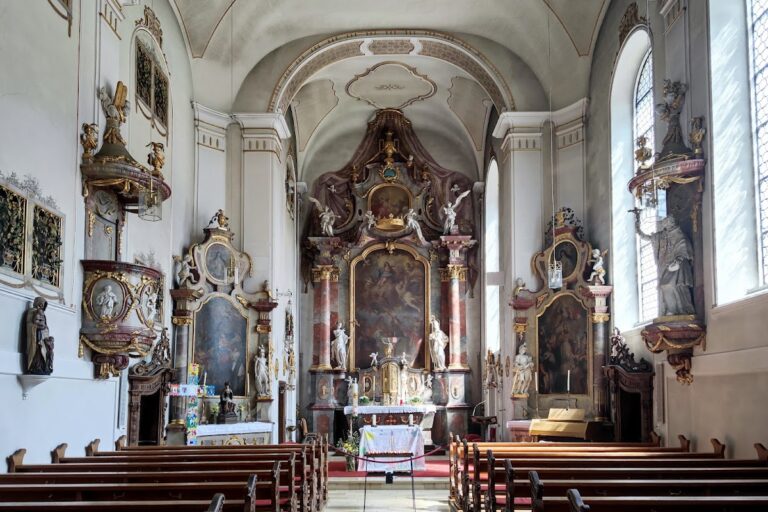
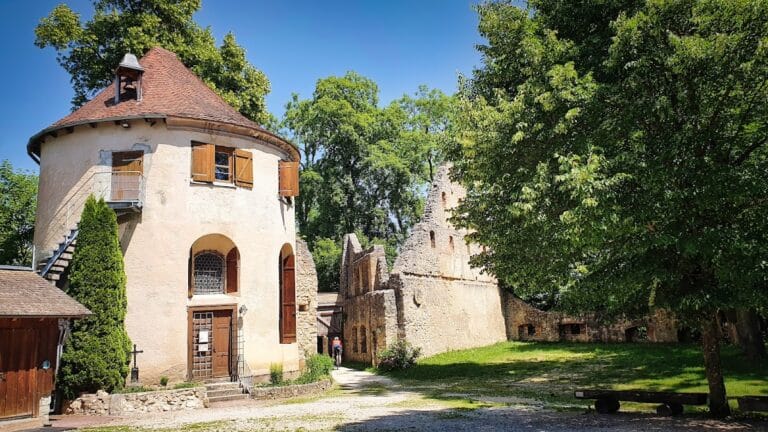
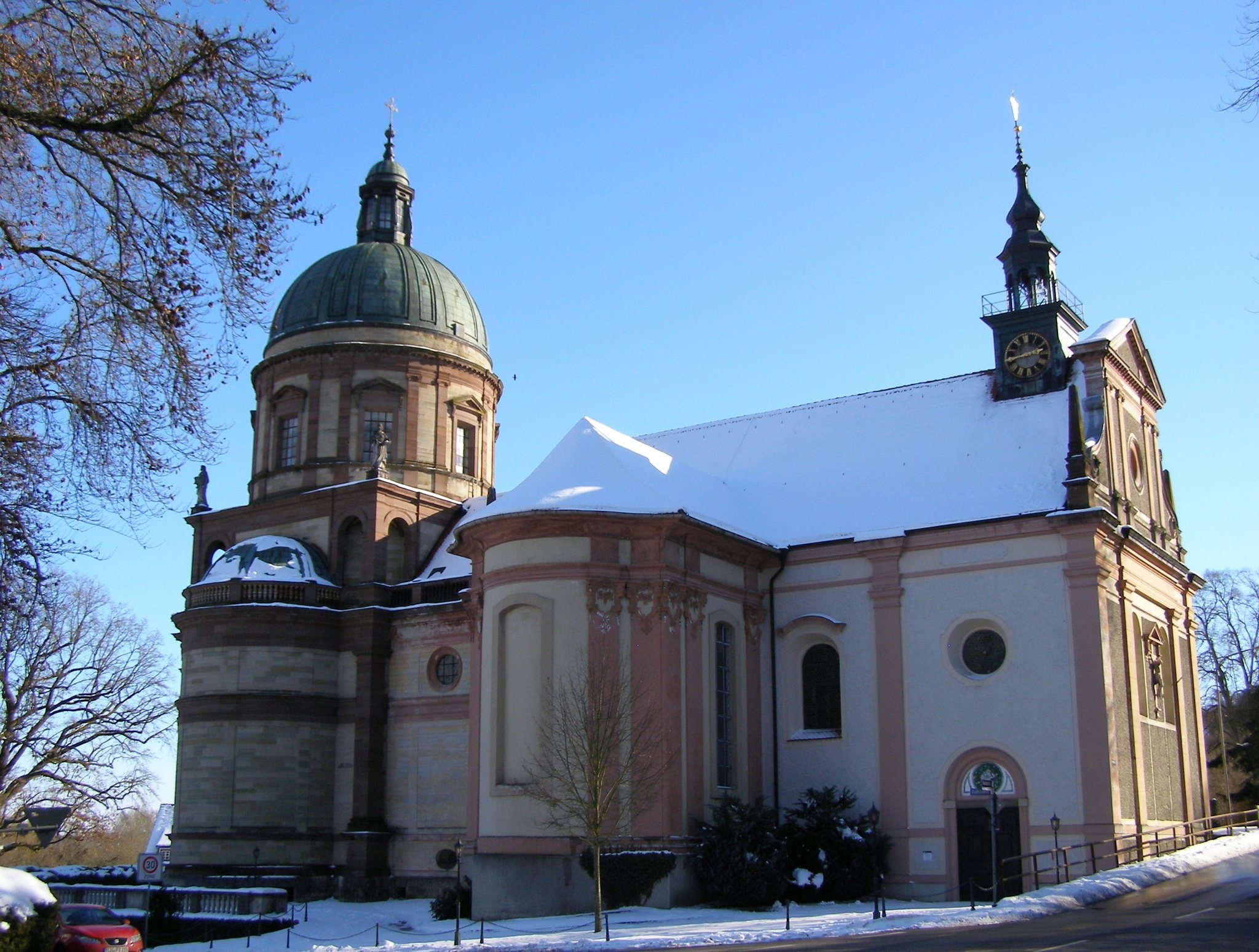
The surviving complex includes the Roman Catholic Hedinger Church, also called the Church of the Redeemer, together with a cloister. The church is a crypt church, meaning that a burial chamber lies beneath it, and its present form brings together a Baroque nave, a Rococo Marian Chapel, and a later domed space over the princely crypt.
Church buildings and decoration
Baroque nave and princely dome
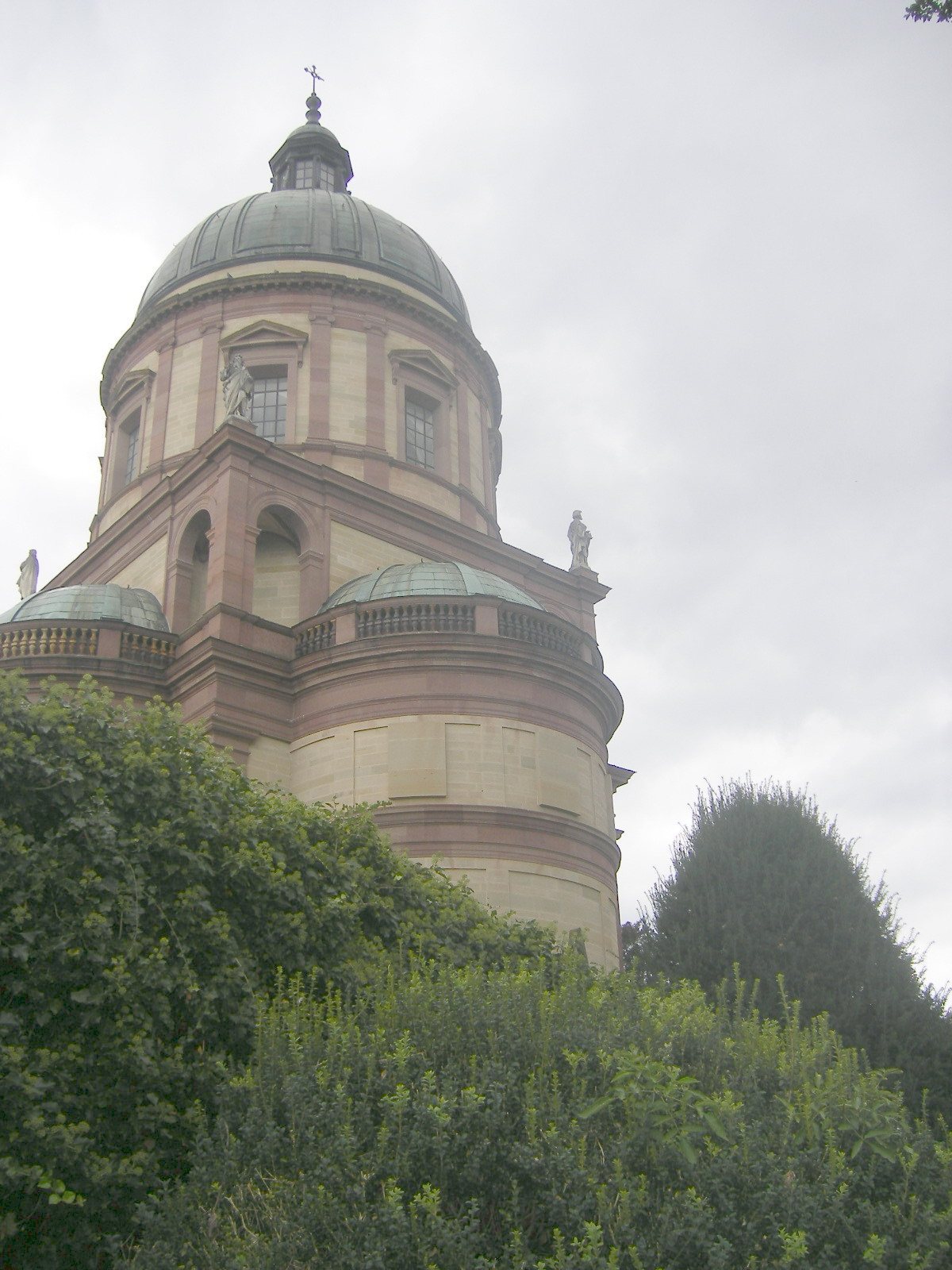
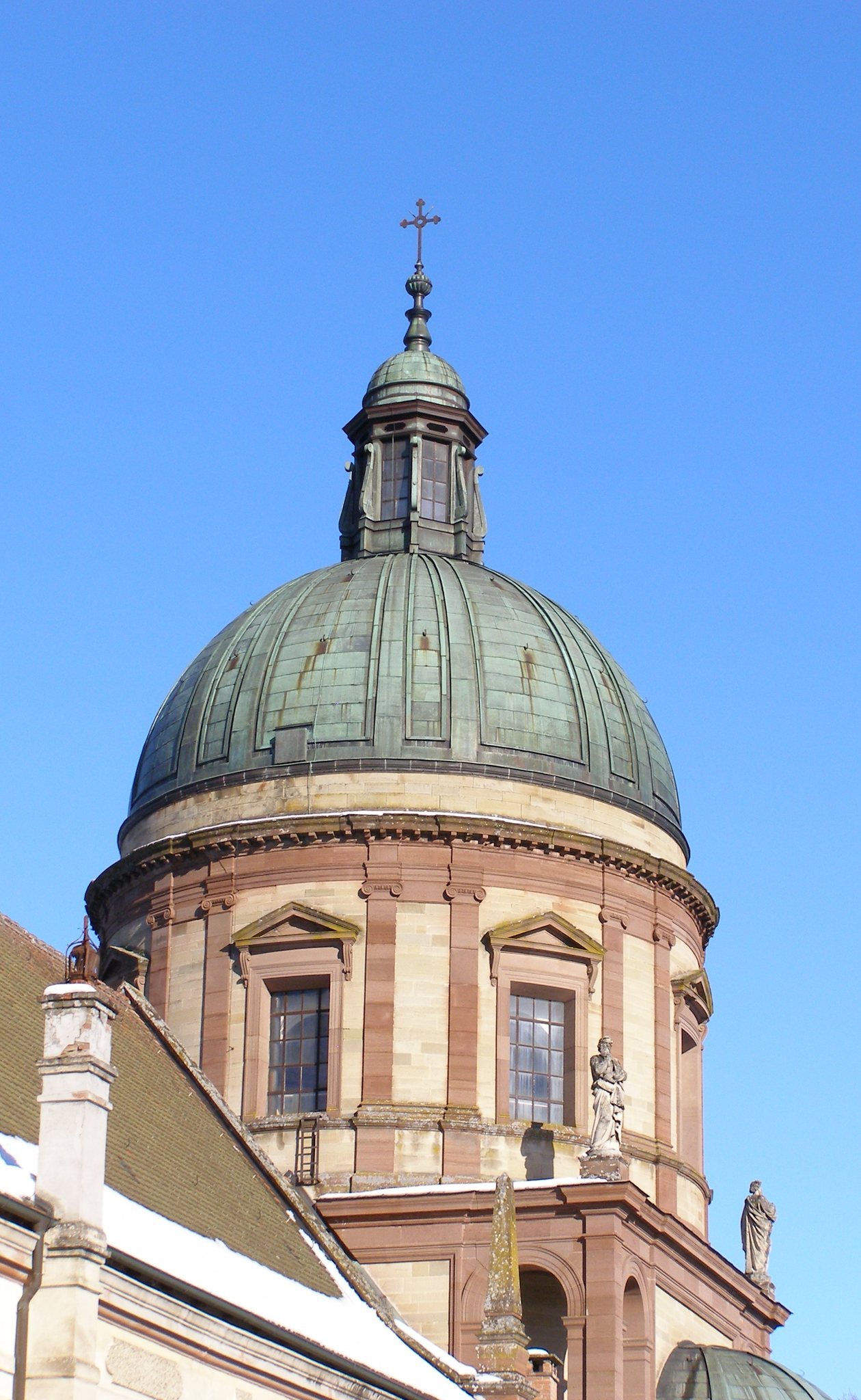
The Franciscans built the present Baroque nave between 1680 and 1682 on the site of an older church. A thorough transformation of the modest mendicant-order church began in 1889 under the court architect Johannes de Pay. He raised a monumental dome in the Italian High Renaissance style above the princely crypt. The domed space has eight windows, rose-shaped motifs on a gold ground, and a circular metal plate with small openings that permits a limited view into the crypt. The crypt, dome, and cross above the dome are aligned.
Below the dome stands a high altar of white Carrara marble, a stone quarried near Carrara in Italy, brought from Venice. Beneath the Latin inscription “Ego sum resurrectio et vita” are representations of the four Evangelists. Higher in the church are representations of the Trinity, Mary, and John the Baptist. The floor is comparatively plain, reflecting the Hohenzollerns’ need to economize after the costly construction of the palace.
Marian Chapel
A Marian Chapel was added around 1715 in the Rococo style, a later European style known for delicate and highly ornamental decoration. Nikolaus Schütz of Landsberg created its stucco decoration. Fire destroyed the chapel soon afterward, and it was rebuilt in 1747. The chapel now contains the Hedingen nativity scene.
Organ
Franz Xaver Späth of Ennetach built the church organ in 1911. It survives largely in its original condition as opus 194 of the Späth organ workshop. The instrument has 32 registers, each a separately controlled group of pipes with a particular tone color, distributed across three manuals and a pedal. The church was consecrated in 1911.
Hedingen nativity scene
The Hedingen nativity scene is a Baroque work from the mid-eighteenth century, approximately 250 years old, owned by the Hohenzollern family, and displayed in the Marian Chapel. It covers about 20 square meters and was enlarged during the nineteenth century. It was exhibited again for the first time in 1893.
The scene contains 175 individual pieces, including 64 nativity figures, animals, and utensils. It is arranged as a simultaneous nativity scene, presenting several biblical events side by side. Its setting is about seven meters deep and five meters wide, and the scenes are progressively changed during the Christmas season according to the liturgical calendar.
The opening scene depicts the birth of Jesus with the Holy Family. Another shows the Massacre of the Innocents at Bethlehem, commanded by a mounted King Herod. On 6 January, the birth scene is replaced by the Adoration of the Magi. A group of townspeople appears against a city backdrop in every version. The figures have painted wooden heads and hands measuring about 40 to 60 centimeters. Their costumes reflect Baroque ideals, with women in powdered wigs and large dresses made from elaborate fabrics, while townspeople and rural figures wear period clothing.
Some richly dressed women and other figures probably came from a no-longer-preserved scene of the Wedding at Cana. The soldiers in the Massacre of the Innocents wear armor representing Baroque-period cavalry, including one figure in the uniform of an eighteenth-century member of the Hohenzollern District Cuirassier Regiment. The Magi and their attendants wear Oriental-style clothing and are accompanied by a camel.
The painted scenery is made from burlap and depicts mountains, the vault beneath which the Holy Family took refuge, and the silhouette of Jerusalem. Real trees from the princely forest are also incorporated into the setting.
Burials and dynastic memorials
Hohenzollern burials
The monastery and cloister contain burials of Ferdinand, Maria Magdalena, Barbara, Karl, Euphrosyne, Georg Friedrich, Maria Salome, Philipp Eusebius, and Jakob Friedrich von Hohenzollern-Sigmaringen. Two unnamed children of Meinrad I, Prince of Hohenzollern, also lie in the complex. They died in infancy in 1650 and 1655. Other infant burials include Friedrich Joseph Fidelis Anton, Johann Baptist Friedrich Fidelis, Anton Joachim Georg Franz, Fidelius Joseph Anton Franz, Maria Franziska Anna Antonia, and Joachim Adam.
Later Hohenzollern burials include Prince Karl Anton Joachim Zephyrin Friedrich Meinrad von Hohenzollern, Prince Anton Egon Karl Friedrich von Hohenzollern, Prince Friedrich Eugen Johann von Hohenzollern, Prince Friedrich Wilhelm von Hohenzollern, and Prince Johann Georg von Hohenzollern.
Wettin burials
Members of the former royal Saxon Wettin house buried at Hedingen include Luise of Austria-Tuscany, the last Crown Princess of Saxony, and Ernst Heinrich of Saxony, the youngest son of King Friedrich August III and Crown Princess Luise. Their sons Gero and Dedo of Saxony are also associated with the Hohenzollern crypt as a columbarium, a chamber containing urns with cremated remains. Dedo’s urn was placed there beside Gero’s in 2009.