Reformed Church in Moscow: A Historic Calvinist Church and Protestant Centre
Site at a Glance
- Rating
- 4.7
- Popularity
- Low
- Country
- Russia
- Primary era
- Modern
- External website
- Open
- Eras represented
- Early Modern, Modern
- Civilizations
- Russian
- Site type
- Religious
- Remains
- Church
On this page11 sections
History
The Reformed Church in Moscow, Russia, was a Protestant Calvinist congregation whose present building developed from a late-eighteenth-century stone house acquired in 1834 and rebuilt in the Eclectic style in 1865. Often called the Dutch Church, it is described as Russia’s oldest Calvinist church and formed part of Moscow’s Protestant history from the early modern period into the twentieth century.
Early Reformed communities
Adam Olearius, a German scholar and traveller, wrote that Reformed Christians had a wooden chapel inside Moscow’s White City by the sixteenth century. Other traditions place the first permitted Reformed chapel in 1629, during the reign of Tsar Michael Feodorovich, the first Romanov ruler. It stood outside the White City near Pogany Ponds, where pastors Buleus and later Kravinckel served the congregation.
The chapel closed in 1643. After the 1649 Council Code required non-Orthodox churches to be removed, Dutch merchants who had been expelled to the German Settlement established a small wooden church there. The German Settlement was Moscow’s quarter for many foreign residents, including Western European merchants, artisans, soldiers, and officials, and became an important centre of Protestant religious life.
The church in the German Settlement
During the reign of Peter the Great, the congregation built a stone church in the German Settlement after St. Michael’s Lutheran Church, the area’s first stone Protestant church, had been constructed. The States General of the Netherlands financed the project, while Nicolaas Witsen, burgomaster of Amsterdam, made a substantial personal contribution. The church stood at the corner of German Street, now Baumanskaya Street, and Dutch Lane, now Denisovsky Lane.
Smaller than the Lutheran churches, the building had simple furnishings and accommodated about 200 worshippers. A motto from Witsen’s coat of arms, translated as “Labor conquers all,” was placed on the gates of the narthex, the entrance or vestibule before the worship space. The church also served Protestants beyond the Dutch congregation. Patrick Gordon, a Catholic and close associate of Peter the Great, used its pastor for his marriage and for the baptism of his children because Moscow had no Catholic church or priest. English residents without a church of their own also attended, despite having an Anglican priest.
Franz Lefort, another close associate of Peter the Great, was a prominent member of the congregation. He was first buried in the church grounds and was reburied at Vvedenskoye Cemetery in the nineteenth century. The German Settlement church burned during the fire of 1812, although St. Michael’s Lutheran Church was the only church in the settlement to escape the destruction.
Reconstruction and institutional separation
After the 1812 war, the Moscow Evangelical-Reformed Church divided into an English faction and a Franco-German faction. In December 1813 the Russian government allocated approximately 41,000 rubles for reconstruction, but control of the money passed to the English faction under the merchant Hawes. A plot was purchased in 1816, yet construction did not begin.
The Franco-German faction was led by the French pastor Jean-Alexandre-André-François Mayor. A long legal dispute followed. A court ordered Hawes and his associates to return the funds in March 1822, the congregation formally separated into two independent sections in 1825, and the ruling was confirmed in April 1829. The money was finally returned in March 1831.
The old Dutch Lane plot was sold in November 1834. The Reformed community then acquired a house and ancillary buildings from Second Lieutenant Voeykov in the Myasnitskaya district, at 3 Maly Trekhsvyatitelsky Lane. The property included a stone residential house built in the late eighteenth century. A prayer hall was installed there, although some accounts indicate that worship may already have taken place on the premises during the 1820s.
The English congregation temporarily worshipped in a house at the corner of Tverskaya Street and Maly Gnezdnikovsky Lane, and later in Voznesensky Lane. The Dutch congregation moved to Maly Trekhsvyatitelsky Lane. In 1844 V. A. Balashov remodelled the house for worship, and in 1865 Hermann von Nissen completely rebuilt the prayer house as the congregation grew.
The administrative position of Reformed congregations also changed during this period. Until 1834, Reformed and Lutheran communities in the Russian Empire belonged legally to a single Evangelical Lutheran Church. A Senate decree of 19 May 1834 created separate Reformed sessions within the Lutheran consistories of Moscow, Saint Petersburg, Riga, and Mitau. A consistory was a regional church administrative body, and special rules for Reformed administration were approved in 1836.
The congregation, school, and twentieth-century changes
Members of the congregation founded a Reformed school with gymnasium status in 1908. It admitted pupils regardless of religion or nationality, taught entirely in Russian, introduced coeducation, and did not require uniforms. The school began in a two-storey house at 1/6 Pokrovka Street, on the corner of Armenian Lane. As enrolment grew, the congregation commissioned a three-storey building beside the church in Bolshoy Trekhsvyatitelsky Lane, completed in 1912–1913.
During the First World War, the school building housed a hospital for wounded soldiers from 1915 to 1918, while lessons moved temporarily to the Practical Academy on Pokrovsky Boulevard. The school was nationalized during the Soviet period and received a succession of numbers, including 42, 43, 24, 35, 327, and 1227. Its building now houses a branch of School No. 2095 specializing in English-language study.
After the 1917 Revolution, most of the Reformed congregation emigrated. About twenty Reformed believers remained, and services continued until 1920. On 23 April 1917 an Evangelical Christian Baptist prayer house opened in the building. During the Soviet period, it became a regular Protestant worship centre for several denominations. St. Michael’s Lutheran congregation worshipped there from 1928 to 1933 after losing its own building, and from 1940 the premises were shared by a Seventh-day Adventist congregation and the Moscow Baptist Christian congregation.
In 1944 the Evangelical Christians united with the Baptists. The Baptists received full ownership of the building in 1993, after which it became the Central Baptist Church of Moscow. The Reformed Church in Moscow now worships in a chapel at the Lutheran Cathedral of Saints Peter and Paul in Starosadsky Lane. The former church building is a regionally designated cultural-heritage property of the peoples of the Russian Federation.
Remains
The rebuilt church
Facade and interior
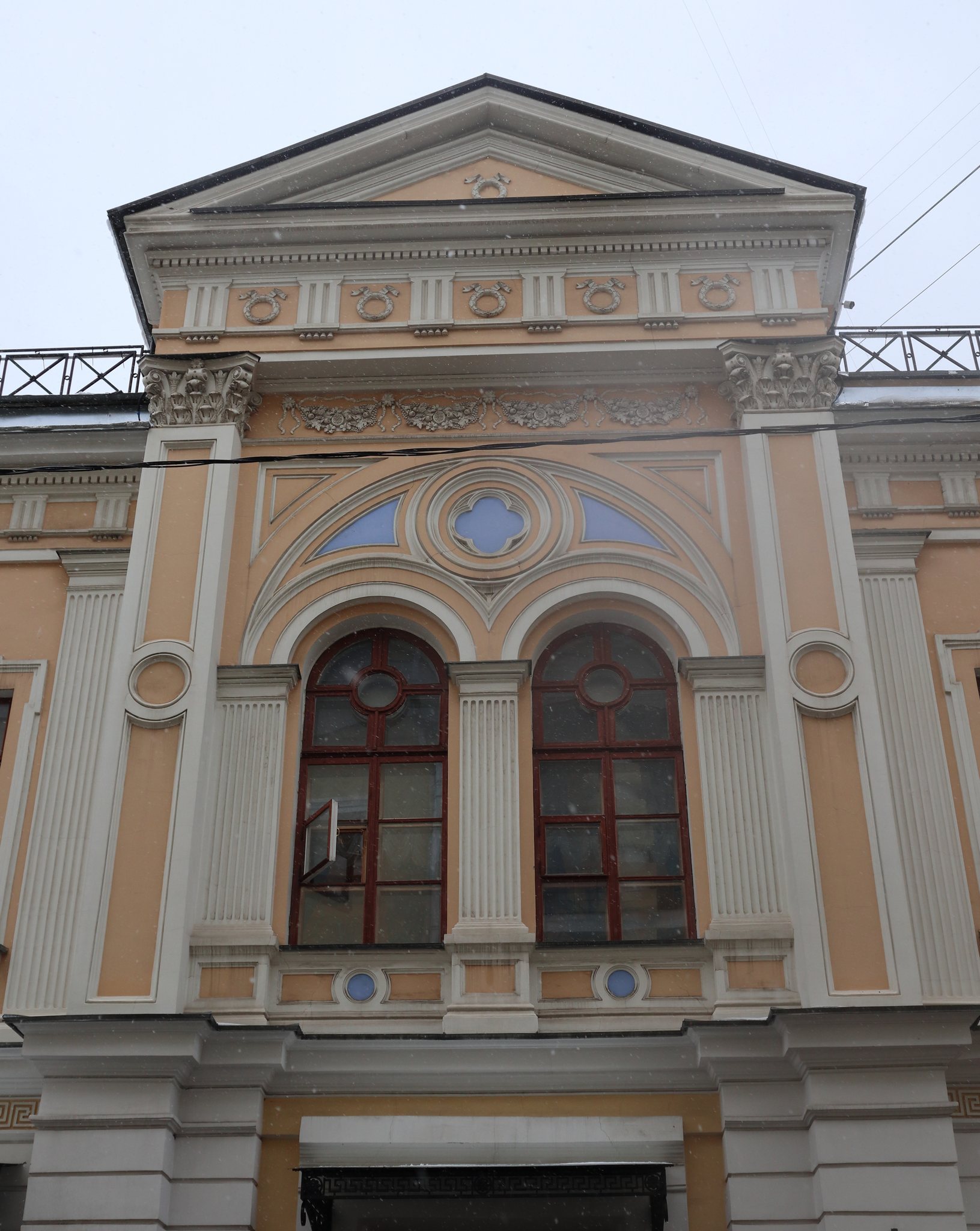
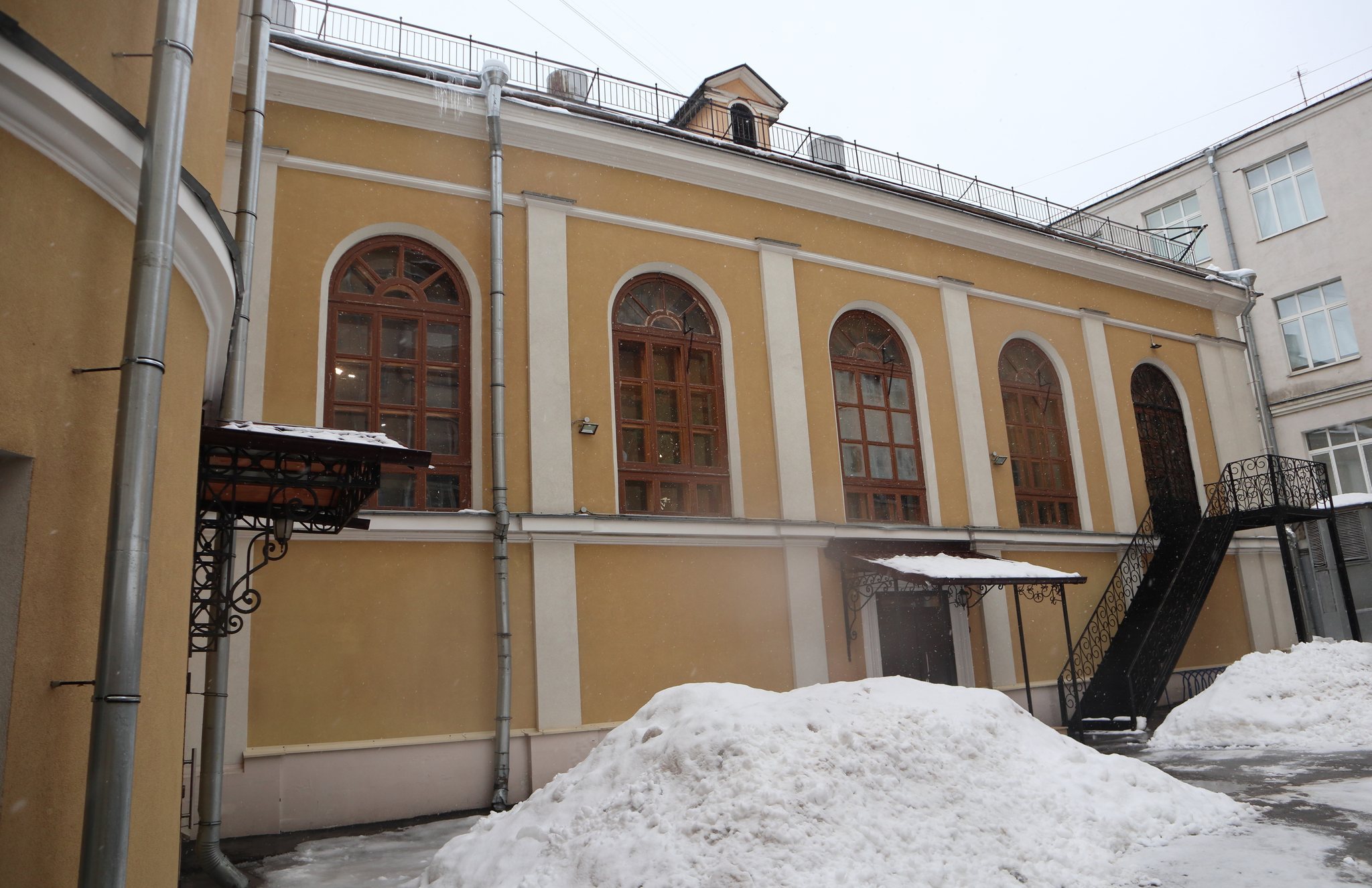
The present church at 3 Maly Trekhsvyatitelsky Lane incorporates the late-eighteenth-century stone residential house acquired by the congregation in 1834. Balashov’s 1844 remodelling adapted it for worship, while von Nissen’s 1865 rebuilding gave it its Eclectic character, combining forms drawn from different historical styles.
The 1865 facade had a two-part Italianate window on the second floor above the central entrance. An iron canopy once protected the entrance, and a pediment, a framed gable-like feature, crowned the building above its frieze. The former German Settlement church was a smaller stone structure with simple interior decoration and capacity for approximately 200 people. Its Witsen plaque was transferred to the later building after the congregation moved.
Witsen plaque
During the Soviet period, a stage-like pulpit was built in the central altar area, concealing the Witsen plaque. Its position was established in 2010 through documentary research and examination of the building. The plaque is now displayed on the left wall of the vestibule with an explanatory plaque.
Röver organ
A Friedrich Ladegast organ with 18 stops was installed in 1871. In 1898 it was replaced by a German Romantic organ made by Ernst Röver as Opus 73 in 1897–1898 at Hausneindorf in the Harz. An organ stop is a controlled set of pipes producing a particular tonal colour. The instrument has 38 stops, three manuals, a pedal, pneumatic stop and key action, manual and pedal couplers, two free combinations, prepared combinations, a swell box for the third manual, a reed-stop cancel device, and a crescendo roller.
Except for the replacement of its original air-supply system with an electrically driven blower in 1946, the Röver organ has not been rebuilt and retains its original tonal character. Its manuals are the keyboards played by the hands, while the pedal is operated by the feet. The organ was registered as a historical and cultural monument in 1990 and is described as the only Röver organ outside Germany and one of four church organs in Moscow.
Reformed school building
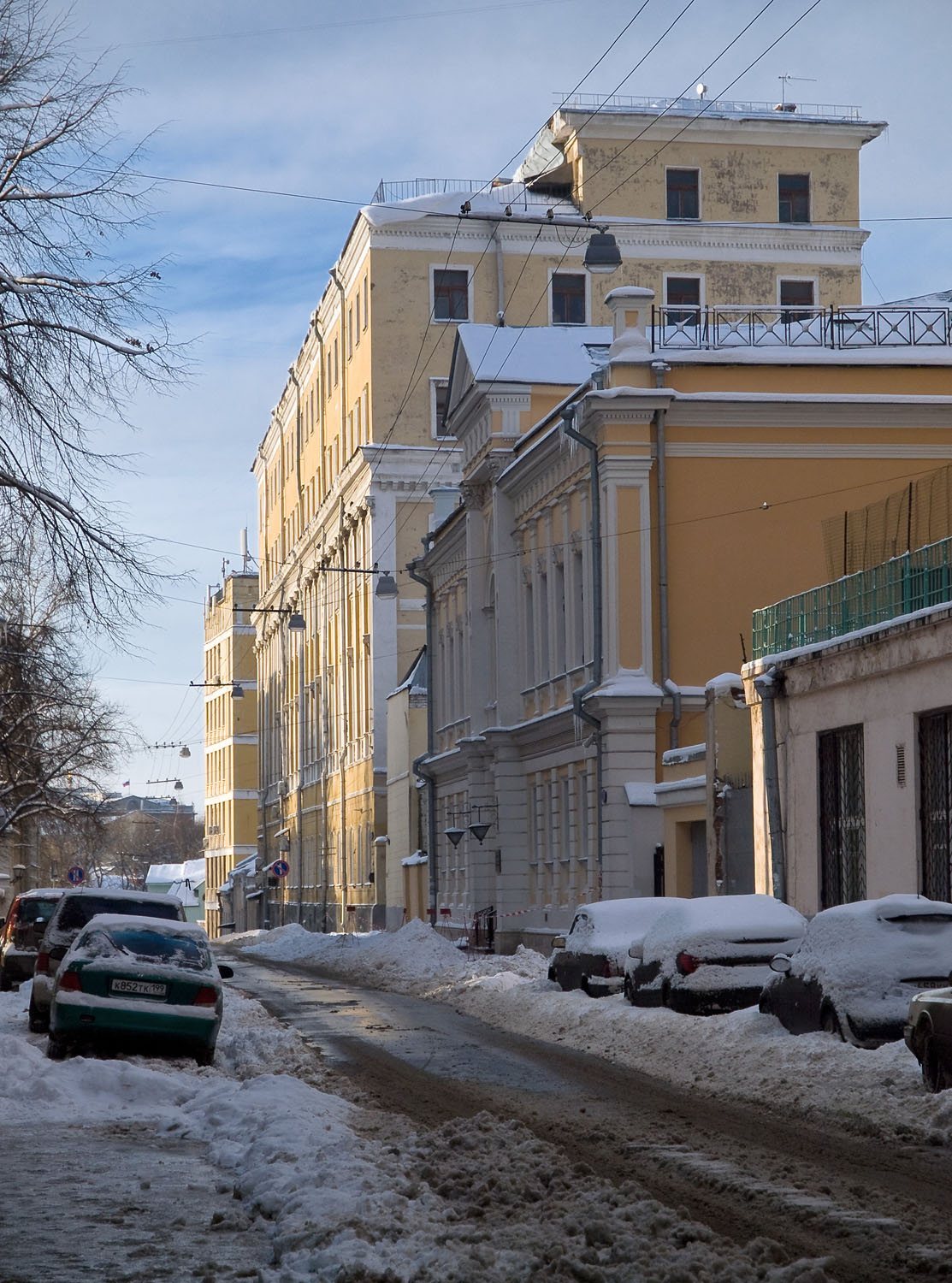
The former Reformed school beside the church in Bolshoy Trekhsvyatitelsky Lane is a three-storey structure designed by Adolf Erichson, a member of the congregation, and erected in 1912–1913. Its purpose-built facilities included spacious, well-lit classrooms, broad corridors, rooms for chemistry, physics, and natural science, and a modern sports hall. It replaced the school’s earlier two-storey premises at the corner of Pokrovka Street and Armenian Lane.
The church complex and associated buildings therefore preserve several stages of adaptation and reuse. A residential house became a Reformed prayer house, the structure was rebuilt for a growing congregation in 1865, and the premises later served Baptist, Lutheran, and Adventist communities as a shared Protestant worship centre in Moscow.