Aiguebelle Abbey: A Cistercian Monastery in France
Site at a Glance
- Rating
- 4.7
- Popularity
- Low
- Country
- France
- Primary era
- Medieval
- External website
- Open
- Eras represented
- Medieval, Modern
- Civilizations
- County of Provence, French
- Site type
- Religious
- Remains
- Monastery
On this page13 sections
History
Aiguebelle Abbey is a Cistercian monastery in France, refounded on 26 June 1137 in the wooded borderlands between historic Dauphiné and Provence. Dedicated to Notre-Dame and belonging to the Diocese of Valence, it developed into a major religious and agricultural centre before its dissolution during the French Revolution and its revival by Trappists in the nineteenth century.
From Benedictine foundation to Cistercian abbey
A Benedictine monastery was founded at Aiguebelle in 1045 by Hugues Adhemar, baron of Grignan. Pope Paschal II visited it in 1107, but the community soon fell into disuse. On 26 June 1137, Gontard Loup, lord of Rochefort, re-established the monastery as a Cistercian house and endowed it with land. An abbot and twelve monks arrived from Morimond Abbey, making Aiguebelle a daughter house within Morimond’s institutional lineage.
During the twelfth and thirteenth centuries, Aiguebelle expanded its holdings around Montjoyer and Réauville and received further gifts of land. Its network of granges, or monastic farm estates, supported the community and its economic growth. The nearest grange eventually developed into the village of Montjoyer, while the abbey also possessed the large Combemaure grange in Vivarais. Aiguebelle established daughter houses during the later twelfth century, including Frayssinet, which soon became a grange, and Féniers in Auvergne.
In 1281, the abbot granted the land of Réauville to the Count of Provence, the brother of Saint Louis. The monastery’s lands and influence continued to connect it with the political and agricultural life of the surrounding region, whose territories remained dependent on Provence until the French Revolution.
Decline, destruction, and revolutionary dissolution
Aiguebelle’s influence weakened during the fourteenth and fifteenth centuries. The Black Death, the Hundred Years’ War, changing patterns of religious vocation, and the decline of lay-brother labour reduced the resources available to the monastery. Its lands were increasingly leased, and by the early sixteenth century the abbey was governed under the commendatory system. A commendatory abbot held the abbacy as a benefice and often did not reside in or directly govern the monastery, a practice that could diminish a community’s independence and income.
The abbey was burned during the Wars of Religion in 1562 and restored after 1585. It remained a religious and territorial institution until the French Revolution. The monastery was dissolved in 1791, when its community had already fallen to three monks. Its goods were seized and sold, but the buildings remained standing because their distance from transport routes made demolition for building materials uneconomic.
Trappist revival and nineteenth-century development
Trappists from La Valsainte in Switzerland re-established the monastery in 1815 and 1816 under Pierre-François de Paul Malmy, known as Father Étienne. Trappists are Cistercians of the Strict Observance, a branch of the order that emphasizes silence, prayer, manual labour, and contemplative discipline. The restored community grew rapidly, reaching 233 monks in 1850.
The monks resumed agriculture and animal husbandry and created several craft industries. These included the manufacture of rosaries, brooms, and wicker baskets. A cloth factory operated from 1841 to 1877, and a flour mill was established in 1867. Chocolate production became the abbey’s principal industry before being transferred to Donzère in 1895, when the growing workforce was considered incompatible with the monastery’s contemplative vocation.
Aiguebelle also became the centre of an extensive network of affiliated communities. It founded or developed Notre-Dame de Staouëli in Algeria in 1843, Notre-Dame-des-Neiges in Ardèche, Sainte-Marie-du-Désert in Haute-Garonne, Acey in Jura, Notre-Dame des Dombes in Ain, Bonnecombe in Aveyron, and Koutaba in Cameroon. The Algerian foundation later gave rise to Notre-Dame de Tibhirine and Notre-Dame de l’Atlas, whose community was transferred to Midelt in Morocco. Aiguebelle also oversaw the nuns of Notre-Dame de Bon-Secours at Blauvac.
Damage, war, and twentieth-century history
Earthquakes centred near Châteauneuf-du-Rhône between 14 July and 15 August 1873 damaged the abbey. Their intensity reached VII to VIII on the MSK scale, which measures the observed effects of an earthquake on people, structures, and the landscape.
From 1914 to 1918, during the First World War, the abbey’s infirmary temporarily served as a hospital for wounded soldiers. During the Second World War, the community, then numbering about 75 monks, produced false identity cards for people avoiding the compulsory Service du travail obligatoire. From late 1942, refugees, including Jews disguised as agricultural workers, were sheltered in annexes of the distillery. Farms dependent on the monastery hid groups belonging to the Secret Army, a French resistance organization. Weapons were reportedly concealed in the building’s boiler in June or July 1940. A Gestapo search in April 1944 found nothing, although the monks were threatened with the destruction of the abbey by fire.
Aiguebelle was also the setting of a murder in 1891. On 28 October, Father Ildefonse, the procurator, was killed after discovering the novice Brother Eugène, whose secular name was Matthias Hadelt, stealing valuables in his care. Hadelt was sentenced to death on 4 May 1892 and guillotined at Valence on 5 July.
The abbey church received the status of minor basilica in 1937. This is an honorific Catholic designation for a church recognized for particular historical, religious, or pastoral importance. In 2025, the monastery housed a community of 22 Cistercian-Trappist monks, aged between 45 and 96.
Remains
Aiguebelle stands in a wooded valley on the right bank of the Vence, slightly above 200 metres in elevation. Its name derives from aqua bella, referring to the purity of the local water resource. Despite demolitions and extensive restoration, the complex retains most of its medieval conventual buildings, arranged around the church and cloister with associated agricultural and service areas.
Abbey church
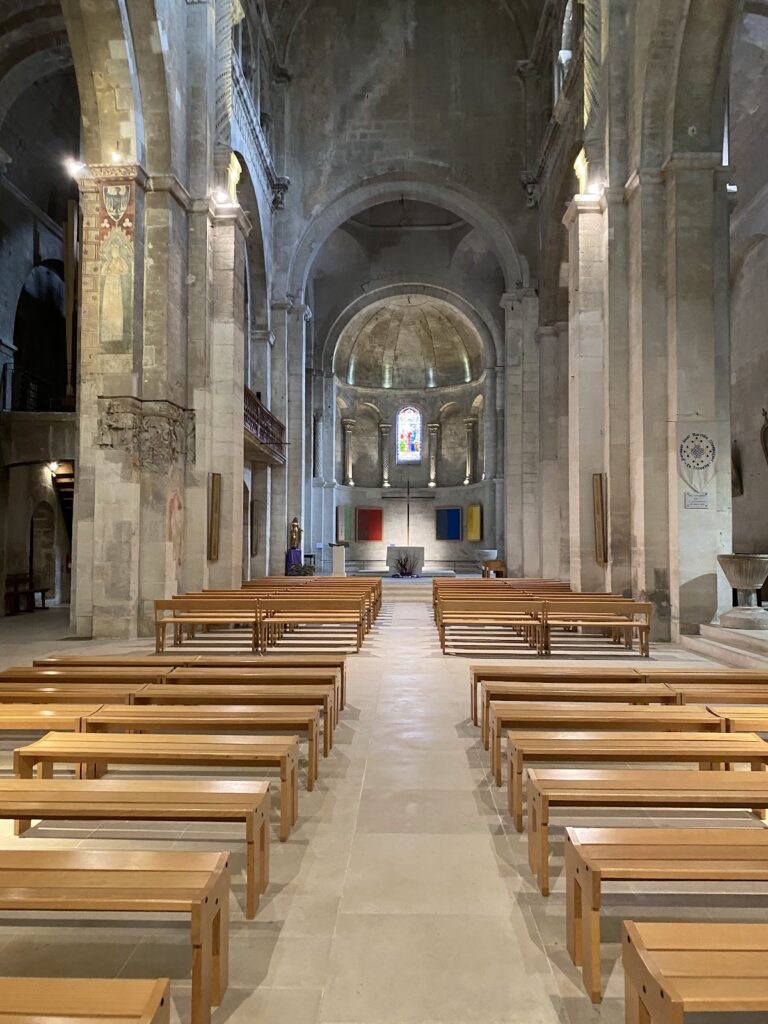
The restored abbey church was built in the late twelfth century. It is unusually low, measures about 50 metres in length, and has the plan of a Latin cross. The choir and chapels were altered later. Inside, the nave has groin vaults, with three bays in the central vessel and six in the side vessels, following the Cistercian bound-system arrangement. Each arm of the transept has one bay and two chapels ending in semicircles.
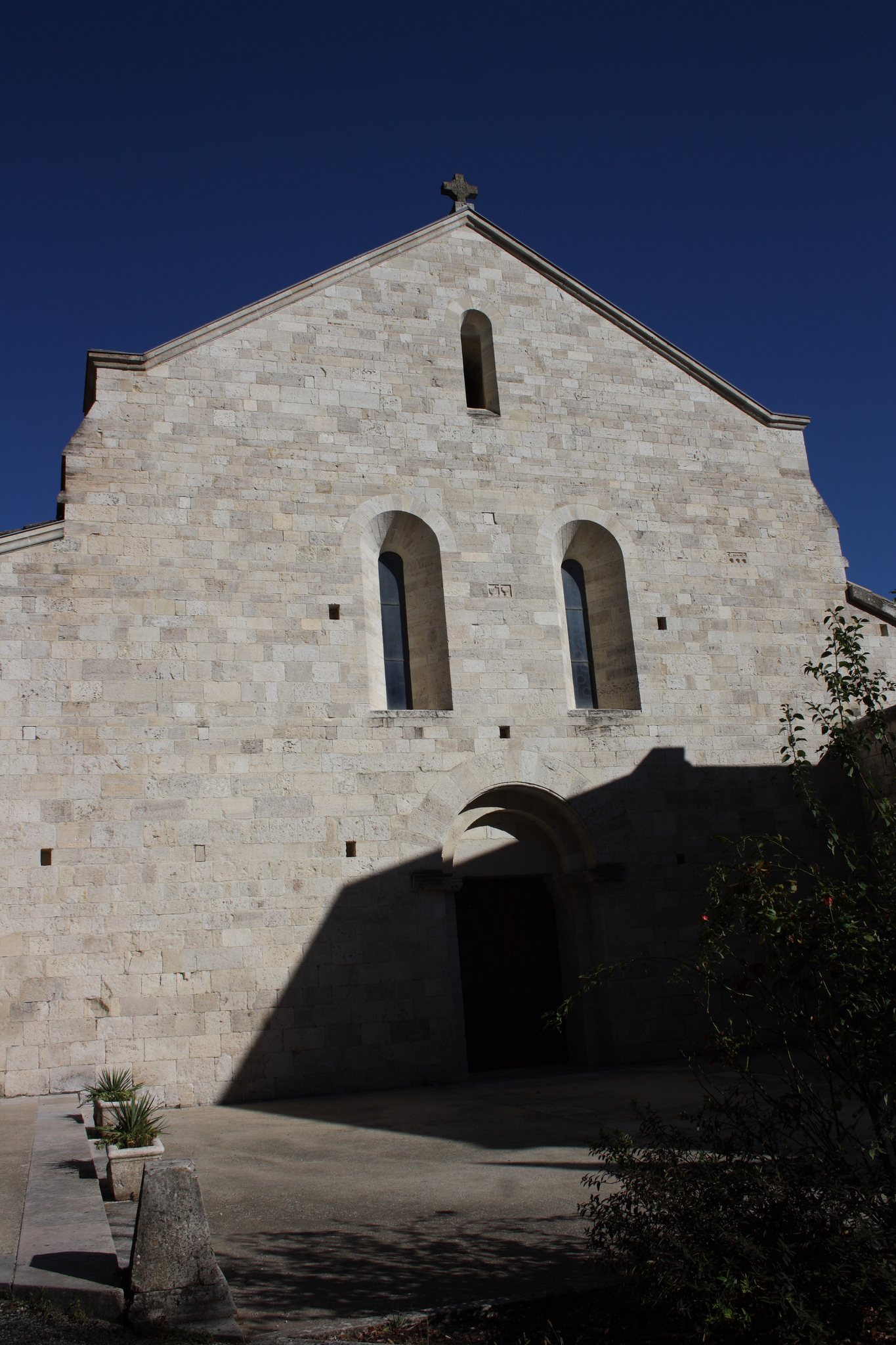
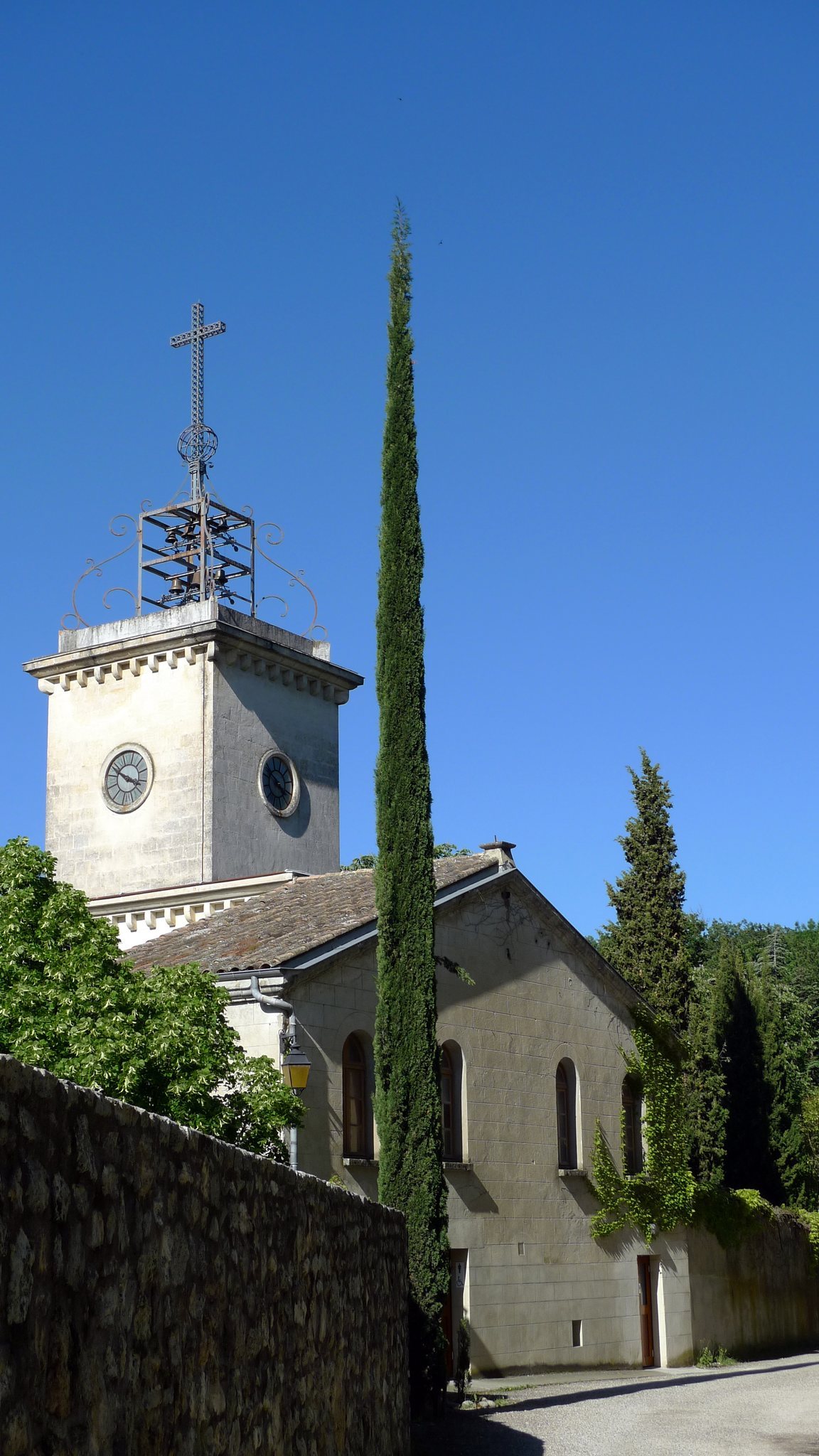
The church underwent major restoration after the community returned in 1815. Work continuing until about 1847 included rebuilding the facade, replastering the cloister, whitening the church interior, and installing a rood screen and gallery. A rood screen is a partition separating the choir or chancel from the nave, traditionally associated with a cross or crucifix. A 35-metre bell tower was built during this campaign and later demolished, while a smaller bell-gable was retained. The church received another restoration in 1856.
Cloister and conventual buildings
The cloister and the main conventual range lie south of the church. The cloister measures about 29 metres on each side. Its corners have groin vaults, while the north and east galleries are covered by slightly pointed barrel vaults. The surrounding buildings include the sacristy, chapter house, monks’ room, refectory, kitchen, and the range occupied by the lay brothers.
Chapter house and monks’ hall
The chapter house is divided into six compartments covered by groin vaults and supported by two pillars. The two-aisled monks’ hall has round pillars. These spaces formed part of the monastic buildings adjoining the cloister and retain the structural organization of the medieval conventual complex.
Refectory and kitchen
The plain refectory and adjoining kitchen have slightly pointed barrel vaults. When the community returned in the nineteenth century, the kitchen and monks’ refectory remained comparatively intact, while other parts of the complex had been more heavily reused.
Lay-brothers’ range
The lay-brothers’ range is separated from the cloister by the original lay-brothers’ passage, or alley. The passage and the lay-brothers’ dormitory survive, preserving a circulation route between the working community’s accommodation and the rest of the monastery. Aiguebelle is one of only two former Cistercian monasteries in France, together with Fontfroide, to retain this original route.
Reuse and restoration
By 1815, the surviving buildings had been extensively adapted to agricultural use. The lay-brothers’ refectory and chapter house served as a stable, the warming room became a wine cellar, the cloister was used to store manure, and the church became a cowshed and sheepfold. The arms of the transept were stripped of their vaults and roofs, while the kitchen and monks’ refectory remained comparatively intact.
Restoration began in 1815 and continued until about 1847. Later work restored the conventual buildings, guesthouse, and gardens. The guesthouse was rebuilt higher on the plateau in 1868, and the former guesthouse became an infirmary. A guesthouse for women was built in 1884. These interventions returned the complex to religious use while adapting parts of it to the needs of the revived community.
Granges and wartime annexes
The agricultural landscape associated with Aiguebelle included granges and farms belonging to the monastery. One former grange near the abbey developed into Montjoyer. The distillery annexes later sheltered refugees during the Second World War, while monastery farms concealed groups of the Secret Army resistance movement. These associated buildings formed part of the wider physical network through which the abbey supported agriculture, production, and wartime protection.