Mondsee Abbey: A Former Benedictine Monastery in Austria
Site at a Glance
- Rating
- 4.7
- Popularity
- Medium
- Country
- Austria
- Primary era
- Early Modern
- External website
- Open
- Eras represented
- Medieval, Early Modern
- Civilizations
- Duchy of Bavaria, Habsburg, Holy Roman Empire
- Site type
- Domestic
- Remains
- Castle
On this page13 sections
History
Mondsee Abbey is a former Benedictine monastery in Mondsee, Austria, founded in 748 by Odilo, Duke of Bavaria, on or near the remains of a Roman settlement. The foundation belonged to the early medieval period, and monastic tradition connects its first monks with St Peter’s Abbey in Salzburg and Monte Cassino in Italy. Archaeological research indicates that a Roman estate occupied the area around AD 300. A local legend says that moonlight revealed the lake and a dangerous rock to Odilo, allowing him to escape, and associates this rescue with both the monastery and the name Mondsee.
Imperial abbey and centre of learning
After the deposition of Tassilo III in 788, Bavaria entered the political sphere of the Frankish Kingdom, and Mondsee became an imperial abbey. This status placed the monastery under the direct authority and protection of the ruler rather than under a local secular lord or bishop. Mondsee subsequently acquired extensive possessions, reaching from the region southwest of Kufstein to the Danube and from there to the Upper Austrian-Salzburg Limestone Alps.
The abbey developed an active scriptorium, a monastic centre for writing and producing books, and became an important place of book production in Upper Austria. The Psalter of Montpellier and the Mondsee Fragments were produced there in the eighth or early ninth century. Around 800, monks wrote the Codex Millenarius, an illustrated Latin Gospel book. Around 810, they translated the Gospel of Matthew from Latin into Old High German. The surviving fragments are described as the oldest known translation of part of the Bible into Old High German.
Medieval administration and reform
In 831, Louis the Pious, the Frankish emperor and son of Charlemagne, placed Mondsee under the administration of the Diocese of Regensburg. The monastery regained its independence in 1142 under Abbot Conrad II, who had led the community since 1127 and successfully defended and recovered its rights and possessions. In 1145, nobles murdered Conrad at nearby Oberwang. The community venerated him as a martyr, and he was later declared Blessed.
Conrad was succeeded by Walter of Mondsee, remembered by the community as a model of religious virtue. He was buried in St Peter’s Chapel in the abbey church. Wolfgang of Regensburg, bishop of Regensburg, also spent a year at Mondsee in 976. In 1389, Pope Boniface IX granted the abbots the right to use pontifical insignia, the liturgical vestments and ceremonial privileges associated with bishops and certain abbots.
The Melk Reform, a fifteenth-century Benedictine movement centred on stricter monastic discipline, reached Mondsee during that century. In 1506, during the reign of Emperor Maximilian I, the Mondseeland passed from Bavaria to Austria. Abbot Wolfgang Haberl founded the abbey grammar school in 1514. Although the Reformation and later unrest brought a period of decline, the monastery subsequently entered a new period of prosperity. From 1625 until its dissolution, it belonged to the Austrian Benedictine Congregation, a federation of Benedictine monasteries in the Habsburg lands.
Rebuilding and dissolution
Under Abbot Bernhard Lidl, who governed from 1727 to 1773, the church and monastic buildings underwent extensive rebuilding in connection with the thousandth-anniversary celebrations of 1748. Opportunus II Dunkl, abbot from 1773 to 1784, was the monastery’s final abbot. After a major market fire on 9 May 1774, he initiated the reconstruction of the complex and planned substantial new construction.
Emperor Leopold II’s church reforms led to the dissolution of Mondsee Abbey in 1791. Its property passed to the Religious Fund, an Austrian state fund that administered property confiscated during the reforms. Most of the estate was assigned that year as an endowment to Joseph Anton Gall, the second bishop of the newly established Diocese of Linz, and returned to the Religious Fund after his death in 1807. Many manuscripts were later transferred to the Austrian National Library, the Upper Austrian State Library, and the Upper Austrian State Archive.
From noble residence to parish church
During the Napoleonic period, the Mondseeland returned to Bavaria for several years. In 1810, Napoleon transferred the Mondsee estate to Carl Philipp von Wrede, a Bavarian military commander and minister. Wrede converted the former abbey into a noble residence, retained ownership after the territory returned to Austria, and promoted local development, including road construction and the beginnings of Mondsee cheese production.
Ownership remained with the princely Wrede family. After Princess Ignazia von Wrede died in 1905, Mondsee passed to her daughter Helene and her husband, the Bavarian chamberlain Karl August Count Almeida. The last comital owner, Ludwig Count Almeida, died in 1972, and the castle was sold in 1985 to Asamer and Hufnagl of Ohlsdorf.
The former abbey church of St Michael became the parish church. In 2005, Pope John Paul II granted it the status of a minor basilica, a papal honorific for a church of particular religious or historical importance. A three-year interior renovation and conservation campaign began the same year.
Remains
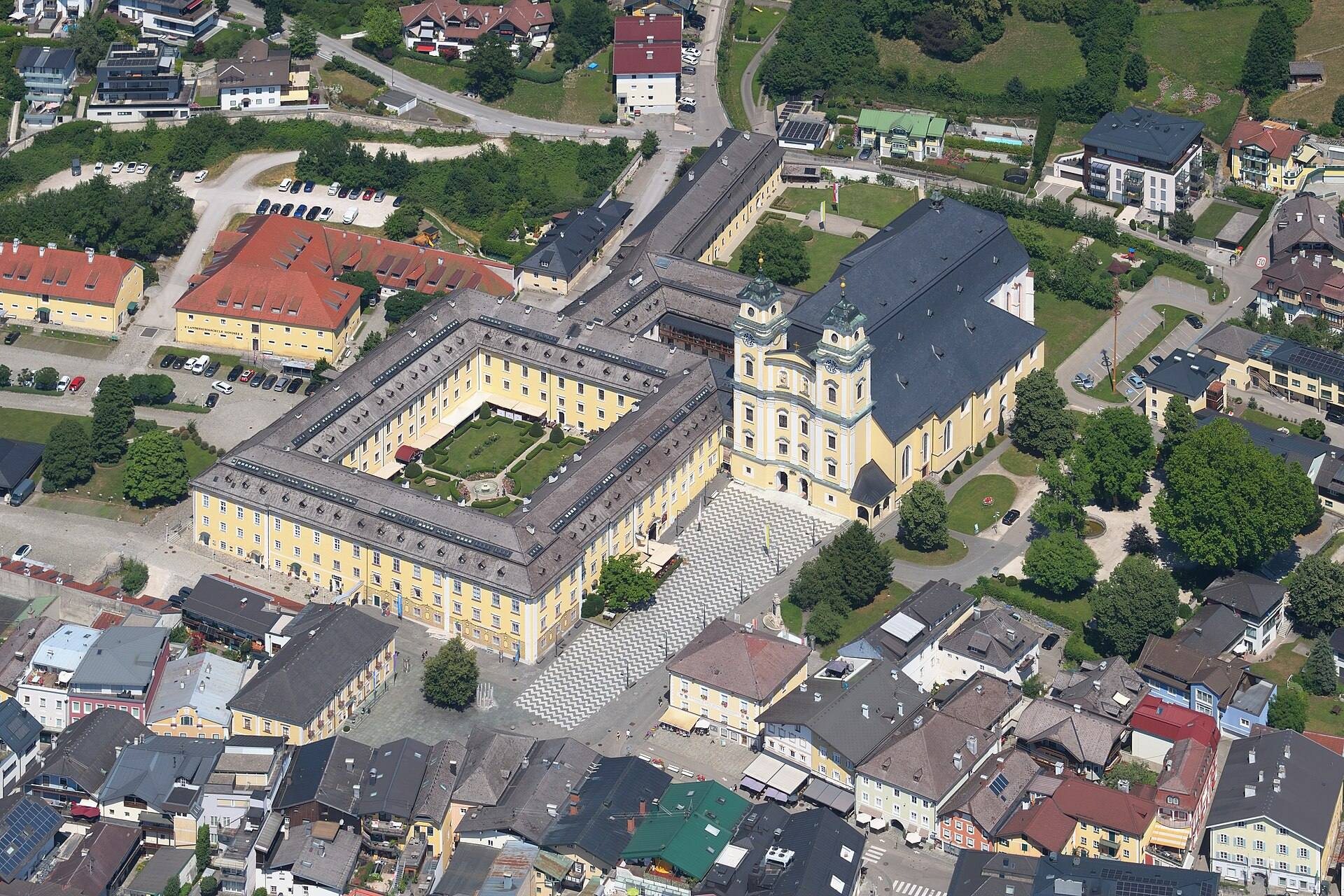
The surviving complex combines medieval monastic elements with a largely late eighteenth-century arrangement created after the 1774 fire. Its principal components include the former monastery and castle, the church of St Michael, the cloister, the chapter house, and the monastic library. The castle forms a four-winged complex around a courtyard, while the church stands connected to the former monastery on its north side.
Former monastery and castle
Cloister and chapter house
The cloister, a covered walkway enclosing an inner courtyard, was completed in 1448 and is among the oldest surviving parts of the complex. The former chapter house adjoins the church. It is a square room with a star-ribbed vault, whose ribs form a star-like pattern, supported by a central column.
Castle and courtyard
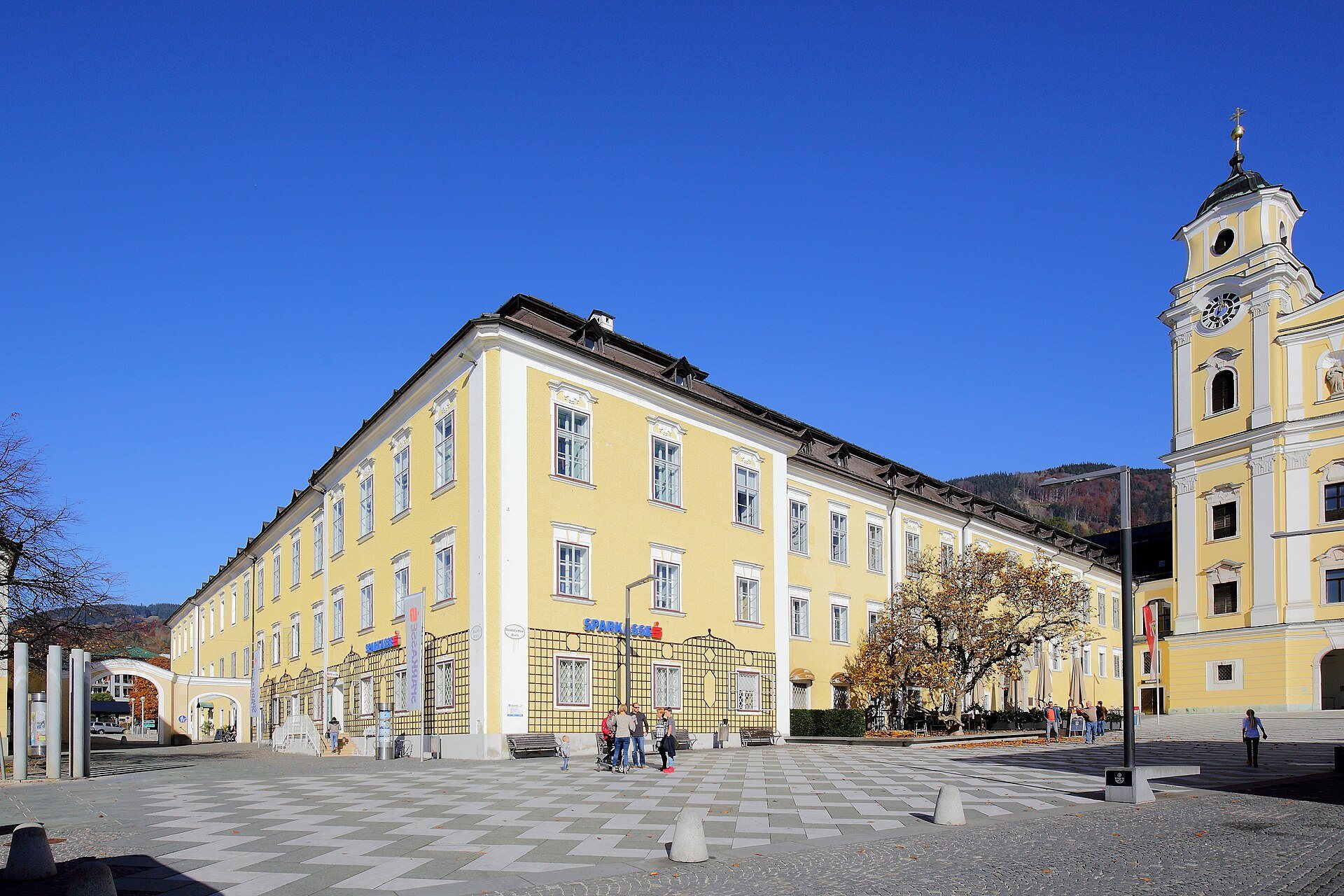
The castle consists of four wings enclosing a courtyard. Its two-storey gate hall contains a staircase closed by a wrought-iron grille dated 1630. The former abbey complex now accommodates residential, commercial, institutional, and event uses. The main building includes Hotel Schloss Mondsee and a hall for theatrical and concert performances. Former library rooms have housed the Mondsee local-history museum since 1957 and also contain the municipal registry office. A separate wing houses the parish office, while the courtyard, ground floor, upper floors, and ancillary buildings have been adapted for public parking, shops, homes, and offices.
Church of St Michael
Late Gothic building
The present church was built between 1463 and 1499 under Abbot Benedikt Eck by Hans Lenngdörffer of Burghausen. Its main nave was consecrated in 1487. St Michael is a three-aisled basilica approximately 70 metres long, 34 metres wide, and 22 metres high. The eastern end creates the appearance of a double-choir arrangement, and the church is joined to the former monastery on the north. Its Baroque facade is flanked by two towers reported as 52 metres high.
Baroque interior and library
Abbots Coelestin Kolb and Bernhard Lidl directed extensive Baroque remodelling. The rebuilding associated with the 1748 anniversary produced a new facade and four side altars. Much of the surviving Baroque interior was created by the painter and sculptor Meinrad Guggenbichler. The church contains twelve Baroque side altars associated with Franz Anton Koch, Guggenbichler, and Leopold Schindlauer. A late Gothic altar commissioned by Benedikt Eck from Piburg in 1497 gave its otherwise unidentified maker the scholarly name “Master of Mondsee.”
The former monastic treasury is now the sacristy, and the church also incorporates the monks’ choir and a 36-metre-long Gothic monastic library. The library was formerly a medieval lectern library, in which books were kept on reading desks rather than modern shelves. The high altar is designed as a giant reliquary and contains, among other relics, the jeweled skeleton of Abbot Conrad II. Two short, massive towers contain four bronze bells cast by the Oberascher foundry of Salzburg and tuned to A-flat, C, E-flat, and G-flat.
Conservation
During the interior renovation from 2005 to 2008, the altars, paintings, floors in the altar areas, and flags were thoroughly inspected and conserved. These works preserved the late Gothic structure and the later Baroque furnishings within the former abbey church.