Munakata Shrine: A Shinto Guardian in Kyoto Imperial Garden
Site at a Glance
- Rating
- 4
- Popularity
- Low
- Country
- Japan
- Primary era
- Early Modern
- External website
- Open
- Eras represented
- Early Modern, Modern
- Civilizations
- Japanese, Tokugawa
- Site type
- Religious
- Remains
- Sanctuary
On this page16 sections
History
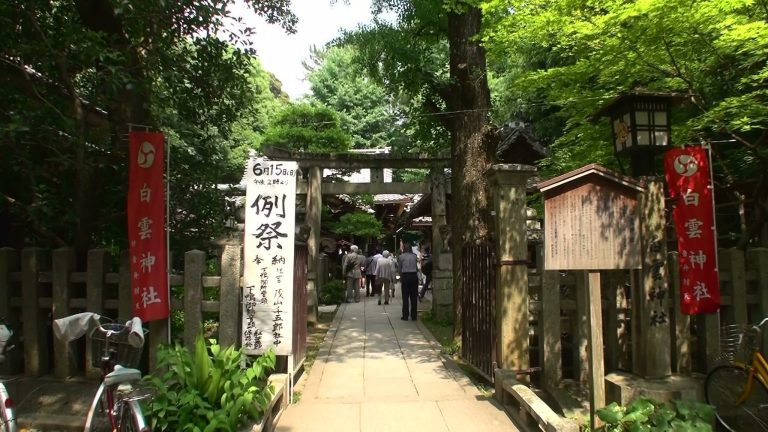
Munakata Shrine is a Shinto shrine in Japan, located in Kyoto’s Kamigyo Ward within the Kyoto Imperial Garden. Tradition dates its foundation to 795, during the Heian period, when Fujiwara no Fuyutsugu invited deities from Chikuzen Province and established a place of worship at the southwestern corner of his residence. Chikuzen corresponded broadly to northern Fukuoka Prefecture on Kyushu. The shrine served as a guardian of the imperial palace and was also associated with protection for the eastern and western markets of Heian-kyo, the capital founded by Emperor Kanmu in 794.
Foundation and imperial associations
Fujiwara no Fuyutsugu, a leading court noble of the early Heian period, maintained a residence known as the Tokyo Residence or Tokyo Ichijo Residence. The three principal deities brought there were Tagorihime-no-Mikoto, Tagitsuhime-no-Mikoto, and Ichikishimahime-no-Mikoto. They were understood as the same deities worshipped at Munakata Shrine in Chikuzen, although the Kyoto sanctuary stood at a different location. The three female deities belonged to a major Shinto tradition associated with protection over travel and sea routes.
A deity connected with opening the Heavenly Rock-Cave was also apparently worshipped at the northeastern corner of the residence. The origin of this worship is uncertain. The shrine’s early religious landscape therefore included both the Munakata deities and associated worship connected with the court residence.
After Fuyutsugu’s death, the Tokyo Residence was divided into the eastern Hanayamain and the western Koichijo Residence. Emperor Seiwa was born there in 850, and the Munakata deities subsequently came to be revered as his birth deities and tutelary deities, meaning divine protectors associated with his birth and continued welfare.
Ranks, family guardianship, and official recognition
The three Munakata deities received the rank of Senior Second Rank in 859 and were elevated to Junior First Rank in 864. The Heavenly Rock-Cave-opening deity received Junior Third Rank in 865. On April 17 of that year, shields, spears, and a saddle were offered to the deity. Munakata Shrine was not included in the Engishiki, a tenth-century compilation of regulations and ritual procedures that contained a register of officially recognized shrines.
Fujiwara no Tokihira is traditionally said to have enshrined Ukanomitama at the shrine. In 1131, Fujiwara no Moromitsu transferred Hanayamain, formerly the Koichijo Residence, to his son Ietada. This inheritance established the Hanayamain family, a branch of the powerful Fujiwara aristocratic lineage. The family later incorporated the Heavenly Rock-Cave-opening deity into the shrine and treated it as its guardian deity.
Members of the Hanayamain family served as administrators and officiants of the shrine from the family’s inheritance of Hanayamain until the Meiji period. The shrine entered the official system of state-supported shrines in 1275. It was destroyed by fire during the Onin War, a fifteenth-century conflict that devastated much of Kyoto, and was subsequently rebuilt.
From aristocratic district to imperial garden
As the surrounding area developed into an aristocratic residential district, Munakata Shrine remained in its established location even after the Hanayamain family moved elsewhere. Its position in the southwestern part of the grounds was traditionally identified as the ura-kimon, or “rear demon gate,” a direction associated with protection against directional calamities.
After Emperor Meiji transferred the imperial capital to Tokyo, the shrine became part of the Kyoto Imperial Garden. In 1875 it was designated a prefectural shrine. After the Second World War, it became affiliated with the Association of Shinto Shrines. Its annual festival is held on September 15.
Tradition also tells of a close relationship between Fujiwara no Yoshifusa and the Munakata deity. Yoshifusa was said to converse regularly with the deity, who became distressed at having a lower rank than Yoshifusa. According to the story, Yoshifusa arranged for the deity’s elevation.
The shrine’s subsidiary Shojo-i Shrine retains a ritual connection with the Gion Festival, Kyoto’s major annual festival. On July 24, during the festival’s later observance, priests from Yasaka Shrine visit Shojo-i, present sacred food offerings, and report on the performance of the festival rites.
Remains
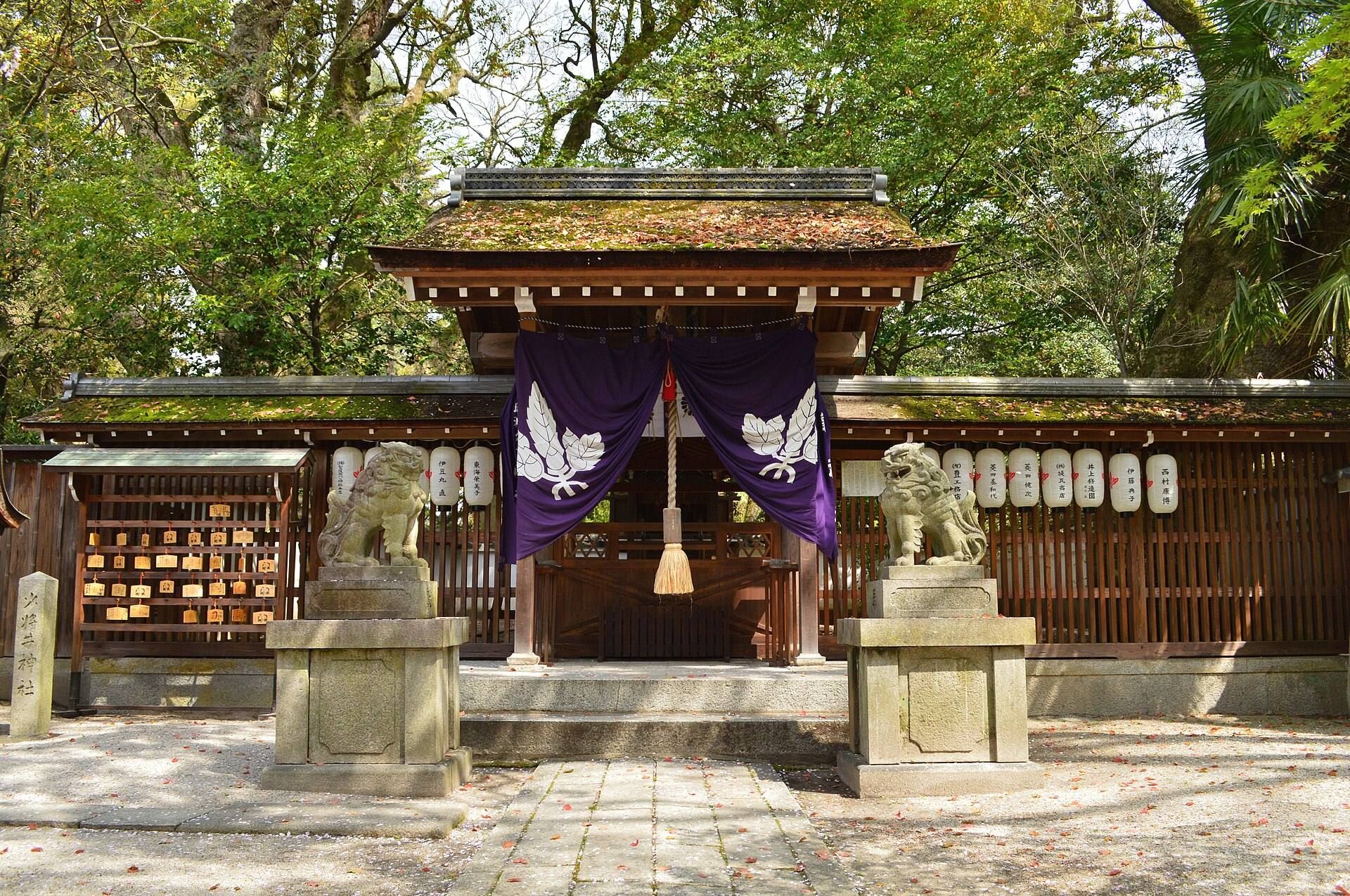
Munakata Shrine occupies the southwestern part of the Kyoto Imperial Garden and includes the main sanctuary, several subsidiary shrines, and a separate place of worship. Its buildings preserve several traditional shrine forms, particularly nagare-zukuri, a style with a curved gabled roof whose forward slope extends over the worship area. Cypress-bark roofing is used on the principal shrine and several associated buildings, while Kyoto Tourism Shrine has a copper-sheet roof.
Main sanctuary and associated worship
Principal shrine
The principal shrine is a one-bay nagare-zukuri building, meaning that its roof projects forward to shelter the worship space. It has a cypress-bark roof and was rebuilt during the Ansei era, from 1854 to 1860. The sanctuary enshrines Tagorihime-no-Mikoto, Tagitsuhime-no-Mikoto, and Ichikishimahime-no-Mikoto, together with Ukanomitama and the Heavenly Rock-Cave-opening deity as associated deities.
Hanei Inari Shrine
Hanei Inari Shrine enshrines Myobu Inari and is a one-bay nagare-zukuri building with a cypress-bark roof. It is traditionally described as the guardian shrine of Fujiwara no Mototsune, the adopted son of Fujiwara no Yoshifusa. Another tradition says that Mototsune rescued a fox from children who were beating it. After releasing the animal, he received a dream in which the fox promised to avert fire and other disasters if given a place to live. The fox was then assigned a place at Munakata Shrine as an attendant of the Munakata deity.
Shojo-i Shrine
Shojo-i Shrine enshrines Kushinada-hime. It was traditionally transferred from a former Yasaka Shrine otabisho, a temporary or subsidiary sacred place where a deity’s procession rests during a festival. The former site lay between the Shojo-i and Shojo-i Otabi districts in Nakagyo Ward. The shrine building uses nagare-misedana-zukuri, a related form with a shelf-like front instead of a conventional worship hall, and has a cypress-bark roof.
Kotohira Shrine
Kotohira Shrine enshrines Omononushi and Emperor Sutoku. It was established on October 10, 1806, when Kyogoku Takaatsu, lord of the Marugame domain in Sanuki, invited the deity of Kotohira Shrine. Its building follows the Kasuga-zukuri style, a compact form with a gabled roof and projecting front sanctuary, and is covered with cypress bark.
Hanayama Inari Shrine
Hanayama Inari Shrine stands in the southern part of the grounds beneath a large camphor tree. It enshrines Ukanomitama as the guardian deity of the Hanayamain family. The building is a one-bay nagare-zukuri structure with a cypress-bark roof.
Kyoto Tourism Shrine
Kyoto Tourism Shrine enshrines Sarutahiko Okami as a deity of guidance. Tourism operators founded it on November 1, 1969, to pray for visitors’ safety and well-being and for the development of the tourism industry. Its one-bay nagare-zukuri building has a copper-sheet roof.
Trees, memorial features, and ritual space
Camphor tree
The large camphor tree beside Hanayama Inari Shrine was reputed to be about 600 years old in 2010. It was regarded as the oldest camphor tree in the Kyoto Imperial Garden, and its position beside the subsidiary shrine forms part of the surviving character of the southern grounds.
Sakon cherry
The former Sakon cherry tree was transplanted to Munakata Shrine in 1936, when the Sakon cherry in front of the Shishinden of the Kyoto Imperial Palace was replaced. Its presence links the shrine grounds with the ceremonial landscape of the imperial palace.
Worship place and ritual offerings
In addition to its shrine buildings, the site includes a place of worship. The shields, spears, and saddle offered to the Heavenly Rock-Cave-opening deity on April 17, 865, remain part of the shrine’s recorded ritual history and express the importance once attached to that associated deity.