Kumano Nachi Taisha: A Shinto Shrine of the Kumano Sacred Mountains


Site at a Glance
- Rating
- 4.5
- Popularity
- Medium
- Country
- Japan
- Primary era
- Early Modern
- External website
- Open
- Eras represented
- Early Modern
- Civilizations
- Japanese
- Site type
- Religious
- Remains
- Sanctuary
On this page13 sections
History
Kumano Nachi Taisha is a Shinto shrine in Japan, located at Nachisan in Nachikatsuura, Wakayama Prefecture. It developed from the ancient worship of Nachi Waterfall and became one of the Kumano Sanzan, the three major sacred shrine complexes of the Kumano region. Together with Kumano Hongu Taisha and Kumano Hayatama Taisha, it formed a destination visited by medieval pilgrims as part of a single religious journey.
Origins in waterfall worship
The shrine’s precise foundation date is uncertain. One tradition attributes the establishment of the Twelve Kumano Gongen, Buddhist manifestations understood through Shinto sacred presences, to the ascetic Ragyo during the time of Emperor Koshō. Another places the foundation in the reign of Emperor Nintoku, while a further tradition dates the transfer of the shrine buildings to their present location to 317, described as the fifth year of Nintoku’s reign.
Nachi differed from the other two Kumano shrines because it began with the veneration of a natural feature rather than with an established shrine institution. Its earliest buildings stood in the area now occupied by Hiryū Shrine, directly before the waterfall. One tradition holds that Nachi Waterfall became sacred as a place of purification for pilgrims climbing Mount Myōhō, after which Fusumi-no-kami was enshrined there. A kami is a sacred or divine presence in Shinto.
The principal deity is Kumano Fusumi-no-Ōkami. One interpretation identifies this figure with Izanami, a major creator deity in Japanese mythology and the female counterpart of Izanagi. Other traditions identify the deity with Kotosaka-no-o-no-mikoto or Kumano Kusubi-no-mikoto. By the late Heian period, Nachi had joined the worship of the Twelve Kumano Gongen. Because the waterfall deity held a special position, the complex was also described as a shrine of Thirteen Gongen.
The Kumano pilgrimage in the Heian period
References from the tenth and eleventh centuries show the growing recognition of Fusumi-no-kami and the development of the Kumano Sanzan as a shared religious complex. Records of a pilgrimage led by Fujiwara Munetada in 1109 indicate that the shrine had already been transferred to its present location.
By the late Heian period, repeated pilgrimages brought retired emperors and other members of the imperial court to Kumano. Toba, Go-Shirakawa, and Go-Toba were among those associated with these journeys. Go-Toba visited Nachisan in 1201, and in 1212 twelve of the 190 koku of land granted from the Kumano Shingu estate were assigned to Nachi. A koku was a historical Japanese measure of land or agricultural yield conventionally based on rice production.
A combined shrine and temple institution
Nachi developed as a religious complex shaped by shinbutsu shūgō, the historical combination of Buddhist and Shinto beliefs, institutions, and rituals. Its neighboring Nyoirin-do, now Seigantoji Temple, formed part of this shared institution. In the medieval period, the complex was administered through the Kumano Sanzan inspectorate by a council that included the Nachi and Waterfall administrators, elders, and local officials.
The religious staff consisted not simply of shrine priests but of shrine-monks who also practiced mountain asceticism. This tradition, known as Shugendo, combines Buddhist, Shinto, and other religious practices associated with disciplined activity in the mountains. In the early modern period, the shrine-monks were organized into eastern and western groups, each led by a senior administrator. The wider organization included elders, lecturers, religious devotees, waterfall practitioners, ascetics, officials of the Nyoho religious center, and grain-store administrators.
Religious lodges run by the Shōshōin and Jippōin houses, together with other pilgrimage guides, accommodated travelers arriving through pilgrimage networks across Japan. Their role grew as income from estates declined during the Muromachi period. Mountain ascetics, religious women, holy men, and the Seven Principal Benefactor Institutions of Nachi led donation campaigns that supported repairs and new construction.
Fire, conflict, and reconstruction
The complex burned in 1223 and was rebuilt through the efforts of pilgrimage guides. In 1581, opposition by the shrine family and the pilgrimage-guide house Rō-no-bō to the strengthened authority of Horiuchi Ujiyoshi led to armed conflict. Horiuchi’s attack destroyed the main shrine buildings. The Nachi complex was then divided between opposing factions, and property formerly held by relatives of Rō-no-bō was later assigned to Jippōin.
In 1601, the shrine’s recorded estate amounted to more than 633 koku. That same year, Asano Yoshinaga, lord of the Kishu domain, granted Nachisan 300 koku from Ichinono and Futakō villages, now within Nachikatsuura. These grants formed part of the shrine’s early modern economic foundation.
Separation of Buddhism and Shinto
The Meiji government’s policy of separating Buddhism and Shinto ended Nachi’s former institutional unity with Seigantoji. Nyoirin-do was initially spared demolition because it served as the first station of the prominent Saigoku Thirty-Three-Temple pilgrimage, a Buddhist route linking thirty-three sacred sites in western Japan. It later became the independent Seigantoji Temple in 1874. The ascetic hall within the shrine precinct was demolished during the early Meiji separation; a successor, the Nachisan Gyōjadō of Kumano Shugendo, was rebuilt in the Seigantoji precinct in October 2023.
The shrine became a prefectural shrine called Nachi Jinja in 1873 and was later renamed Kumano Fusumi Jinja. In 1921 it became an imperial government-supported middle-ranking shrine. It was renamed Kumano Nachi Jinja in 1948, when it also entered the Association of Shinto Shrines’ designated shrine category, and took its present name in 1963.
Kumano Nachi Taisha and its precincts form part of the UNESCO World Heritage property Sacred Sites and Pilgrimage Routes in the Kii Mountain Range, inscribed in 2004. The shrine and the adjacent Seigantoji precinct are also included in the national historic site known as Kumano Sanzan.
Ritual traditions
The Nachi Fire Festival, also called the Fan Festival, takes place on July 14. Its principal ritual uses twelve large burning torches and twelve portable shrines, or mikoshi, some approximately six meters high and carried by men in white. The fire symbolically purifies the waterfall. The festival also includes the consecration of rice seedlings through Nachi Dengaku, which received designation as an Important Intangible Folk Cultural Property in 1976 and inscription on UNESCO’s Intangible Cultural Heritage list in 2012. The Nachi Fire Festival received national designation in 2015.
New Year observances center on the Kumano Goō talisman. At 3 a.m. on January 1, sacred water called “secret-place water” is drawn from beyond Nachi Waterfall. It is used for the first printing of the crow Goō sacred seal on January 2. On January 8, the Goō sacred-seal festival is held at Hiryū Shrine before the waterfall, and the printed talismans are distributed by the shrine office.
Remains
Approach and shrine precinct
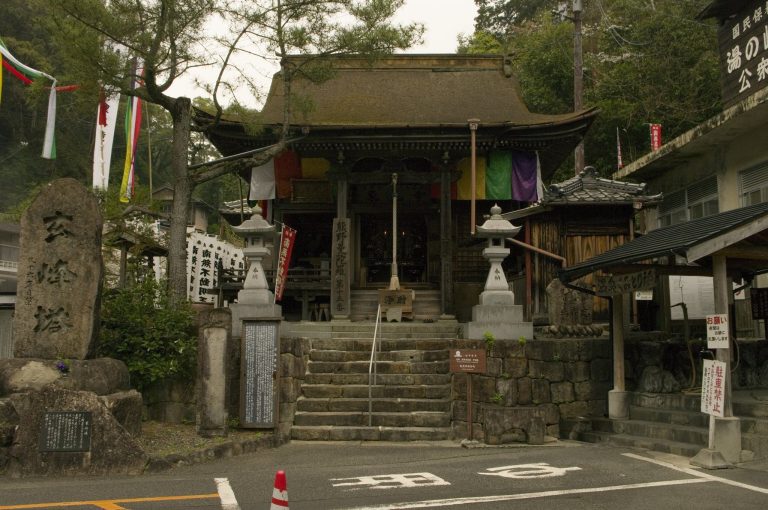
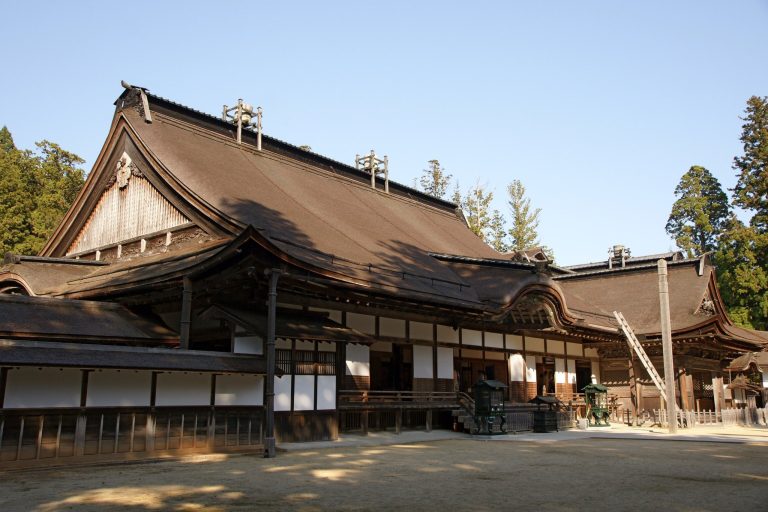
A long flight of stone steps leads to the precinct. Seigantoji Temple stands to the right of the approach, while a large vermilion torii, the gateway marking a Shinto sacred precinct, and the shrine grounds extend to the left. The worship hall stands before the main sanctuary. Behind it are the bell gate and sacred enclosure, followed by the principal sanctuary buildings arranged from right to left as Takimiya, Shōjōden, Naka-no-Gozen, Nishi-no-Gozen, and Wakamiya. The Sixth Hall, Hasshaden, stands to the left and slightly forward of Wakamiya.
Sanctuary buildings
The six sanctuary buildings serve thirteen kami. The First through Fifth Halls use gabled forms, while the Sixth Hall is an eight-bay building in the nagare-zukuri style, which has a sweeping asymmetrical gabled roof. Most of the buildings follow the Kasuga-zukuri tradition, a compact shrine form with a pronounced gabled roof and projecting entrance canopy. Their wooden elements are painted cinnabar red and their walls are whitewashed.
The sanctuary buildings stand in a row behind an enclosure. A covered gate before each building provides the approach for worship directed toward its corresponding deity. Nishi-no-Gozen, the Fourth Hall, is the largest of the principal halls. The buildings are associated with an early-modern rebuilding phase, although their precise construction date is uncertain, and they were repaired in 1935. The First through Sixth Halls, the Mikageta-hiko Shrine, and the Bell Gate with its sacred enclosure are Important Cultural Properties. The eight structures received that designation in 1995.
Waterfall and sacred landscape
Nachi Waterfall, known as the First Waterfall, descends 133 meters. With other waterfalls upstream, it forms the group called the Forty-Eight Waterfalls of Nachi, a landscape associated with the training of Kumano mountain ascetics. Hiryū Shrine stands before the waterfall, where the cascade is worshipped as a manifestation inhabited by Hiryū Gongen.
Cedar forest surrounds the shrine. An ancient sacred forest lies to its east, while Nachi Primeval Forest is designated as a nationally protected natural monument. Other valued natural features include the cedar avenue along the old Nachisan pilgrimage route, the large Hidehira cherry tree before the shrine office, a weeping cherry beside the main sanctuary enclosure, and a large mokkoku tree in the Jippōin garden.
Sacred Camphor Tree
The Sacred Camphor Tree stands between the worship hall and Seigantoji Temple. It is approximately 850 years old and is traditionally said to have been planted by Taira-no-Shigemori. A shimenawa, the sacred rope used to mark a consecrated object or space, and paper streamers identify the tree as sacred. Moss, ferns, and other plants grow on its trunk, whose base can be entered to reach a small offering altar.
Wider Nachi religious landscape
The lower Nachi coast contains Fudarakusanji Temple, associated with voyages to the Buddhist paradise of Fudaraku, and the Kumano Three-Gongen site at Nagusa Ōji. Historic locations connected with the wider precinct include the former mountain-top Fudō Hall, the site of a commemorative stupa for Emperor Kameyama, the former retreat of retired Emperor Kazan, the site of Tōfuke Ōji, and a medieval imperial lodging site. Together, these places preserve the range of religious and imperial associations that developed around Nachi.