Kurozuka Kofun: An Early Kofun-Period Keyhole Burial Mound in Japan


Site at a Glance
- Rating
- 4
- Popularity
- Low
- Country
- Japan
- Primary era
- Classical
- External website
- Open
- Eras represented
- Classical, Early Modern, Modern
- Civilizations
- Yamato
- Site type
- Burial
- Remains
- Burial Mound
On this page14 sections
History
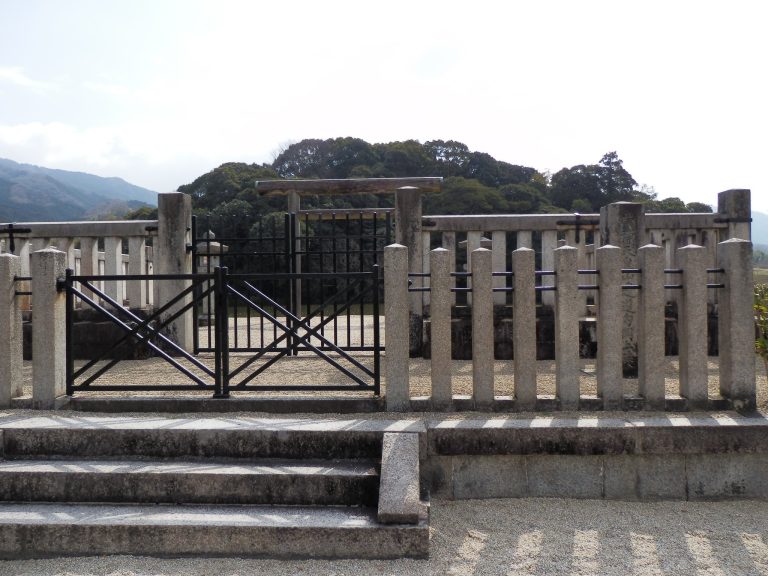
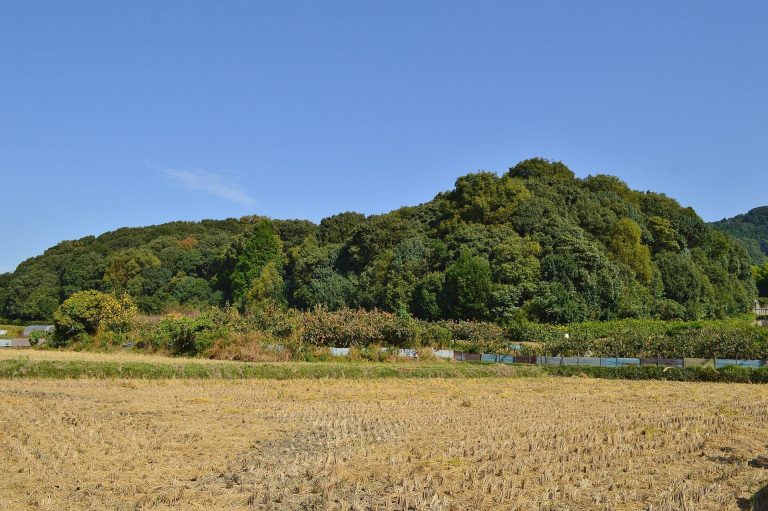
Kurozuka Kofun is a large keyhole-shaped burial mound in Tenri, Nara, Japan, constructed during the latter half of the third century in the first half of the Early Kofun period. It belongs to the Yanagimoto subgroup of the Oyamato Kofun Group and occupies a ridge-like east-west landform about 500 meters west of Andonyama Kofun, traditionally identified as the mausoleum of Emperor Sujin. The quantity and arrangement of its mirrors and iron objects make it an essential reference point for understanding early Kofun-period tombs.
Construction and Early Burial
The mound was built as a monumental tomb with a rectangular front section facing west and a circular rear section. Its central burial chamber was excavated in an almost unrobbed condition. Although an earthquake probably caused the upper structure to collapse during the Kamakura period, the fallen stones covered much of the chamber floor and protected the positions of the grave goods. The southern end was later disturbed by robbers, but approximately 90 percent of the floor retained its original arrangement.
This unusual preservation made it possible to examine how the burial equipment had been distributed around the coffin. The chamber is regarded as the only example in the Oyamato Kofun Group in which the complete structure of a nearly unrobbed burial facility has been identified. Its contents also clarified the possible ritual significance of the mirrors, weapons, armor, tools, and pottery placed with the deceased.
Medieval Fortification
In the medieval period, the area formed part of the Yanagimoto estate of Kofukuji Temple, a landed territory administered for the temple. The Yanagimoto clan managed the estate before conflict with the Tochi clan in the late fifteenth and early sixteenth centuries brought the area under Tochi control.
The Tochi clan is said to have established a fortification on or beside the mound in 1571, probably turning the kofun into an outwork, a supporting fortification for a larger stronghold, of Yanagimoto Castle. Matsunaga Kingo entered the fortification in 1575 and reportedly committed suicide at Kurozuka in 1577, when Oda Nobunaga’s campaign against the Matsunaga forces began. These changes introduced defensive earthworks and enclosures into the earlier burial landscape.
Domain Administration and Conservation
In 1615, Oda Naonaga became the first lord of the Yanagimoto domain. A Yanagimoto jinya, a domain administrative headquarters smaller than a full castle, was established during 1624 to 1644 and incorporated the kofun into its grounds. The mound was substantially reshaped for military and administrative purposes. Its moat was reused, while stone walls and enclosures were added. The jinya continued until the abolition of the domains in the Meiji period, and further earthworks modified the mound during the late Edo and Meiji periods.
Archaeological and survey work took place in five stages from 1961 onward. Investigations accompanied the development of a children’s park in 1961, mound surveying followed in 1981, and excavations near the mound foot accompanied bank-protection work in 1988 and 1989. Major academic excavations were conducted in 1997 and 1998 by the Kashihara Archaeological Institute and the Tenri City Board of Education.
The kofun precinct became a National Historic Site on January 29, 2001. On June 8, 2004, the excavated objects were designated collectively as a National Important Cultural Property. The group includes 34 bronze mirrors, 210 iron objects, three Haji ware vessels, and one associated wooden object. Conservation and development formed part of Yanagimoto Park in 2003 and 2004. A life-size reconstruction of the burial chamber and replica grave goods are displayed at the adjacent Tenri City Kurozuka Kofun Exhibition Hall, while the excavated objects are held by the Nara Prefectural Kashihara Archaeological Institute.
Remains
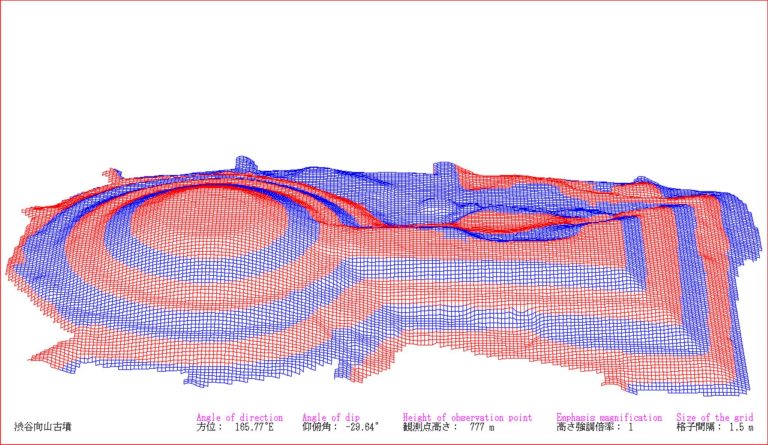
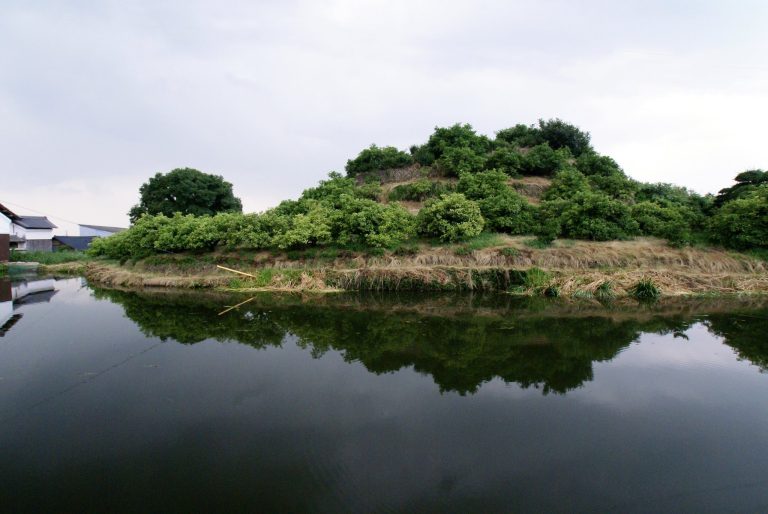
Kurozuka Kofun consists of a keyhole-shaped earth mound set on a ridge-like east-west landform, with valley terrain on its north and south sides. The mound is about 130 meters long, with an estimated restored length of 134 meters. The circular rear section measures about 72 meters across and 11 meters high, while the western front section is about 48 meters long and 6 meters high, with a slightly curved outline resembling a drumstick. The rear section has three construction tiers and the front section has two. Most of the structure is made from earth fill.
Mound and Fortifications
Burial Mound
The mound’s three-tiered rear section and two-tiered front section preserve the basic form of an early keyhole tomb. No haniwa, clay funerary objects commonly placed around or on burial mounds, have been identified, and no fukiishi, stone coverings or revetments applied to mound surfaces, are thought to have been used. Ponds surround three sides of the mound. Embankments at the front and rear sections are considered to date from the Edo period onward.
Later Defensive Works
Later fortification produced four stepped enclosures on the rear mound and three on the front. A large V-shaped ditch between the circular and rectangular sections measures about 6.7 meters wide and 3.4 meters deep, with another measurement giving its width as approximately 6.8 meters. A narrow curved enclosure wall surrounded the rear mound, and additional stone walls were constructed as part of the defensive alterations.
Burial Chamber and Coffin
A vertical stone burial chamber, a subterranean chamber entered from above rather than through a horizontal passage, was built at the center of the rear mound. Its north-south axis crosses the mound’s main east-west axis. The chamber is 8.20 meters long internally, between 0.89 and 1.22 meters wide, and 1.58 meters high at the southern end.
The chamber was formed inside a construction pit made while the mound was being built. The pit is estimated to have measured about 19 meters from north to south, 15 meters from east to west, and 4 meters deep. A cut-through working route led from the ridge saddle toward the rear mound, and a stone-lined underground drainage channel was also identified.
The lower approximately 50 centimeters of the chamber wall consists of three or four vertical courses of locally collected granite river stones, laid with their short ends facing outward. Above them, slabs from the southern foot of Mount Nijo, identified as Kasugayama and Shibayama stone, were set with pronounced inward corbelling. The roof has a gassho-shaped profile without clearly defined capstones. Stone slabs and clay covered the upper chamber.
A prepared clay coffin floor occupied the central area, measuring approximately 6.3 meters by between 0.7 and 0.85 meters, with spaces of about 0.5 to 1 meter at both ends. It supported a hollowed wooden coffin shaped like split bamboo. The coffin is reconstructed as about 6.09 meters long and between 0.92 and 1.01 meters in diameter. Its central section was painted with vermilion cinnabar, while bengala pigment was used elsewhere. The hollowed central portion measured about 2.7 meters long and 0.45 meters wide.
Wood fragments adhering to one mirror indicate that the coffin was probably made from a large tree of the mulberry genus rather than the koyamaki commonly used in other tombs of the Oyamato group. The human remains had disappeared. The northern end of the coffin is slightly higher, suggesting, though not proving, that the head was positioned to the north. Near this presumed head position stood a decorated-band divine-beast mirror, with its patterned face turned inward toward the south. One iron sword and one iron straight sword were also placed inside the coffin.
Mirrors and Ritual Objects
Bronze Mirrors
Thirty-four bronze mirrors were recovered. One decorated-band divine-beast mirror came from inside the coffin, while 33 triangular-rimmed divine-beast mirrors were placed outside it. The smaller inner mirror has a diameter of 13.5 centimeters. Its imagery includes the Chinese religious figures Boya, Xiwangmu, and Dongwanggong, along with cloud vehicles, running animals, and immortals. An inscription includes the phrase meaning “I made this bright mirror.” The mirror is thought to date from the late Eastern Han to the beginning of the Three Kingdoms period.
All 33 triangular-rimmed mirrors are regarded as imports from China. Fifteen, representing seven types, have matching mold or design relationships. Seventeen were found along the western side of the coffin, one at its northern end, and 15 along the eastern side. Together they formed a U-shaped arrangement around the northern half of the coffin. They were probably wrapped individually in cloth or placed in cloth bags, and may have fallen from the coffin lid onto the floor.
The mirrors depict Xiwangmu and Dongwanggong, prominent figures in ancient Chinese religious and Daoist imagery, together with divine animals. Most carry inscriptions, chiefly auspicious phrases. Some refer to copper from Xuzhou or production in Xuzhou, while one mentions a mirror craftsman from Luoyang. These references have been used in arguments that the mirrors were manufactured in Wei. The 33 mirrors represented about one-tenth of the known examples when the excavation took place, although only three new mirror types were identified.
Weapons and Associated Equipment
Most grave goods outside the coffin were concentrated along its eastern and western sides. The eastern group included 15 triangular-rimmed mirrors, swords, spears, Y-shaped iron objects, and organic objects. The western group contained 17 mirrors, swords, spears, pointed implements, and unidentified iron objects. These items were stacked in the spaces between the coffin and chamber walls and above the coffin lid. The swords were probably unsheathed and wrapped in cloth.
Outside the coffin, the weapons included three ring-pommeled swords, 16 straight swords, 13 spears, and two other swords. Together with one straight sword, one spear, and one sword inside the coffin, the assemblage included 34 edged weapons outside the coffin and additional weapons within it. Wooden handles survived on some of the outside swords. Several weapons had rusted together in clusters.
More than 270 iron arrowheads representing 13 types were recovered. Their forms include willow-leaf, fixed-angle, chisel-head, A-shaped short-stem, stemless willow-leaf, triangular, and notched willow-leaf varieties. The arrowheads occurred in 16 groups, generally in bundles of about ten or more, indicating that they had been stored in quivers or similar holders. No bow was identified. The assemblage is described as the largest known from an early kofun in Japan.
Armor and Ceremonial Objects
Armor and related fittings were concentrated at the southern end of the chamber, where looting makes their original positions and condition difficult to determine. The small iron plates number about 1,700 including fragments, or approximately 1,000 actual pieces, together with iron frame plates. Some can be reconstructed as a leather-laced lamellar helmet. The equipment is among the earliest known weapon and armor assemblages from a kofun and includes forms regarded as distinctive to the Japanese archipelago.
Two Y-shaped iron objects divide into two branches and were probably attached to wooden handles. They are interpreted as ceremonial equipment rather than practical tools. Another unusual object consists of large and small U-shaped iron frames joined by iron tubes in a sawtooth pattern. Cloth may have been stretched between the frames. Its function remains uncertain, although it may have served as a flag or banner.
Tools and Pottery
Agricultural and craft equipment from the southern end of the chamber included three iron sickles, ten axes, 12 knives, at least nine chisels or planing tools, and three sets of pointed implements. The axes comprised six large and four small examples. Four tweezer-shaped iron objects were also recovered wrapped in cloth, although their function is unknown.
Approximately 1,470 pottery fragments were recovered. The chamber contained two small jars and a bowl-shaped, low-footed tall cup, probably used during the burial ritual and assigned to the later phase of the Furu 0 type. A red-painted jar with a doubled rim came from the robbers’ pit and may originally have stood above the chamber or burial pit. Pottery within the burial-pit and mound fill probably came from settlements or artifact-bearing deposits that predated construction of the kofun.