Nishimotomezuka Kofun: An Early Kofun-Period Burial Mound in Japan


Site at a Glance
- Rating
- 3.4
- Popularity
- Very Low
- Country
- Japan
- Primary era
- Classical
- External website
- Open
- Eras represented
- Classical
- Civilizations
- Unclassified
- Site type
- Burial
- Remains
- Burial Mound
On this page11 sections
History
Nishimotomezuka Kofun is a burial mound in Kobe, Japan, built during the Kofun period, an ancient era associated with large elite tombs and regional political powers. Generally dated to the latter half of the third century, it is regarded as an important early example of a front-square-back-square mound, a form composed of two joined rectangular sections. Its scale and rich burial goods indicate the status of the person buried there, who may have been a local leader connected with water transport through the Seto Inland Sea and Osaka Bay.
Origins and regional connections
The mound was traditionally identified as a keyhole-shaped tomb, with a square front and rounded rear. Excavations carried out continuously from 1985 showed instead that its rear section was rectangular, placing Nishimotomezuka among the largest early mounds of the front-square-back-square type. Archaeologist Taichiro Shiraishi proposed that construction may have taken place soon after 250 CE. This early date was based on the presence of an older type of divine-beast mirror and the recovery of only the earliest two phases of triangular-rimmed mirrors.
The burial complex reflects connections extending well beyond the immediate area. Stone used for the burial chamber came from the local region as well as Awa Province, in present-day Tokushima Prefecture, and Kii Province, in present-day Wakayama Prefecture. Ritual pottery included examples associated with the San’in region, while no pottery produced locally was found. These materials point to close relationships with San’in, Shikoku, and the southern Kinai region. The occupant may therefore have belonged to a powerful local clan that retained some autonomy instead of being ruled directly by the central Yamato authority.
Excavation and interpretation
The fifth excavation, conducted between 1992 and 1993, brought the mound wider attention when eleven bronze mirrors were recovered, including seven triangular-rimmed divine-beast mirrors. Together with a mirror found during the first excavation, the total reached twelve. These mirrors carry divine and animal imagery around their rims. Two were found with evidence that they had been wrapped in cloth. Mirrors made from the same mold have also been found at Tsubaiotsukayama Kofun in Kyoto Prefecture, Ishizukayama Kofun in Fukuoka Prefecture, Samita Takarazuka Kofun in Nara Prefecture, and Nakaoda No. 1 Kofun in Hiroshima Prefecture.
The mound’s interpretation also changed as excavation clarified its form. Work in 2001 established that the front section opened outward in a splayed, club-like shape. One side of the junction between the front and rear sections had a projecting area, and the mound measured at least 98 meters in length. Its form is associated with powerful regional clans of the early Kofun period, giving the tomb a place in discussions of political organization before direct control by the Yamato authority had fully extended across the region.
Damage, preservation, and cultural memory
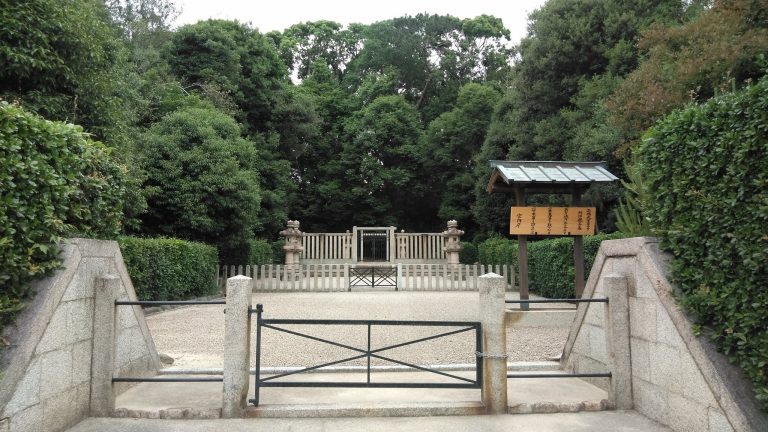
The burial chamber collapsed after natural disasters, particularly the Keicho-Fushimi Earthquake of 1596. A fault passed directly beneath the rear section, making the mound’s original form difficult to recognize. The land remained privately owned and was used as a residential property until 1964, when Kobe City purchased it and converted it into a park. It is now maintained as an archaeological park.
Nishimotomezuka Kofun was designated a National Historic Site of Japan on March 2, 2005. The excavated artifacts were collectively designated National Important Cultural Properties in the same year. In January 2009, an elementary-school child found a bronze-mirror fragment while playing in the park. After studying the Kofun period at school, the child submitted it for examination in 2013 through the school principal and Kobe City’s cultural-property authorities. The fragment was identified as part of Nishimotomezuka Kofun Mirror No. 1, donated to Kobe City, and shown at an exhibition that year at the Kobe City Archaeological Cultural Properties Center.
Nishimotomezuka Kofun is also linked with Otomezuka Kofun and Higashimotomezuka Kofun through the tragic Unai-otome legend recorded in the Man’yoshu and Yamato Monogatari. The three burial mounds stand in a broadly regular line along the coastline.
Remains
Nishimotomezuka Kofun occupies an alluvial fan, a fan-shaped deposit formed where a stream leaves higher ground for flatter land, between the southern foot of Mount Rokko and Osaka Bay. The mound stands at approximately 6 to 8 meters above sea level. Its principal axis runs east to west, and the surviving structure consists of two joined rectangular sections. The mound is approximately 98 meters long or slightly longer, with a rear section about 52 meters long and 50 meters wide, a front section about 46 meters long, and a junction about 25 meters wide. Its maximum height is approximately 9 meters.
Mound structure and burial chamber
Rectangular mound
The front section widens outward in a splayed form and has at least two stepped levels. Limited remains of fukiishi, stones laid over or around a mound to surface and protect its earthen slopes, were detected near the base. A projecting area extended from one side of the junction between the front and rear sections. These features define the mound’s unusual front-square-back-square plan, which differs from the more familiar keyhole-shaped form with a rounded rear.
Burial facility
At the summit of the rear section was a pit-type stone burial chamber with an auxiliary chamber. The main chamber measured approximately 5 meters in length and 85 centimeters in width. It contained a split-bamboo-shaped wooden coffin. The chamber later collapsed as a result of the fault and earthquake damage beneath the mound, affecting the preservation and recognition of the original structure.
Burial goods
Bronze mirrors and jasper objects
The main chamber contained bronze mirrors and spindle-shaped objects made of jasper. The complete excavated assemblage comprised twelve bronze mirrors, including seven triangular-rimmed divine-beast mirrors. Two of these retained evidence of cloth wrapping. A decorated-band ring-knob divine-beast mirror is also attributed to the mound as a purported find, although its precise excavation status is uncertain.
Iron objects from the auxiliary chamber
The auxiliary chamber held iron objects associated with weapons and equipment, including swords, daggers, arrowheads, axes, and fishing gear. The assemblage included 56 iron arrowheads and 26 iron swords. Together, these objects provide material evidence for the wealth and connections of the person buried within the mound. The surviving mound and its excavated contents are now incorporated into the archaeological park.