Tamashiki Shrine: A Shinto Shrine and Center of Regional Folk Tradition in Japan


Site at a Glance
- Rating
- 4.1
- Popularity
- Low
- Country
- Japan
- Primary era
- Early Modern
- External website
- Open
- Eras represented
- Early Modern
- Civilizations
- Tokugawa
- Site type
- Religious
- Remains
- Sanctuary
On this page13 sections
History
Tamashiki Shrine is a Shinto shrine in Kazo, Saitama, Japan, traditionally founded in 703 in the nagare-zukuri, or flowing-style, tradition of shrine architecture. The foundation is attributed to Tajihi no Mahito Miyakemaro, an official charged with pacifying the Tōsandō, an ancient administrative route and region through the mountainous interior of eastern and central Japan. Another tradition credits Etamohi no Mikoto, the provincial chieftain of Musashi, with establishing the shrine during the sixth year of Emperor Seimu’s reign.
Early Recognition and Destruction
The shrine was originally located north of its present site in Shono Village, now Shono in Kazo. It appears in the Engishiki, a tenth-century administrative and ritual compilation, as Tamashiki Shrine of Saitama District in Musashi Province. Its listing in the Engishiki Jinmyocho, the compilation’s register of officially recognized shrines, placed it among the small shrines of the period.
In 1574, fire destroyed the shrine buildings, earlier documents, and sacred treasures during Uesugi Kenshin’s military campaign in Musashi. Because of this loss, the shrine’s earlier history cannot be traced in detail. Its principal deity is Ōnamuchi no Mikoto, a Shinto deity associated with the formation and governance of the land and with the establishment of social order.
Relocation and Regional Religious Role
During the Edo period, the era of Tokugawa rule from 1603 to 1868, the shrine was rebuilt in Nekoya Village, now Nekoya in Kazo, in front of the main gate of Kisa Castle. It was moved again to its present location around 1627. Until the end of the Edo period, it was also known as Hisaizu Daimyojin and was revered as the chief guardian shrine of Saitama District.
Tamashiki Shrine is regarded as the principal shrine among the Hisaizu shrines distributed through the Moto-Arakawa River basin. Under the former shrine-ranking system, which administratively classified recognized shrines, it was later designated a prefectural shrine. Its religious influence also extends through seasonal community practices, including purification rites, prayers for harvests and household safety, and ceremonies for children’s health.
Rituals and Living Traditions
The nationally designated Tamashiki Shrine kagura, ritual music and dance offered in a Shinto setting, is performed in the shrine’s kagura hall during four annual festivals. These are the Early Spring Festival on February 1, the Spring Grand Festival on May 5, the Summer Festival on July 15, and the Annual Grand Festival on December 1. Parishioners from Shono traditionally transmitted the performance from father to son, while a preservation society now maintains it.
The Ouma Kuguri rite was once performed during measles epidemics to protect children, who passed beneath two horses. After measles ceased to be prevalent after the Second World War, the rite disappeared, but it was later revived as a prayer for children’s health and growth. From January through November, the shrine also conducts the Oshissama purification rite with a sacred treasure set consisting of a Sarutahiko mask, a sacred treasure, and a sword. Sarutahiko is associated with guidance and the protection of roads and boundaries. Communities borrow the set, place it before a local shrine, worship, and carry out a village procession for purification. The practice extends mainly through municipalities along the northeastern Moto-Arakawa basin and as far as Tamamura and Itakura in Gunma Prefecture.
The shrine conducts water-taking on the first day of every month. Since the early Edo period, its natural groundwater has been regarded as sacred water with medicinal efficacy. The shrine’s cultural and natural heritage has received several levels of protection. The kagura became an Important Intangible Folk Cultural Property nationally in 2008, while the embroidered image of the Thirty Guardian Deities received prefectural designation in 2019. The shrine wisteria was designated a prefectural Natural Monument in 2002, and municipal designations include the kagura hall and shrine documents, the shrine’s sangaku, the large votive tablet of the Kagura Association, and the shrine ginkgo tree.
Remains
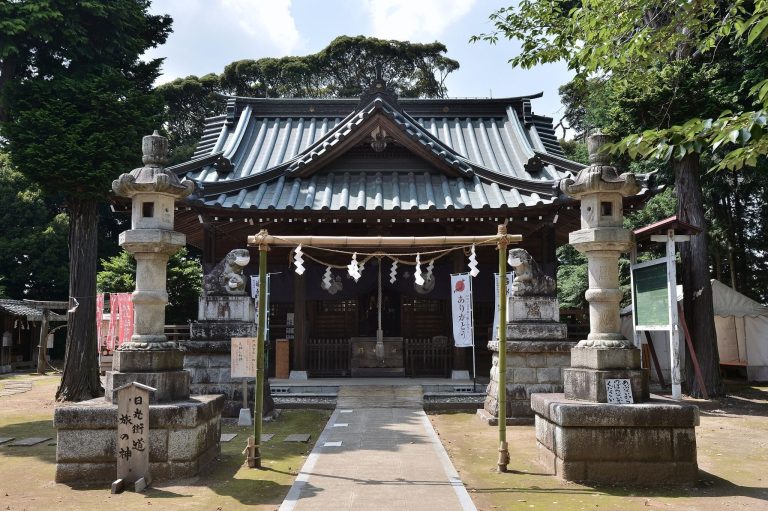
The surviving precinct includes the main sanctuary, the kagura hall, ritual objects, votive tablets, and protected trees. The sanctuary uses the nagare-zukuri form, whose defining feature is a strongly projecting, curved gabled roof over the front. The kagura hall stands to the left of the main sanctuary and remains associated with the shrine’s ritual performances.
Sanctuary and Ritual Features
Main Sanctuary
The main sanctuary is built in the nagare-zukuri style. Its projecting curved roof over the front gives the building its characteristic flowing profile and identifies it as the principal architectural focus of the precinct.
Kagura Hall
The kagura hall is positioned to the left of the main sanctuary. It serves as the setting for the shrine’s ritual performances, including the nationally designated Tamashiki Shrine kagura presented during the four annual festivals.
Sacred-Horse Statues
Two sacred-horse statues are associated with the Ouma Kuguri rite. One carries an inscription dated to a propitious day in March 1785, while the other was dedicated in 1881. Together, they preserve a material connection with the rite’s changing purpose as a prayer for children’s protection and well-being.
Votive Objects and Natural Features
Sangaku
The shrine’s sangaku, a mathematical tablet offered at a religious site, presents 15 geometry problems. Such tablets placed mathematical learning within the setting of religious offering.
Large Votive Tablet
The large votive tablet of the Kagura Association was dedicated in 1848. It measures 180 centimeters wide and 151 centimeters high, and depicts preparations for kagura, including the offering of food to the shrine. Its colors are described as having remained unfaded since the dedication.
Wisteria and Ginkgo
The shrine’s wisteria grows in the Tamashiki Shrine Garden, now Tamashiki Park, adjoining the eastern side of the precinct. Estimated to be about 400 years old, it was transplanted to its present location in 1933 and is said to have been donated by the Wakayama family of Tomuro. A ginkgo tree associated with Tamashiki Shrine is also preserved as a protected natural feature.