Yōkō-ji: A Sōtō Zen Monastery in Japan

Site at a Glance
- Rating
- 4.4
- Popularity
- Low
- Country
- Japan
- Primary era
- Medieval
- External website
- Open
- Eras represented
- Medieval
- Civilizations
- Ashikaga shogunate, Kamakura shogunate
- Site type
- Religious
- Remains
- Monastery
On this page12 sections
History
Yōkō-ji is a Sōtō Zen Buddhist monastery in Hakui, Japan, founded in 1312 during the medieval period. The Sōtō school emphasizes seated meditation, monastic discipline, and the continuity of religious transmission from teacher to disciple. Yōkō-ji became one of the principal centers of the lineage associated with Keizan Jōkin in the former province of Noto, now Ishikawa Prefecture.
Foundation under Keizan
The monastery was established on land at Sakai estate donated by Sonin, daughter of the local land steward Sakō Yorichika, and her husband, Shigeno Nobunao. They invited Keizan to create the institution. After Sonin’s brother, Sakō Yorimoto, died, his residence was converted into monastic buildings. This rebuilding took place in 1317, when Keizan became Yōkō-ji’s founding abbot. In the following year, he established a temporary monastic residence in the mountains.
Yōkō-ji’s independence was shaped by Keizan’s earlier experience at Daijō-ji. In 1311, he had appointed his disciple Meihō Sotetsu as abbot there, but the Togashi family later installed the Rinzai monk Kyōō Unryō and Meihō lost control of the monastery. Keizan therefore sought written guarantees for Yōkō-ji. Nobunao and Sonin promised not to interfere in its affairs, while Sonin and her descendants undertook to support Keizan’s religious lineage at the monastery.
Lineage and monastic administration
Keizan required Yōkō-ji’s abbots to be chosen exclusively from among his Dharma heirs. A Dharma heir was a disciple formally recognized as having received a teacher’s religious transmission and authority. The abbots were also to succeed one another according to seniority within that lineage. In 1319, Keizan and Sonin signed expanded regulations that committed Sonin and her descendants to supporting this succession. The resulting rotating-abbot system, known as rinjū, was later adopted throughout much of the Sōtō school.
During Keizan’s lifetime and that of his immediate disciples, Yōkō-ji was the principal monastery of the Gikai lineage. After Keizan died in 1325, its abbots included Meihō Sotetsu, Mugai Chikō, Gasan Jōseki, and Koan Shikan. Four of Keizan’s six principal disciples eventually held the abbacy, followed by Gasan’s disciples Mutei Ryōshō, Taigen Sōshin, and Mutō Esū.
The monastery’s organization developed around several related lineages. A property register from 1379 listed four subsidiary temples representing the Meihō, Mugai, Gasan, and Koan lines. Representatives of these groups jointly administered Yōkō-ji, and the abbots were selected in a predetermined order from the heads of the subsidiary temples. This arrangement broke down in the same year. The next ten abbots were disciples of Meihō Sotetsu, producing a schism that separated Yōkō-ji from the support of the other lineages. The precise cause and nature of the division remain uncertain.
Ritual foundations and patronage
In 1322, Keizan opened Enzū-in, a chapel dedicated to Kannon, the Buddhist bodhisattva associated with compassion, and allowed Sonin to use it as her private prayer chapel. Local patrons financed the Buddha Hall, bathhouse, latrines, and three principal Buddhist images. In return, the monastery performed prayers for the removal of bad karma, the future enlightenment of deceased relatives, and the fulfillment of patrons’ wishes. Keizan also introduced chanting ceremonies and lectures connected with donated meals.
In 1323, Keizan established the Five Masters Peak sanctuary as a mausoleum for his own remains and for relics associated with Sōtō patriarchs. Other Sōtō monasteries were expected to participate in its annual commemorative ceremonies and to contribute financially. The sanctuary strengthened Yōkō-ji’s role as a center for the remembrance and transmission of the Sōtō lineage.
Under Mugai Chikō, the Ashikaga shogunate, the military government that ruled Japan during much of the Muromachi period, sponsored a three-story pagoda. This patronage reflected the monastery’s high status and encouraged further donations. A new monks’ building and bathhouse were completed in 1338, connecting corridors in 1339, and a bell tower for a bronze bell in 1342.
Rivalry, destruction, and restoration
Yōkō-ji’s long rivalry with Sōji-ji intensified during the late medieval and Tokugawa periods. In 1378, a directive instructed monks of the Gasan lineage not to become abbots of Yōkō-ji unless they held senior status there, while declaring Sōji-ji the principal monastery of that lineage. Former Sōji-ji abbots later returned to serve at Yōkō-ji, but the rivalry continued. By 1415, Sōji-ji had become the most powerful monastery in the Sōtō school.
The Ōnin War, a fifteenth-century civil conflict that caused widespread destruction in Japan, contributed to the ruin of many religious institutions, and Yōkō-ji underwent reconstruction with imperial patronage after the war. The monastery was nearly destroyed by fire during warfare in 1579. The Founder’s Hall and Five Masters Peak survived, and Maeda Toshiie sponsored reconstruction in 1582. The remaining monastic complex was rebuilt during the Edo period.
During the Meiji period, Sōji-ji secured dominance over Eihei-ji, and Yōkō-ji became so impoverished that its few remaining monks reportedly sold temple buildings to obtain food. In the nineteenth century, the abbot Kohō Hakugun restored the monastery through his efforts. Yōkō-ji is formally known as Tōkoku-san Yōkō Zen Temple. It is also associated with the Noto Kannon pilgrimage as its thirteenth station and with the Hokuriku Thirty-Three Kannon pilgrimage as station twenty-two. Its nationally designated Important Cultural Property material and prefecturally designated cultural properties include Keizan’s written regulations, wooden seated statues of major Sōtō figures, and 251 temple documents and books.
Remains
Monastic complex
Main complex
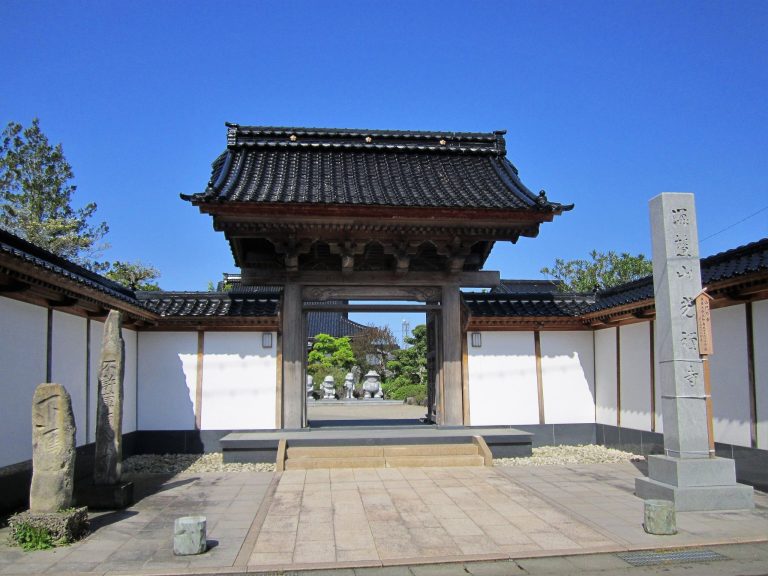
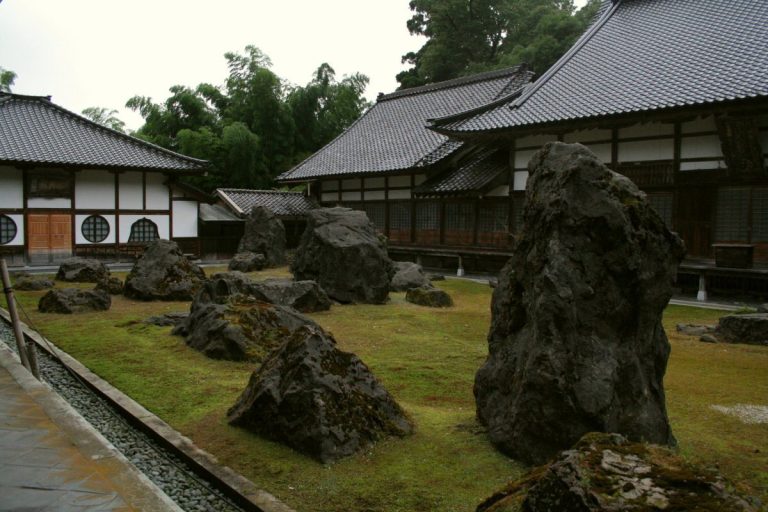
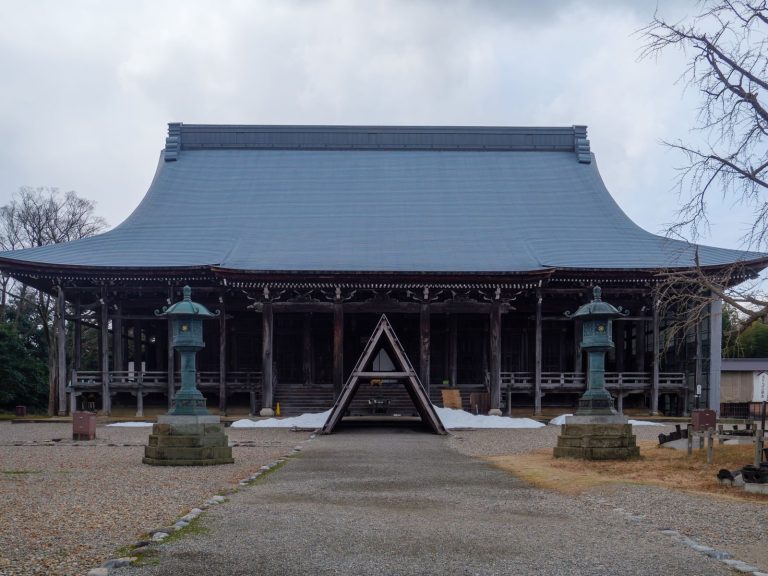
Yōkō-ji’s traditional plan uses wood, brick, and stone. After the main gate, the Dharma Hall, which serves as the main hall, stands directly ahead. The monastic kitchen and residence and the study occupy the right side, while the monks’ hall, monks’ quarters, and bell tower occupy the left. Corridors join the buildings. The layout developed around 1323, and the main hall, known as Fūkō Hall, was completed around 1324.
The medieval complex included a three-story pagoda, Buddha Hall, bathhouse, latrines, monks’ building, connecting corridors, and a bell tower containing a bronze bell. Most surviving buildings are Edo-period reconstructions, while the Founder’s Hall and Five Masters Peak are identified as survivors of the late-sixteenth-century destruction.
Founder’s Hall and Five Masters Peak
Behind the main hall stands Dentō-in, the Founder’s Hall, a temple building dedicated to the founder and lineage ancestors. Five wooden images are enshrined there: Tiantong Rujing, Dōgen, Koun Ejō, Tettsū Gikai, and Keizan Jōkin. Tiantong Rujing was a Chinese Chan Buddhist master associated with the transmission of Zen teachings to Japan. Dōgen founded the Japanese Sōtō school, while Koun Ejō and Tettsū Gikai were early leaders in its transmission lineage.
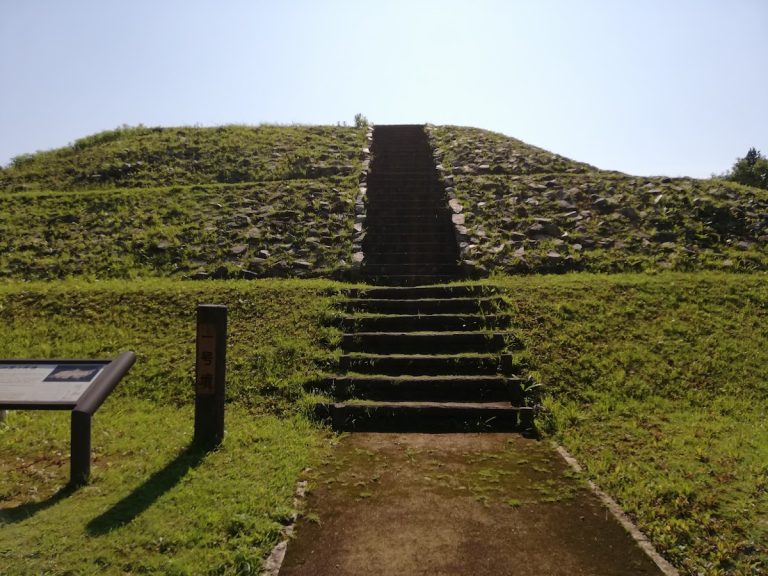
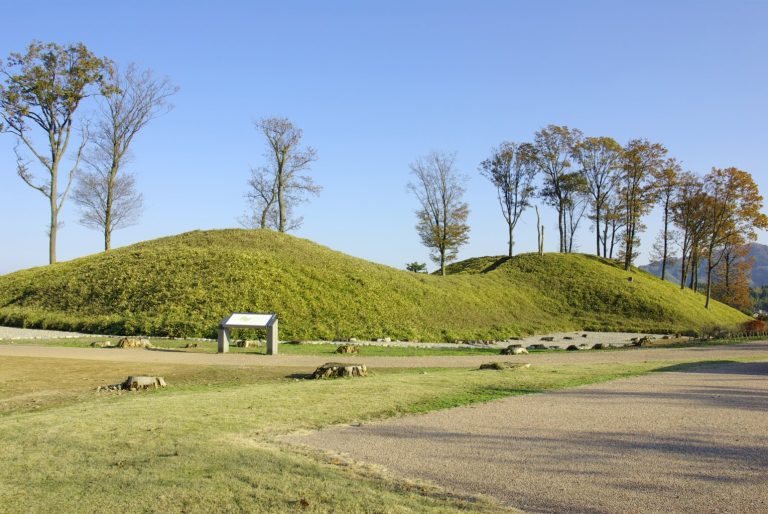
Beyond Dentō-in is the burial mound called Five Masters Peak, or Gorōhō. It contains personal belongings and other relics associated with the five patriarchs represented in the Founder’s Hall. The sanctuary’s relic collection includes a written record of Tiantong Rujing’s sayings, part of one of Dōgen’s bones, a sutra copied in blood by Koun Ejō, pieces of Tettsū Gikai’s bones, a succession certificate from the Daruma school, and Chinese cremation relics known as śarīra.
Documents and artworks
Keizan’s regulations
Keizan’s nationally designated written regulations comprise six documents bearing his wooden seal. They include the “Regulations for All Future Time” from 1319, a boundary and fields register from 1321, two registers of documents and donated land from 1323, regulations protecting mountain pines from 1325, and regulations governing future monastic observances, also from 1325.
Books and portraits
The monastery preserves or is associated with a twelve-volume version of Shōbōgenzō and a record of Tiantong Rujing’s sayings. Two ink-and-light-color portraits painted by Kawanabe Kyōsai in 1886 depict Yamaoka Tesshū and Ka Reishū.