Shōin-ji Temple: A Rinzai Buddhist Temple Associated with Hakuin Ekaku


Site at a Glance
- Rating
- 4.2
- Popularity
- Very Low
- Country
- Japan
- Primary era
- Early Modern
- External website
- Open
- Eras represented
- Early Modern
- Civilizations
- Tokugawa
- Site type
- Religious
- Remains
- Monastery
On this page13 sections
History
Shōin-ji Temple is a Rinzai Buddhist temple in Japan, located in Hara, Numazu, Shizuoka Prefecture. Traditionally founded in 1279 by the monk Tenshō Seidō, it developed within the Zen tradition associated with Kamakura’s Engaku-ji and later became closely linked with Hakuin Ekaku. Rinzai is a major Japanese school of Zen Buddhism centered on disciplined meditation, teacher-student training, and koan practice. Historically, Shōin-ji stood in the eastern district of Hara-juku on the Tōkaidō road. Its formal name is Hakuin-shū Daihonzan Kokurin-zan Shōin-ji, and its principal image is Shakyamuni Buddha.
Foundation and Tokugawa Reorganization
The temple was traditionally established by Tenshō Seidō in 1279, within the lineage of Mugaku Sogen of Engaku-ji. It later declined, but its fortunes changed after Tokugawa Ieyasu established the political order that unified Japan. In 1615, the government tightened its control over Buddhist institutions, and local Zen temples were organized within the Myōshin-ji network. Myōshin-ji, one of the principal centers of the Rinzai school, historically supervised a broad network of affiliated temples.
In 1624, Daisui Sōiku of Daishō-ji in Numazu revived Shōin-ji. The new hierarchy placed Kyoto’s Myōshin-ji at its head and Okitsu’s Seiken-ji in a middle-ranking position. On October 17, 1649, Tokugawa Iemitsu, the third Tokugawa shogun, granted Shōin-ji an official vermilion-seal charter. This document recognized the temple as the Zen temple of Hara-juku and assigned it an income of fourteen koku, six to, and five shō.
Hakuin and the Temple’s Wider Reputation
Hakuin Ekaku was born into the merchant Nagasawa family in Hara and entered Shōin-ji in 1699, when he was fifteen. Under the temple’s third abbot, Tanrei, he received the monastic name Ekaku. After years of study and practice elsewhere in Japan, he returned to Hara at the end of 1716 at the request of the temple’s parishioners and his family. He entered Shōin-ji in January 1717 and formally became its fifth abbot in 1718.
Hakuin’s teaching made Shōin-ji nationally renowned. Several hundred disciples gathered around him, and the temple was enlarged in stages because its buildings could not accommodate everyone seeking his instruction. His presence also gave Shōin-ji a lasting connection with the Myōshin-ji Dharma lineage, the chain of Zen transmission through recognized teachers.
Tōrei En’i arrived at Shōin-ji in 1743 and became one of Hakuin’s principal disciples. Hakuin recognized him as his Dharma heir in 1759. Tōrei helped preserve and systematize the intellectual standards of Hakuin’s Zen teaching. On Tōrei’s recommendation, another disciple, Suiō Genro, became abbot. Suiō was a monk and painter, although he did not possess the qualities then commonly expected of a Zen master.
Hakuin died at Shōin-ji in 1768 at the age of eighty-four. After his cremation, his remains were divided among memorial tombs at Shōin-ji, Ryūtaku-ji in Mishima, and the former Muryō-ji site in Hina, Fuji. The temple’s close association with him gave it the familiar name “Hakuin-san.”
Later Institutional History
During the Taishō period, Yamamoto Genpō served as abbot of Shōin-ji while working to revive the Hakuin-associated Ryūtaku-ji in Mishima. During the tenure of his disciple Nakajima Genshō, Shōin-ji became independent of the Myōshin-ji branch and adopted the designation Hakuin-shū for its independent institution. The current abbot is Miyamoto Enmei.
Shōin-ji’s founder’s hall and gate are recognized as cultural properties, and the temple is associated with designated book, painting, historic-site, and sculptural cultural properties. The gate was nationally registered as a tangible cultural property in 2016. Hakuin’s tomb is a prefecturally designated historic site, while his seated wooden statue is a cultural property of Numazu.
Remains
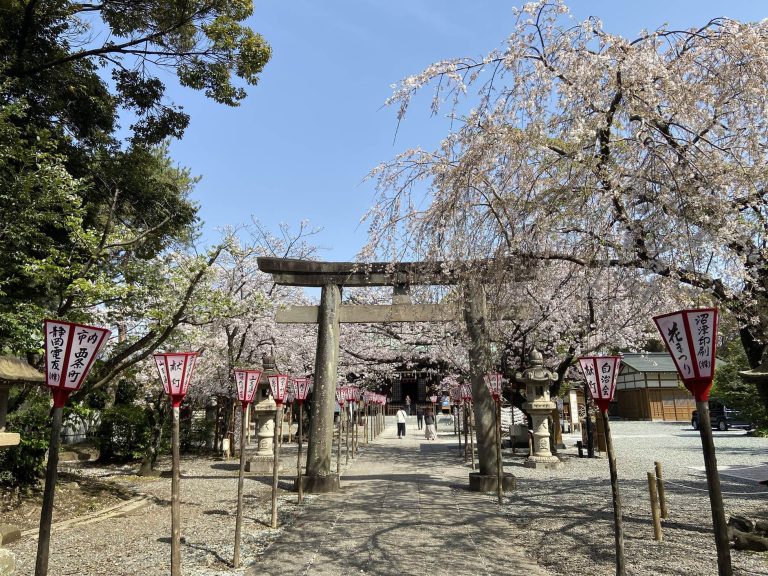
Shōin-ji’s surviving complex includes a wooden entrance gate, the founder’s hall, a main hall, a cemetery behind the main hall, and objects connected with Hakuin’s teaching and memory. These features preserve both the temple’s institutional history and its association with the eighteenth-century Rinzai master.
Gate and Founder’s Hall
Sanmon
The Sanmon is a single-story wooden gate with a gabled form and a stone-tile roof. Each roof surface carries three courses of eighteen tiles. The tiles are approximately 30 centimeters wide and 1 meter long, producing 54 tiles on each surface and 108 across both sides of the roof. Tradition attributed the roofing design to Hakuin, but later investigation placed the gate’s construction in the Edo-period Bunsei era. Its form is regarded as exceptional in the local area.
Kaizandō
The Kaizandō, or founder’s hall, is a designated cultural property and a named part of the temple complex. Its function is commemorative: a Kaizandō is a hall dedicated to a temple’s founder or principal founding figure.
Memorial Features and Hakuin-Related Objects
Cemetery and Tombs
Behind the main hall, the cemetery contains three unseamed stupas, bell-shaped Buddhist funerary monuments without horizontal joints. The stupa on the left is Hakuin’s tomb. Damage caused in part by typhoons that brought down pine trees led to repairs and the reinterment of the remains. Tombstones of former abbots and itinerant monks surround the tomb. Hakuin’s divided remains are also commemorated at Ryūtaku-ji in Mishima and at the former Muryō-ji site, now Takekago Park, in Fuji.
Books and Paintings
The temple holds an eight-volume, ten-book edition of the Lotus Sutra printed in 1690 and translated by Hakuin. It also preserves one of Hakuin’s self-portraits. Hakuin originally painted two self-portraits for his senior disciple Tōrei when Tōrei moved to the position of First Seat at Myōshin-ji, a senior monastic office. One portrait was destroyed by fire in 1776. Tōrei later found the surviving portrait and transmitted its provenance to Shōin-ji.
Seated Statue of Hakuin
A wooden seated statue of Hakuin was made in 1769, shortly after his death, and represents him in old age. It measures 104 centimeters in overall height and 66 centimeters in seated height. The statue was carved from cypress using joined-block construction, then finished with polychromy and inlaid crystal eyes. Its large, forcefully open eyes are a defining feature.
Hakuin’s Suribachi Pine
The grounds formerly contained a black pine known as Hakuin’s Suribachi Pine. Tradition connected the tree with Lord Ikeda Tsugumasa of Okayama, who visited Hakuin while traveling down the Tōkaidō after completing his alternate-attendance journey. When Tsugumasa asked what gift Hakuin wanted, Hakuin requested a large broken mortar. Tsugumasa supplied one in Bizen ware, and Hakuin placed it over a wound where a storm-damaged branch had broken. Pine resin fixed the mortar to the branch as the tree grew, turning it into a local landmark.
In 1985, the original Bizen-ware mortar was replaced with one made in Shimizu ware to commemorate the 300th anniversary of Hakuin’s birth. The pine died and posed a danger of collapse, so it was cut down on September 13, 2010.