Narita-san: A Shingon Buddhist Temple and Center of Fudō Worship


Site at a Glance
- Rating
- 4.5
- Popularity
- High
- Country
- Japan
- Primary era
- Modern
- External website
- Open
- Eras represented
- Early Modern, Modern
- Civilizations
- Japanese, Tokugawa
- Site type
- Religious
- Remains
- Temple
On this page27 sections
History
Narita-san is a Shingon Buddhist temple in Narita, Japan, traditionally founded in 940 during the Heian period after the suppression of Taira no Masakado’s revolt in the Kantō region. Its formal name is Narita-san Kongō-ō-in Jingō Shinshō-ji, and it is also known as Narita Fudō. The temple is one of the head temples of the Chisan branch of New Shingon and a major center of worship of Fudō Myōō, a Buddhist Wisdom King associated with immovability and the destruction of spiritual obstacles.
Foundation and the Fudō Image
The temple’s foundation is linked by tradition to Emperor Suzaku’s campaign of prayers for the defeat of Taira no Masakado, a powerful warrior and provincial leader whose rebellion in the Kantō was suppressed in 940. The Shingon priest Kanchō Daisōjō brought an image of Fudō Myōō from the Goma Hall of Takao-san Jingo-ji in Kyoto. Fudō Myōō is commonly shown with a sword, a rope, and flames, and at Narita-san he remains the central deity of Goma, a Shingon fire ritual in which offerings are placed into a sacred fire while prayers and ritual formulas are recited.
Kanchō is said to have reached the region by sea through Naniwa-tsu and landed at Otare Beach in Kazusa Province. At Kōzuga-hara, he performed a 21-day Goma fire ritual. Soon afterward, Masakado was defeated. Tradition holds that the Fudō image became immovable when Kanchō tried to carry it back to Kyoto. Emperor Suzaku then ordered a temple to be built at the site, granted it the name Jingō Shinshō-ji, and established it as a place dedicated to protecting eastern Japan.
Another tradition says that Emperor Suzaku gave Kanchō the sacred sword Ama-no-Kuni Hōken. The temple’s connection with Masakado’s defeat has also shaped later religious practice. Some people associated with Masakado’s cult, including followers of Kanda Myōjin and Tsukudo Shrine in Tokyo, have traditionally avoided visiting Narita-san.
The principal image is traditionally identified as the Fudō brought by Kanchō and attributed to Kūkai, also known as Kōbō Daishi, the ninth-century founder of Japanese Shingon Buddhism. Art historians date the present image no earlier than the thirteenth century. The image, together with its two attendants, is now an Important Cultural Property of Japan, a high-level national designation for culturally significant buildings, works of art, and other heritage resources.
Warrior Patronage and the Sengoku Period
Narita-san later attracted the devotion of influential Kantō warriors, including Minamoto no Yoriyoshi, Minamoto no Yoritomo, and Chiba Tsunetane. Minamoto no Yoriyoshi is recorded as having rebuilt the main hall in 1063. These associations connected the temple with the religious life and political influence of powerful military families in eastern Japan.
A major change came around 1566, during the Sengoku period, an era of prolonged warfare among competing military powers. The principal image was reportedly carried to the vicinity of Fudōzuka in present-day Namiki, Narita, by the headman representing the 17 households of Narita village. A temple complex gradually developed there, and the area is regarded as the birthplace of Narita-san. Warfare caused the temple to decline, leaving it as a neglected provincial institution until the Edo period.
Edo-Period Revival and Pilgrimage
Tokugawa Ieyasu’s establishment of the political capital at Edo in 1603 changed Narita-san’s position. The Edo period was the era of Tokugawa rule, and the temple’s proximity to Edo helped transform it from a provincial temple into a major pilgrimage center. Narita-san became associated with protection of Edo’s northeastern approach, although substantial shogunal support began with the reconstruction of its main hall under the fourth shogun, Tokugawa Ietsuna, in 1655.
The temple received patronage from the Tokugawa shogunate and from Tokugawa Mitsukuni, lord of the Mito domain. Its buildings were rebuilt and improved, while pilgrimage brought increased religious and economic activity to the surrounding temple-town district. The first recorded traveling display of its sacred images took place at Eitaiji in Fukagawa in 1703. Twelve such displays were held during the Edo period, almost all at Eitaiji, allowing the temple’s religious presence to reach worshippers beyond Narita.
Popular devotion grew especially through the influence of Ichikawa Danjūrō I, a leading kabuki actor of the late seventeenth and early eighteenth centuries. After praying at Narita-san for a child and receiving a son, the later Ichikawa Danjūrō II, he performed works centered on Fudō Myōō and adopted the theatrical house name Naritaya. His performances and personal devotion helped stimulate pilgrimages, donations, new construction, and the expansion of the district around the temple.
Institutional Development and Modern History
Narita-san’s institutional position changed during the early eighteenth century. It left the Eitaiji branch in 1706 and entered the branch network of Daikakuji in 1707, where it was elevated as a center for doctrinal study. In 1946, it became a head temple within the Chisan branch of New Shingon. The temple now has 71 branch temples, subordinate temples, and related churches across Japan. Among its best-known branch institutions are Fukagawa Fudōdō in Tokyo, Kawagoe Betsuin Hongyō-in, Nagoya Betsuin Daishō-ji, and Osaka Betsuin Myōō-in.
Narita-san also became associated with the protective amulet known as the Substitute Amulet. A tradition linked to construction of the Niōmon says that a carpenter named Tatsugorō fell from a high scaffold but escaped injury when the temple amulet split in two in his place. The story helped shape the amulet’s association with protection from physical danger.
During the Sino-Japanese War and later conflicts, soldiers widely wore the Substitute Amulet as protection from bullets. From 1933 to 1941, soldiers of the 57th Infantry Regiment and imperial guards repeatedly visited Narita-san to pray for military success and wore the amulets. The temple’s eighteenth head priest, Araki, founded an association in 1928 to promote what he regarded as traditional Japanese thought. In 1938, the temple donated aircraft to the army and navy, named for Narita-san, and in 1943 it donated 1,000 trees cut from the Okunoin precinct for naval shipbuilding. The Navy Hydrographic Department occupied the association’s hall, now the Reikōkan, from 1944.
The temple brought forward its 1,000th-anniversary celebrations from 1940 to 1938. This avoided competition with national ceremonies planned for the 2,600th anniversary of the traditional founding of Japan and the resulting shortage of donations. Later anniversary celebrations took place in 1988, 2008, and 2018, marking the 1,050th, 1,070th, and 1,080th anniversaries.
The main wooden image of Fudō Myōō and its two attendants received designation as an Important Cultural Property of Japan in 1964. Narita-san became a component cultural property of a Japan Heritage designation in 2016, while its principal historic buildings also have national or municipal cultural-property protection.
Narita-san continues to serve as a center for Buddhist prayer and Goma rituals. Its religious calendar includes the Gion Festival, during which the Ama-no-Kuni Hōken is used in a purification ceremony, and the Setsubun bean-throwing ceremony. At Setsubun, the customary cry is “Fortune in!” rather than “Demons out!” because even demons are believed to reform before Fudō Myōō. Narita-san Park has held an annual Plum Festival since the mid-1950s.
Remains
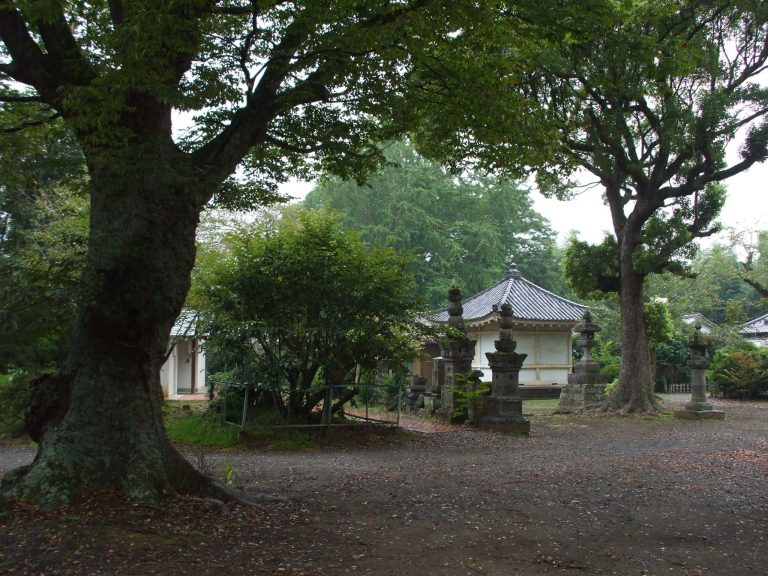
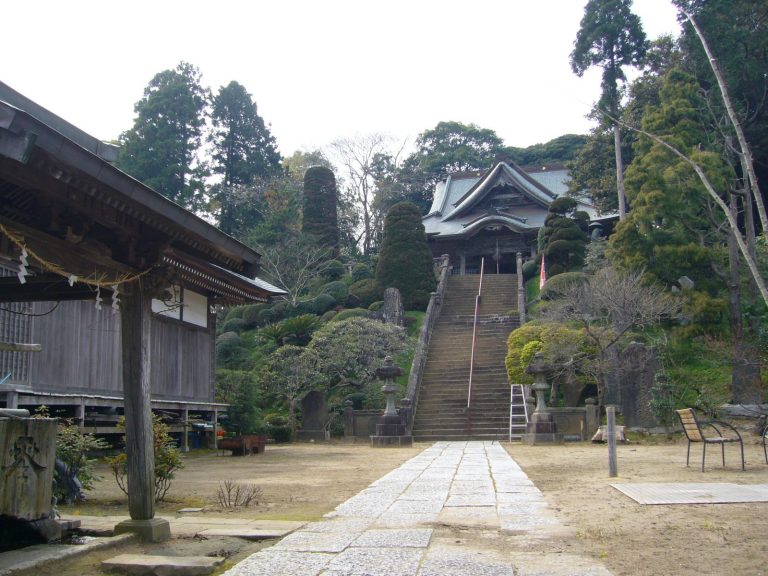
Narita-san occupies a large precinct reached through a pilgrimage avenue and temple-town district from the Narita and Keisei Narita station areas. A steep stone staircase leads to a plateau where the Great Main Hall forms the central focus. The Niōmon stands on the approach, while the three-storied pagoda, bell tower, and Issaikyōzō are positioned near the hall. The Shaka-dō lies to the hall’s left, and the Gaku-dō, Sanja, Kōmyō-dō, Seiryū Gongen-dō, Kaizan-dō, and Great Pagoda occupy higher ground behind it. The buildings represent successive phases of rebuilding, religious expansion, and modern construction.
Entrance and Central Buildings
Main Gate
The present Main Gate was constructed as part of the 1,070th-anniversary project. Construction finished in 2006, and its formal completion ceremony took place on November 28, 2007. Built entirely of zelkova, the gate is approximately 15 meters high, 14.2 meters wide across the front, and 6.3 meters deep. Eight wooden Buddhist images are housed within it, including figures of Fudō Myōō, Senju Kannon, and Dainichi Nyorai.
Niōmon
The Niōmon stands midway up the approach staircase. Built in 1830, it is a hip-and-gable, eight-legged gate and an Important Cultural Property. Its position makes it a principal architectural threshold between the approach and the upper precinct.
Great Main Hall
The Great Main Hall was built in 1968, replacing the Shaka-dō as the principal hall. It is a reinforced-concrete, hip-and-gable building with a double roof. The structure measures 95.4 meters across, 59.9 meters in depth, and 32.6 meters to the ridge. It houses the principal image of Fudō Myōō, whose special displays occur on designated occasions.
Kōrin-kaku
Kōrin-kaku is a reinforced-concrete building completed in 1975 near the entrance, to the left of the Niōmon. It provides facilities for applications for Goma prayers and for serving vegetarian meals to worshippers.
Historic Halls and Religious Structures
Three-Storied Pagoda
The three-storied pagoda was built in 1712 and rises approximately 25 meters to the right of the Great Main Hall. Its eaves use carved boards with cloud patterns instead of ordinary rafters. The first story has central doors and carvings of the Sixteen Arhats between the supporting pillars. Pillars, lintels, penetrating tie beams, and other structural members also carry decorative pattern carving.
Shaka-dō
The Shaka-dō is the former main hall, built in 1858. It is a hip-and-gable Buddhist hall slightly larger than the Kōmyō-dō and has a small triangular gable on the front of its roof. Relief carvings of the Twenty-Four Paragons of Filial Piety and the Five Hundred Arhats decorate its exterior.
Gaku-dō
The Gaku-dō is the second Votive Tablet Hall, built in 1861. It is an open-sided, hip-and-gable structure measuring three bays across the front, six bays across the rear, and two bays in depth. The hall was built to display large framed votive paintings, and its rear was originally enclosed by a plank wall. Repairs in 2015 and 2016 improved its safety after the 2011 earthquake raised concern that the paintings could fall during aftershocks.
Kōmyō-dō
The Kōmyō-dō, built in 1701, is a hip-and-gable former main hall beyond the Gaku-dō. It enshrines Aizen Myōō, Fudō Myōō, and Dainichi Nyorai. The building served as the main hall before the Shaka-dō and is an Important Cultural Property.
Issaikyōzō
The Issaikyōzō stands in front of the three-storied pagoda. Built in 1722, it is a square, three-bay structure with a pyramidal roof. Inside is a revolving sutra repository containing the Issaikyō Buddhist canon. The formal cultural-property name is Issaikyōzō rather than Issaikyōdō.
Okunoin
The Okunoin is a cave behind the Kōmyō-dō containing an image of Dainichi Nyorai, regarded as the underlying Buddha form of the temple’s principal Fudō deity. The cave is normally closed and opens during the Gion Festival and on certain other occasions.
Rear Precinct and Park
Great Pagoda
The Great Pagoda, also called the Pagoda of Peace, was built in 1984 at the rear of the precinct. This reinforced-concrete, pagoda-shaped building is 58.1 meters high. Its exterior appears to have two stories, while its interior contains five floors. The first floor, the Reikōden, includes the entrance, a sutra-copying hall, and displayed cultural properties. The second-floor Myōōden houses large images of the Five Wisdom Kings and paintings including the Shōwa Mandala.
Repositories on the third and fourth floors contain numerous small Fudō images donated by worshippers. The fifth-floor Kongōden houses the Five Wisdom Tathagatas. A time capsule containing peace messages from heads of state was buried beneath the building in 1984 and is scheduled to be reopened in 2434.
Narita-san Park
Narita-san Park occupies the eastern side of the precinct. Centered on ponds, it covers approximately 165,000 square meters and is used for viewing plum blossoms and autumn foliage. Its landscaped spaces form a substantial eastern extension of the temple grounds.
Detached Precincts and Later Buildings
Yakushi-dō
Yakushi-dō stands in a detached precinct near the route from Narita Station toward the temple. Built in 1655 as the former main hall, it was moved to its present location in 1855. It is the oldest surviving temple building at Narita-san, although little of its original structural timber remains. The building underwent two years of conservation and restoration from 2011.
Prince Shōtoku Hall
A hall dedicated to Prince Shōtoku was erected in 1992. A separate hall beside the Great Pagoda was completed on November 28, 2017, as part of the 1,080th-anniversary project. Built of zelkova with traditional roof tiles, it received images of Yakushi Nyorai and the Twelve Heavenly Generals. The hall is used for prayers for health, longevity, and recovery from illness.
Yudonosan Precinct
The Yudonosan precinct is a restricted sacred area behind the police box near the east exit of JR Narita Station. It contains a small shrine and numerous stone monuments and is associated with the former Yudonosan Gongen cult. The religious background of the Gion Festival developed from this tradition.
Traffic-Safety Prayer Hall
The Traffic-Safety Prayer Hall stands near the Narita-san entrance to National Route 51. It is associated with traffic-safety prayers, a practice begun at Narita-san in the 1950s.
Emperor Meiji’s Temporary Residence
A monument behind Kōrin-kaku marks the site of Emperor Meiji’s temporary residence. He used Narita-san as a temporary residence during visits to the Shimōsa stock farm in 1881 and 1882. The location received historic-site designation in 1933, lost that designation in 1948, and was repaired in 2014.
Other municipally designated cultural properties include the bell tower, Issaikyōzō, Seiryū Gongen-dō, the revolving sutra repository, the wooden seated image of Yakushi Nyorai, and a large zelkova tree. Together with the protected halls, pagodas, religious images, and later facilities, these features preserve the material development of Narita-san from the Edo period into the modern era.