Inariyama Kofun: A Keyhole-Shaped Burial Mound in Japan


Site at a Glance
- Rating
- 4.2
- Popularity
- Low
- Country
- Japan
- Primary era
- Classical
- External website
- Open
- Eras represented
- Classical, Medieval
- Civilizations
- Japanese
- Site type
- Burial
- Remains
- Burial Mound
On this page15 sections
History
Inariyama Kofun is a Japanese burial mound in Gyōda, Japan, built during the latter half of the fifth century in the Kofun period, an era when powerful leaders were buried in monumental tombs as political authority became more centralized. It was the earliest mound constructed in the Sakitama Kofun Cluster and is one of the cluster’s principal monuments. At 120 meters long, it is the second-largest kofun in Saitama Prefecture and the second-largest mound in the cluster, after Futagoyama Kofun.
Construction and political setting
Inariyama Kofun belongs to the zenpō-kōen-fun tradition, a burial-mound form with a rectangular front joined to a circular rear section. Its design has been interpreted as a quarter-scale adaptation of Daisenryō Kofun at Sakai in Osaka, traditionally identified by Japan’s Imperial Household Agency as the tomb of Emperor Nintoku. Futagoyama Kofun and Teppōyama Kofun have similar proportions at smaller scales, and Inariyama’s earlier construction has led to its interpretation as their model within the cluster.
The richly equipped burial chamber probably belonged to a high-ranking leader with close connections to the Yamato court, the early political authority based in the Kinai region that gradually extended its influence across the Japanese archipelago. The occupant’s identity and origin remain uncertain. Interpretations have variously identified the person as a subordinate of the powerful Yamato leader Wowake, a Yamato official sent to eastern Japan, or an eastern Japanese ruler allied with the court.
The Inariyama Sword and its inscription
In 1968, an excavation unexpectedly shifted from the smaller Atagoyama Kofun to the partly damaged Inariyama Kofun. The burial area had escaped looting, allowing the recovery of the Inariyama Sword from a gravel burial chamber. Conservation work in 1978 removed rust and exposed gold-colored areas on the blade. X-ray examination then revealed an inscription of 115 characters inlaid with gold.
The inscription identifies Wowake as a leader of sword bearers who served the great kings and states that his service extended through eight generations. It also names Ohatsuse-wakatakeru-no-mikoto, a royal figure identified in the Nihon Shoki with Emperor Yūryaku, a fifth-century ruler. The inscription’s date is read either as AD 471 or AD 531. Its political setting points to a regional leader in the Kantō area who served a great king as a warrior, while the mound’s design and grave goods indicate strong connections with western Japan.
Another interpretation connects the tomb with the Kasahara family. The Nihon Shoki states that in AD 534 Emperor Ankan appointed Kasahara no Omi, also called Onushi, to the hereditary office of governor of Musashi Province, with a base at Kasahara in present-day Kōnosu. The possibility that Wowake’s father, whose name appears on the sword, was connected with Kasahara has contributed to the theory that the mound belonged to a governor of Musashi. None of these interpretations has decisive evidence.
Damage, excavation, and protection
The rectangular front section was damaged in 1937 when earth was removed for land-reclamation work in the surrounding swamps. Inariyama Kofun received designation as a National Historic Site in 1938. Excavators investigated its burial facilities in 1968 and the surrounding moat in 1973. Part of the inner moat was restored in 1976, followed by substantial restoration in 2003, which made the mound’s original form easier to understand after earlier alterations.
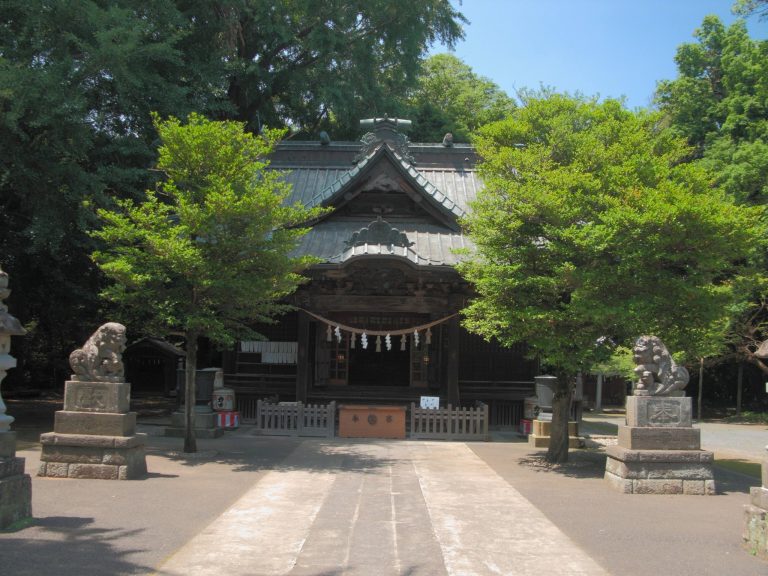
The sword and other excavated objects became an Important Cultural Property in 1981 and a National Treasure in 1983. In 2020, the mound was re-designated as part of the Sakitama Kofun Cluster as a Special National Historic Site. The name Inariyama comes from an Inari shrine once worshipped on the summit. Since the mound formerly stood among rice fields, local people also called it the “field mound.”
Remains
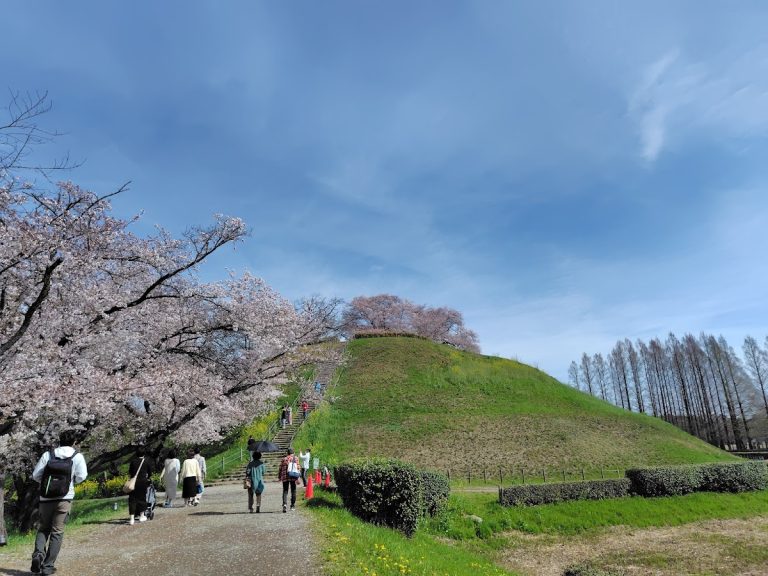
Inariyama Kofun is a keyhole-shaped mound approximately 120 meters long and about 10.5 meters high. Its rectangular front section is about 74 meters wide, while the circular rear section is about 62 meters wide and reaches approximately 10.7 meters in height. The mound was built in two levels and is enclosed by two roughly rectangular moats. These moats were about 1.8 meters deep relative to the ground surface at the time of construction and were normally dry, filling when the surrounding water level rose.
Mound layout and ritual features
Keyhole-shaped mound
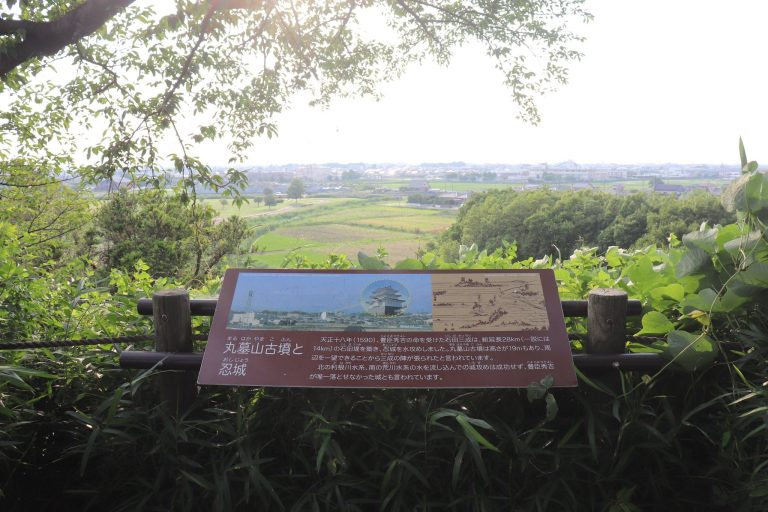
The mound’s main axis points toward Mount Fuji, approximately 100 kilometers away. From the summit of the circular rear section, Mount Fuji can be seen directly on clear days. A projecting platform called a tsukuridashi, probably used for rituals, extends from the western side of the rectangular front section near its junction with the circular rear section.
Restored summit and front section
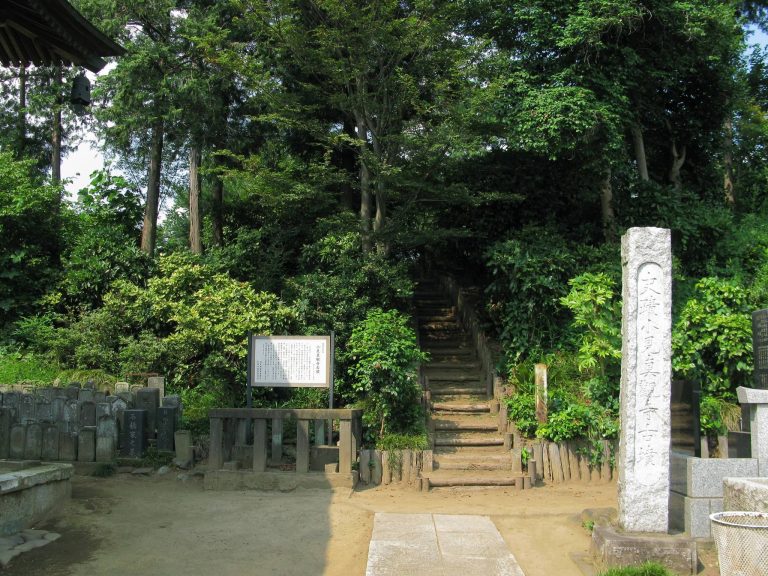
A reconstructed model of a burial facility stands on the summit of the circular section and can be viewed from a stairway. The front section, altered and partly dismantled after the 1937 earth removal, underwent substantial restoration in 2003. The surviving mound has no identified covering of surface stones, known as fukiishi.
Burial facilities
Gravel burial chamber
One burial facility is a gravel chamber, or reki-kaku. It contained a wooden coffin enclosed by clay packing and a layer of gravel. This chamber held the Inariyama Sword, whose gold-inlaid inscription provides evidence for the tomb’s political connections and possible date. Its other contents included a bronze mirror with a pictorial band and divine-beast design, a comma-shaped jade bead known as a magatama, two silver rings, part of a gold-bronze belt fitting, another iron sword, five iron blades, two iron spears, lamellar-armor scales, horse equipment, and iron arrowheads.
Clay burial chamber
The second facility is a clay chamber, or nendo-kaku, which had been looted. Fragments of an iron sword, armor, and horse equipment nevertheless remained. The two known facilities lie slightly away from the center of the circular rear section. Their grave goods date to the early sixth century, later than the construction of the mound, raising the possibility that a central burial facility for the principal occupant remains undiscovered.
Archaeological evidence
Burial goods and tools
Additional excavated objects comprise two iron axes, two iron tongs, an iron tweezer, an iron tool or scraper, four knives including fragments, and a whetstone. Together with the other finds, these objects form part of the National Treasure group titled “Objects Excavated from Musashi Sakitama Inariyama Kofun.” They reflect the weapons, equipment, ornaments, and tools placed in the burial facilities.
Haniwa figures
Excavations also recovered haniwa, modeled clay objects placed around or on burial mounds. Among them are an anthropomorphic figure wearing a helmet with a projecting visor and a female ritual figure equipped with bronze mirrors decorated with bells.
Possible additional chamber
Ground-penetrating-radar surveys in 1998 and 2016 detected responses resembling burial structures near the eastern edge and central area of the summit. In 1997, a concentration of rock fragments, including green schist, was found in the outer moat beside the rear section. The largest measured approximately 1.0 by 1.2 meters and weighed about 0.5 tonnes. Because surface stones have not been identified on the mound, these fragments may have been intended as chamber material and fallen into the moat during transport. This evidence has raised the possibility of a previously unknown pit-style stone burial chamber.
When the front section was dismantled in 1937, stonework reportedly appeared alongside compacted arrowheads and a rusted sword. The relationship between those reported remains and either of the known burial facilities cannot be securely established.