Ōnariko Kofun: An Early Kofun-Period Burial Mound in Yasugi
Site at a Glance
- Rating
- 5
- Popularity
- Very Low
- Country
- Japan
- Primary era
- Classical
- External website
- Open
- Eras represented
- Classical
- Civilizations
- Yamato
- Site type
- Burial
- Remains
- Burial Mound
On this page13 sections
History
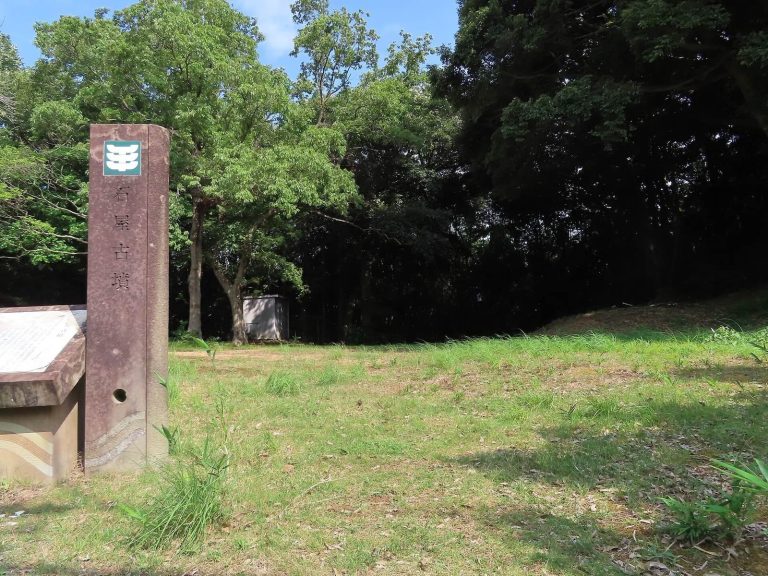
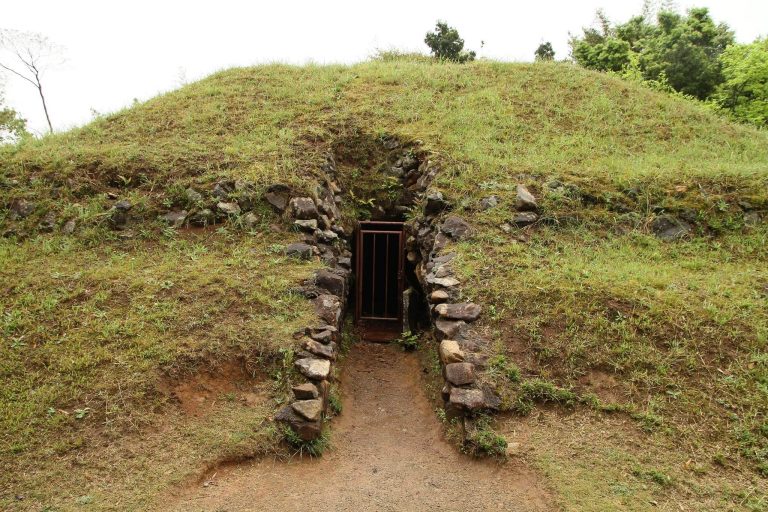
Ōnariko Kofun is an early Kofun-period square burial mound in Yasugi, Japan, built during the fourth century in the middle of the early Kofun period. It belongs to the Arashima Kofun Group and is regarded as the group’s oldest-appearing mound. The site is associated with the development of large burial mounds west of the Yasugi Plain and is considered a representative tomb of the early Kofun period in the Izumo region.
From Yayoi Burial Mounds to Large Square Kofun
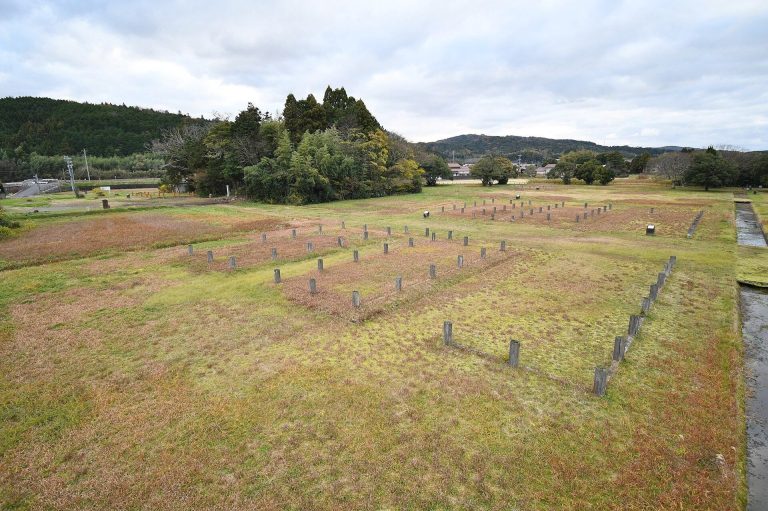
The Arashima burial-mound complex developed from the late Yayoi period through the Nara period. The Yayoi period preceded the Kofun period and was associated in western Japan with agricultural communities and ritual objects such as bronze bells. In the late Yayoi phase, four-cornered projecting burial mounds were built in the area. Later, large square kofun, including Ōnariko Kofun and Tsukiyama Kofun No. 1, formed a new stage in the region’s monumental burial tradition.
Typological study of the bronze mirror and pottery places Ōnariko Kofun in the fourth century. Along with Tsukiyama Kofun No. 1, it was among the largest square burial mounds in the Japanese archipelago at that time. The relationship between the earlier four-cornered projecting mounds and these later square monuments remains open to interpretation. One view emphasizes continuity, while another sees a chronological break. A further proposal holds that the large square mounds deliberately revived the symbolic tradition of the earlier form.
The square plan itself has also been interpreted in different ways. It may represent a regional tradition extending back to the Yayoi period, or it may reflect a form imposed on local powers within the political system associated with keyhole-shaped tombs. A keyhole-shaped mound combines a circular section with a square section. Ōnariko Kofun’s construction appears to have been intended to make the mound look large when viewed from the surrounding plain.
Discovery and Archaeological Reassessment
The mound came to light on June 28, 1911, when heavy rain caused the burial chamber to collapse. Shimane Prefecture reported the discovery to the Imperial Household Ministry in July, and excavation had already reached below the chamber floor. Information about the find was sent to archaeologist Sueji Umehara, who introduced the mound in a published study and compared it with a known square mound containing a pit-type stone burial chamber. This type of chamber was built in a shaft or pit beneath a mound rather than entered through a passage.
Early archaeological reporting made two major errors. The burial facility was identified as a horizontal stone chamber, and objects from nearby Hotoke-yama Kofun were mixed with the Ōnariko material. Postwar research corrected the chamber’s identification and separated the finds associated with Hotoke-yama Kofun. These corrections established a firmer basis for understanding the mound’s date, construction, and burial goods.
Investigations and Historic-Site Status
Five archaeological investigations took place during the 1990s. The first, in March 1991, established the precise position and orientation of the previously reburied stone chamber, clarified its structure, and examined the grave pit, although the work ended before the investigation was complete. A second investigation in August 1991 located the outlet of a drainage facility on the mound’s southern side.
Yasugi City, working with Shimane University, conducted a third investigation in March 1995. It identified the western and southern edges of the mound and substantially clarified its original form. A fourth investigation in March 1997 established the size and shape of the grave pit. From June to October that year, a fifth investigation recovered objects from the stone chamber and examined how it had been constructed. Ground-penetrating-radar investigation was also carried out in August 1996.
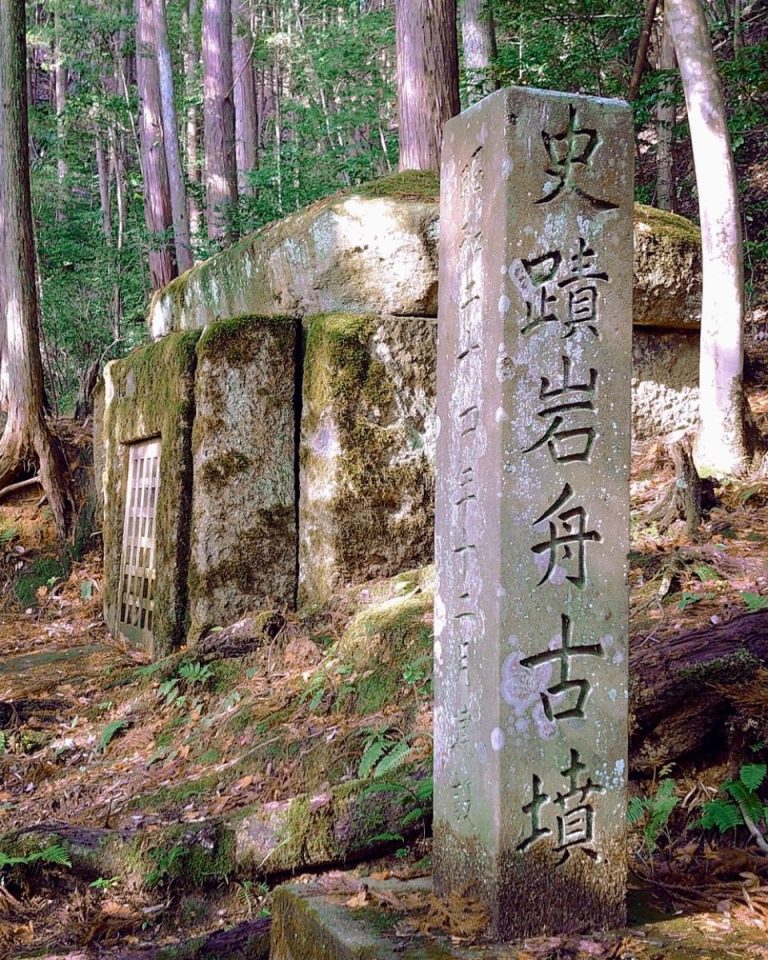
Ōnariko Kofun was added to the nationally designated Arashima Kofun Group Historic Site in 1999. The group had first received designation in 1936, and the designation was expanded on July 13, 1999. At the same time, the historic-site name was changed from “Tsukiyama Kofun.”
Remains
Mound and Southern Boundary
Ōnariko Kofun has a substantially square plan, measuring approximately 60 meters from east to west and 44 meters from north to south. Extensive cultivation damaged the eastern part, making the original east-west dimension uncertain, although the position of the burial facility suggests a possible length of about 60 meters. An observation from the late 1970s measured the base at approximately 65 meters east to west and 44 meters north to south. The mound now rises about 6.5 meters, compared with a height of slightly more than four meters noted in an earlier observation.
The northern side was made larger than the southern side. The western and southern sides meet at right angles, while the northern side follows a different alignment. Gently sloping surfaces occur where the mound’s slopes meet. The western area, particularly toward the north, was substantially levelled, while surviving sections on the north and south retain stone surfacing. A terrace about 1.5 meters wide runs outside the southern foot. Beyond it, a ditch marked the southern limit, with gravel at its bottom.
Burial Facilities
Central Stone Chamber
The central burial facility is a pit-type stone chamber approximately 7.5 meters long, 1.0 to 1.2 meters wide, and 1.0 to 1.1 meters high. It was built within a grave pit, the larger cavity excavated for the burial, which measured about 16 meters along its long axis, 11 meters along its short axis, and approximately two meters deep. The chamber’s drainage facility ran from beneath its northern end toward the southern part of the mound.
The chamber walls were made from flat stones 30 to 60 centimeters wide, arranged in 11 to 13 courses. Clay was packed between the courses, functioning much like mortar between bricks, rather than leaving the stones directly in contact. After the grave pit was backfilled, wooden posts approximately 40 centimeters in diameter were erected. The chamber’s drainage arrangement strongly resembles those at Tsukiyama Kofun Nos. 1 and 3, while its particular structure differs from drainage facilities in other regions.
The remaining clay coffin bed indicates that the wooden coffin was probably boat-shaped or split-bamboo-shaped. A split-bamboo-shaped coffin was made from a log divided lengthwise, producing a curved half-log form. The position of the chamber lies close to the reconstructed line of the western mound edge, with the two differing by approximately five degrees.
Additional Burial Facilities
Possible additional burial facilities occur on both sides of the central chamber. On the east is a clay coffin chamber, while the western side contains a facility using stone slabs. Their positions show that burial activity extended beyond the principal stone chamber within the mound.
Bronze Mirror and Iron Sword
Bronze Mirror
The bronze mirror measures 23.8 to 24.0 centimeters in diameter. It is a two-deity, two-beast mirror with a scrolling-design band and a small rim. The same type is represented by examples from Fudendera Kofun No. 1, Awi Shrine, and Ishikiri Tsurugi-jinja. Comparison of the casting sequence places Fudendera No. 1 first, followed by Awi Shrine and then Ōnariko Kofun.
An inscription on the Fudendera mirror was deliberately removed from the Awi Shrine and Ōnariko examples and replaced with a diagonal lattice design associated with Yayoi-period bronze bells. This change has been used to suggest that the inscription’s meaning may still have been understood in the early Kofun period. It also points to a possible contribution from Yayoi bronze-bell casting traditions to the production of Kofun-period mirrors.
Iron Sword
An iron sword with a plain ring-shaped pommel survives to a total length of 88.0 centimeters. Its grip measures 23.8 centimeters and its blade 62.3 centimeters. The pommel has a major diameter of 7.3 centimeters, while the grip opening measures 1.7 centimeters and the scabbard opening 1.9 centimeters. The wood associated with the sword survives particularly well and preserves evidence of how its fittings were made.
The sword was imported, but its fittings were modified in the Japanese archipelago. They use a traditional matching-mouth fitting for the hilt and scabbard rather than the then-uncommon Han-style swallow-mouth fitting. The combination of an imported weapon and locally modified fittings illustrates the distinct treatment given to the object after it reached Japan.
Pottery and the Scale of the Chamber
Pots, drum-shaped stands, tall-footed cups, and low-footed cups were found above the stone chamber, within a concentrated pottery deposit, and inside postholes. Pots were especially numerous above the chamber, while drum-shaped stands predominated in the pottery concentration. Fragments probably belonging to cylindrical-stand-shaped pottery came from the northern slope. Small round-bottomed jars and low-footed cups were recovered from inside the burial chamber during the 1911 excavation.
The chamber is the largest known in the Izumo region and is unusually large when compared with pit-type stone burial chambers across the Japanese archipelago. Its size, construction, drainage system, associated objects, and square mound form make Ōnariko Kofun an important source for examining burial practices and regional traditions during the early Kofun period.