Shishin Hall: The Principal Ceremonial Hall of Japan’s Inner Palace


Site at a Glance
- Rating
- 4.7
- Popularity
- Low
- Country
- Japan
- Primary era
- Medieval
- External website
- Open
- Eras represented
- Medieval, Early Modern
- Civilizations
- Tokugawa
- Site type
- Civic
- Remains
- Palace
On this page8 sections
History
Shishin Hall is the principal hall of the Emperor’s Inner Palace in the Kyoto Imperial Palace, Japan, and the present building was rebuilt in 1855 in traditional architectural forms. The Inner Palace was the emperor’s residential section within the larger imperial palace, and Shishin Hall originally belonged to this private residential complex while serving a more public and official purpose than the spaces used for ordinary daily life.
From residential hall to ceremonial centre
Imperial coming-of-age rites, the investiture of a crown prince, ceremonies transferring sovereignty, seasonal court gatherings, and later enthronement ceremonies were held at Shishin Hall. From the middle of the Heian period, the hall acquired greater ceremonial importance as Daigokuden, the principal ceremonial hall of the Greater Palace, fell into decline. Major state rituals, including enthronements and the Great Thanksgiving Ceremony, consequently moved to Shishin Hall. The Great Thanksgiving Ceremony is the major thanksgiving rite associated with an emperor’s accession.
The Inner Palace was destroyed by fire during the Kamakura period and was not rebuilt as the original palace complex. Shishin Hall continued to be reconstructed within temporary imperial-palace residences, which were established outside the permanent complex when the main palace could not be used. The present Kyoto Imperial Palace also developed from such a residence.
Enthronements and reconstruction
Before the Onin War, a fifteenth-century civil war that devastated Kyoto, Shishin Hall hosted the enthronements of Emperor Reizei and Emperor Antoku. Reizei could not attend the principal hall because of illness, while Antoku’s principal hall had not yet been completed after the capital moved to Fukuhara. After the war, Emperor Go-Kashiwabara’s enthronement was delayed for twenty-one years because of financial difficulties and disagreement over whether to rebuild the former Council of State complex, an official venue of central court administration, or use Shishin Hall. In 1521, the ceremony took place at Shishin Hall because rebuilding the former complex was considered impractical. Enthronement at Shishin Hall then became established practice. The custom continued at Kyoto even after the capital transferred to Tokyo, lasting through the reign of Emperor Showa, who ruled until 1989.
The building preceding the present hall burned in 1854, and Shishin Hall was rebuilt the following year. Its name was once also written in a form meaning “Purple-Vibration Hall,” although the date when the present spelling became standard is uncertain. “Southern Hall” and “Front Hall” were also used as alternative names, though those terms could refer to other buildings in different contexts. The name derives from Chinese imperial terminology: its first element refers to the Purple Tenuity star region, associated with the seat of the Celestial Emperor; the second means an imperial residence, and the final element means a palace hall. The name was used historically in China, Japan, and Vietnam. The corresponding hall in China survives only as ruins, while the Vietnamese example has disappeared.
Remains
Layout and construction
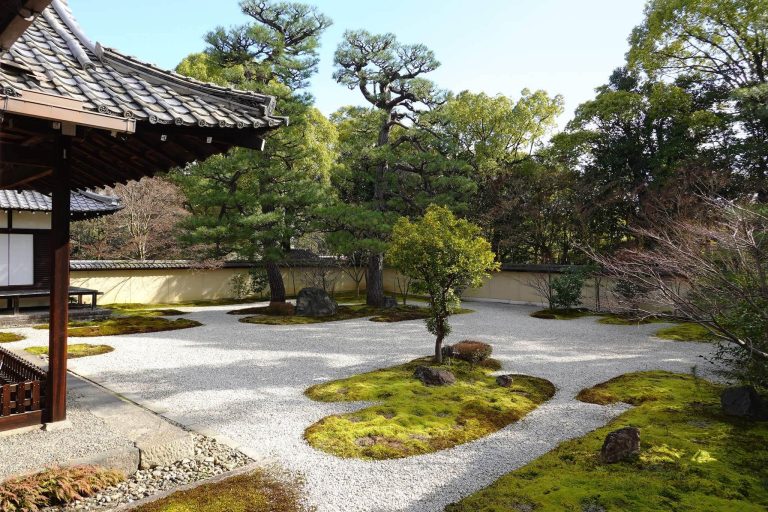
Shishin Hall stands north of the South Garden, with Jinshoden to the north. Its main body is nine bays wide. Four-sided eaves surround the central core, while an outer veranda with balustrades encloses the building. The hall’s arrangement expresses its ceremonial function and distinguishes it from the separate hall used for the emperor’s ordinary daily life.
Throne space and southern approach
The centre of the main body contains the Takamikura, the imperial throne dais used in accession ceremonies. In earlier periods, this central position held the chodai, a curtained ceremonial seat. A panelled push-door screen called the Kenjo no Shoji separates the main body from the northern eave space. At the centre of the southern eave space, an eighteen-step staircase known as the South Stair leads toward the South Garden.
South Garden and guard positions
The South Garden contains a cherry tree on the east and a tachibana citrus tree on the west. Their traditional names, the Left Guard’s Cherry and the Right Guard’s Tachibana, derive from the positions of the Left and Right Imperial Guards nearby. The Left Guard’s Seat occupied an eastern guard position in a covered corridor connecting with the Giyoden. During the height of regency government, an aristocratic administration led by a regent acting for the emperor, court councils were held there, making it an effective centre of national administration. On rare occasions, councils met at the Right Guard’s Seat in the eastern eave space of the Kyoshoden. This arrangement appears in an illustrated scroll of annual court events.
Tradition holds that the Left Guard’s Cherry was originally a plum tree. After it dried up, it was reportedly replaced by a cherry tree during the reign of Emperor Nimmyo. The trees and guard positions remain part of the spatial organization associated with the hall’s ceremonial setting.
Earlier buildings and archaeological markers
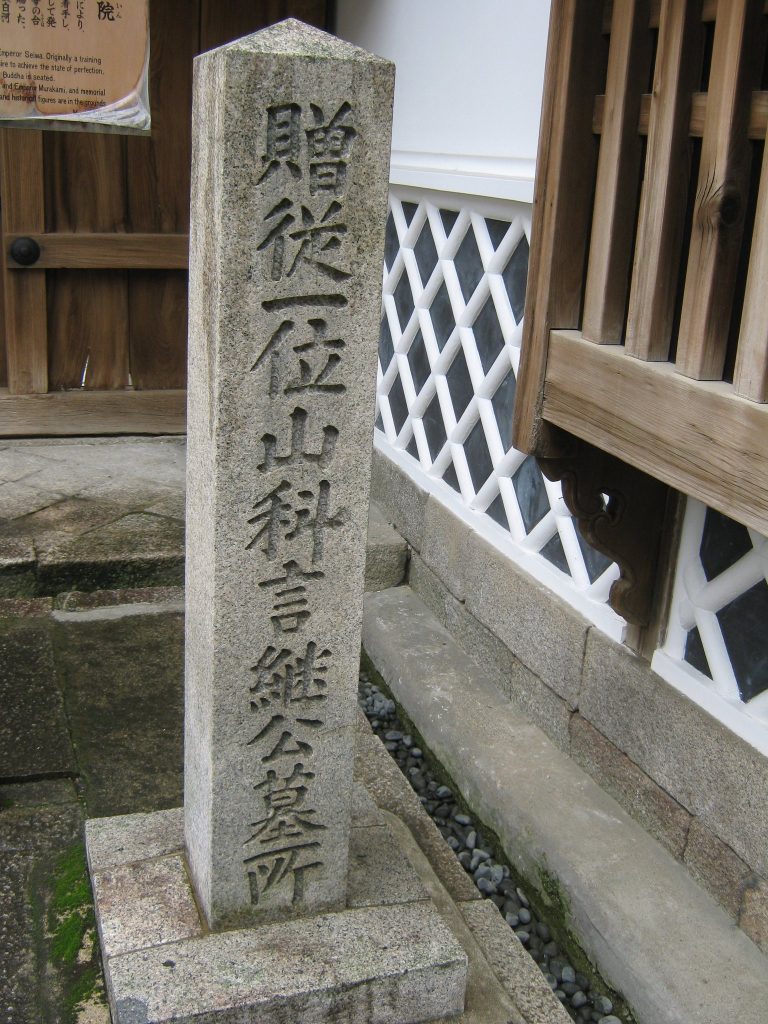
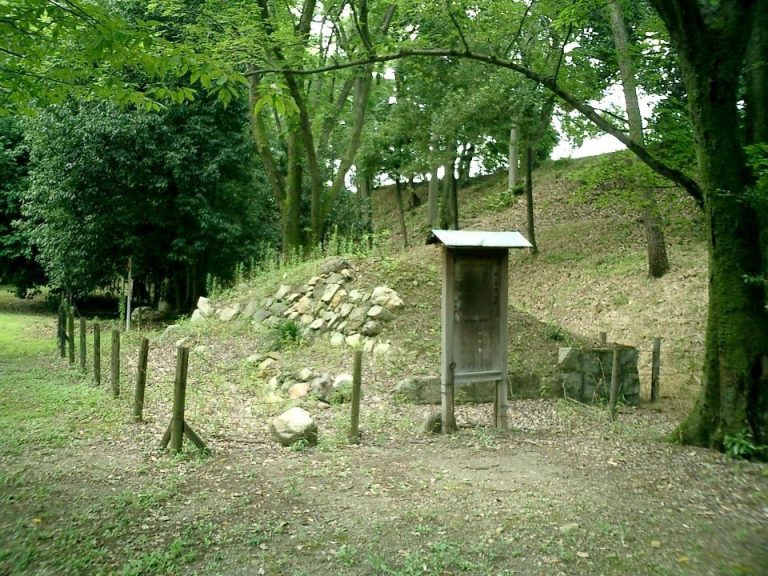
A former Shishin Hall from the Keicho period, the era of the late sixteenth and early seventeenth centuries, survives as the main hall of Ninna-ji, a Buddhist temple in Kyoto. There it is identified as the oldest surviving building known by this architectural identity. The site of the Heian-period Shishin Hall in the former Inner Palace is separately marked in Kyoto. The explanatory marker stands about 25 metres south of the former hall site, in the centre of the former South Garden. Together, the surviving temple building and the marked former site preserve evidence of earlier phases in the hall’s long architectural history.