Isagawa Shrine: An Ancient Shinto Shrine and Auxiliary Shrine of Omiwa


Site at a Glance
- Rating
- 4.1
- Popularity
- Low
- Country
- Japan
- Primary era
- Early Modern
- External website
- Open
- Eras represented
- Early Modern
- Civilizations
- Tokugawa
- Site type
- Religious
- Remains
- Sanctuary
On this page9 sections
History
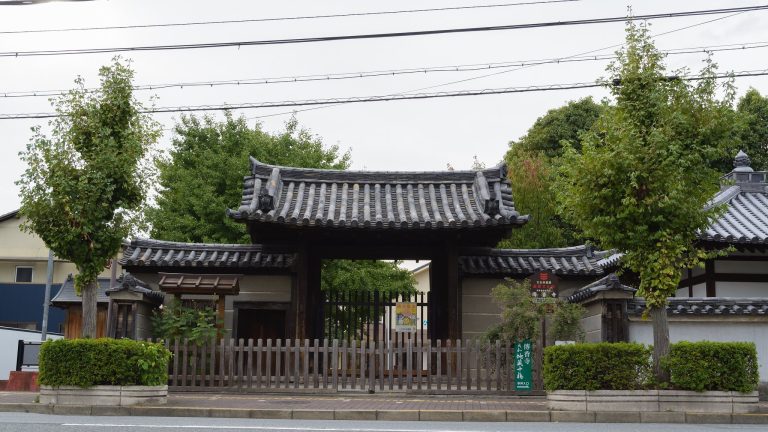
Isagawa Shrine is a Shinto shrine in Nara, Japan, traditionally founded in 593 during the reign of Empress Suiko. Shrine tradition holds that Omiwa no Kimi Shiratsutsumi enshrined Himetataraisuzu-hime, the legendary consort of Emperor Jinmu, by imperial order. The shrine is regarded as the oldest shrine in Nara and remains an outlying auxiliary shrine of Omiwa Shrine, meaning that it belongs to the parent shrine while standing outside its immediate precinct.
Foundation and religious associations
The principal deity is Himetataraisuzu-hime, who is honored together with her divine parents, Sai no Okami and Tamakushi-hime. Sai no Okami is identified with Kotoshironushi or Omononushi. During the reign of Emperor Gensho, Sai no Okami and Tamakushi-hime were added beside the principal deity. Himetataraisuzu-hime occupies the central position, with her father to the west and her mother to the east. This arrangement expresses parental protection and has supported the shrine’s longstanding veneration as Komori Myojin, a deity associated with safe childbirth and child-rearing.
Isagawa Shrine appears in the Engishiki Jinmyocho, a tenth-century register of officially recognized Shinto shrines, as the small-ranked Shikinai shrine “Isagawa-za Omiwa-no-Miko Shrine.” The entry lists three deities. In 852, during the reign of Emperor Montoku, the shrine received the Junior Fifth Rank and six tax households for its support, four in Sakyo and two in Tango Province.
Destruction, rebuilding, and changing affiliations
In December 1180, the shrine buildings were burned during the Nanto attack led by Taira no Shigehira. With support from Kofuku-ji, they were rebuilt in 1190, after which the shrine came under that temple’s control. From the medieval period, priests of Kasuga Wakamiya managed Isagawa, and it became known as Kasuga Saegusa Shrine. Records of repeated shrine relocations were preserved in the archives of Daijo-in temple.
During the early modern period, Isagawa was one of the eleven outer shrines of Kasuga Taisha. In March 1877, the Ministry of the Interior designated it as an outlying auxiliary shrine of Omiwa Shrine. It continues in that formal relationship as an outlying auxiliary shrine, or keigai massha, of Omiwa.
Isagawa Awa Shrine
Isagawa Awa Shrine is traditionally said to have been established in 771 after Dainagon Fujiwara no Korekimi, a senior councillor in the classical imperial court, received a dream revelation and invited its deity from Awa Province. It received the Junior Fifth Rank in 852 and was listed in the Engishiki Jinmyocho as the small-ranked Isagawa Awa Shrine.
Isagawa Awa Shrine was destroyed during a peasant uprising in 1532 and later suffered fires connected with the warfare of the Miyoshi Triumvirate and Matsunaga Hisahide. By the middle of the Edo period, its former site behind the second house from the east on the south side of Nishijodo-cho had become badly neglected. A single pine tree was revered there as a sacred tree. A small shrine was established during the Meiji period, and its main building was moved to the grounds of Isagawa Shrine in 1920. In 1959, site development brought Awa Shrine, Sumiyoshi Shrine, and Kasuga Shrine to their present positions within the precinct.
The Saegusa Festival
The Saegusa Festival takes place annually on June 17 and is popularly called the Lily Festival. It is an ancient rite based on the Chinka Festival, a ritual intended to ward off epidemics. The ceremony follows prescribed customs: sake offerings are surrounded by lily stems, prepared foods are placed in a lidded wooden box on a black-wood stand, and lilies are offered in a large tub. Afterward, seven young women carrying lilies process through the town.
The festival is mentioned in the Taiho Code and the Jingi-ryo, the section of the Yoro Code concerned with rites and the administration of kami worship. The latter explains the name Saegusa Festival by noting that the sake jars are decorated with Saegusa flowers. Isagawa Awa Shrine also holds a separate First Ebisu ceremony on January 5. Ebisu is the common identification of its principal deity, Kotoshironushi. The Saegusa Festival was referred to by Yukio Mishima in his late novel Runaway Horses, where the character Honda describes it as an exceptionally beautiful religious ceremony.
Remains
Main sanctuaries
The main sanctuary is formed by three one-bay buildings in the Kasuga style, a small Shinto building type with a projecting front section. They stand side by side and are connected by partitions, forming the central, right, and left main sanctuaries. Each building has a seven-step wooden stairway at the front, with raised railings finished with giboshi, ornamental balustrade finials. The roofs are covered in cypress bark and carry box-shaped ridge structures topped by chigi, crossed roof finials, and katsuogi, short horizontal logs placed along the ridge. Their construction techniques indicate that the buildings were probably erected during the early Edo period. The central, right, and left sanctuaries are tangible cultural properties of Nara Prefecture.
Subsidiary shrines and precinct features
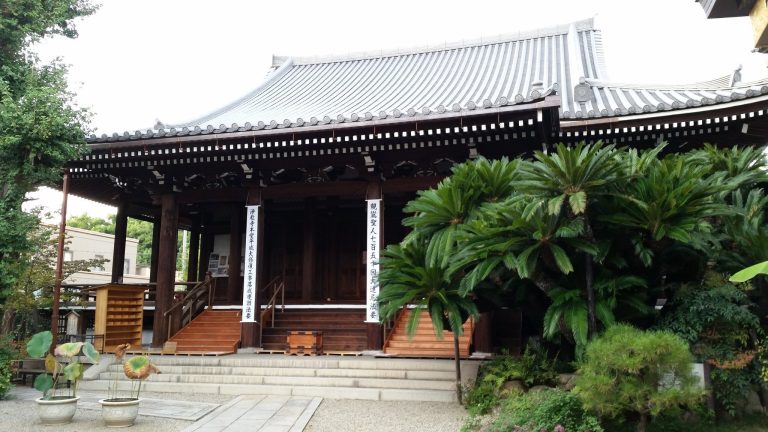
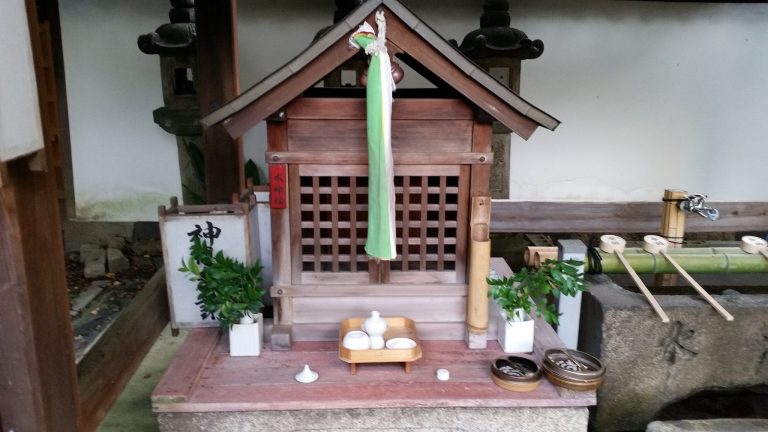
The precinct contains a worship hall, Isagawa Awa Shrine, Sumiyoshi Shrine, Kasuga Shrine, Frog Stone, and a shrine office. Sumiyoshi Shrine enshrines the three Sumiyoshi deities, traditionally associated with the sea, travel, and maritime protection, together with Empress Jingu. Kasuga Shrine enshrines Takemikazuchi, Futsunushi, Ame-no-Koyane, and Himegami.
Isagawa Awa Shrine stands between Sumiyoshi Shrine and Kasuga Shrine. Its principal deity is Kotoshironushi, commonly identified with Ebisu. A square stone lantern in front of the shrine was moved from its former location and carries the inscription “Awa Shrine, 1803.”
River boundary
The Isagawa River runs along the southern edge of the precinct. It is also popularly known as the Komori River, linking the physical setting of the shrine with its longstanding association with Komori Myojin.