Takahara Kumano Shrine: A Historic Shinto Shrine on the Kumano Kodo
Site at a Glance
- Rating
- 4.4
- Popularity
- Very Low
- Country
- Japan
- Primary era
- Medieval
- External website
- Open
- Eras represented
- Medieval
- Civilizations
- Ashikaga shogunate
- Site type
- Religious
- Remains
- Sanctuary
On this page7 sections
History
Takahara Kumano Shrine is a Shinto shrine in Tanabe, Japan, whose main sanctuary was rebuilt in 1532 in the Kasuga-zukuri style. Located in the Takahara settlement beside the Kumano Kodo Nakahechi route, the shrine preserves a religious site associated with the Kumano pilgrimage and the ridge above the left bank of the Tonda River.
Foundation and Medieval Records
The shrine is formally called Kumano Shrine, while local tradition attributes its foundation to 1402, when a deity was transferred from Kumano Hongu Taisha. An inscription on the shrine’s sacred devotional object gives a more specific historical indication, recording the enshrinement of Wakaoji from Kumano on April 27 in the tenth year of the Oei era. The shrine was therefore probably established during the Oei era, which lasted from 1394 to 1428.
The 1474 Oji Register calls the site Takahara Oji. Oji were subsidiary shrines and pilgrimage stations connected with the Kumano pilgrimage, traditionally counted as a sequence of 99 sites. Takahara Oji is not confirmed in surviving records from the Heian or Kamakura periods and is not normally included in that traditional group of 99. Later, the Kii Continuation Gazetteer referred to it as Kumano Gongen Shrine and described it as the village’s local tutelary shrine. A gongen was a deity understood through the manifestation of a Buddhist figure, while a community’s tutelary deity was known as its ujigami.
Takahara and the Kumano Pilgrimage
Takahara had developed as a settlement on the route through the Kii Peninsula. It first appears in the 1109 Chuyuki record, and a 1174 entry in Kikki says that travelers stopped there for lunch to avoid the rain. The same records identify a temporary water station farther into the mountains as the place where travelers lodged, suggesting that Takahara itself formed during the Northern and Southern Courts period, the fourteenth-century era when competing imperial courts existed in Japan. A poem praising the scenery at Takahara was recorded in 1201 in the Kumano road travel account preserved in Meigetsuki.
A 1427 pilgrimage diary kept by Kitano-dono, a consort of Ashikaga Yoshimitsu, records that her party stayed at Takahara on both its outward and return journeys. From the Muromachi period, the era of the Ashikaga shogunate from roughly 1336 to 1573, into the early modern period, the Kumano pilgrimage route shifted toward the crossing of Shiomi Pass. Takahara nevertheless remained along the highway. The settlement below the shrine, on the Tonda River, also functioned as a roadside lodging place, with inns and palanquin operators still active during the Taisho period from 1912 to 1926. Its role declined after a motor road was constructed along the river.
Modern Shrine Status
In 1868 the shrine adopted Kumano Shrine as its formal name. It was classified as a village shrine in 1873 and, in 1907, designated as a shrine eligible to receive state offerings of food and cloth. Its principal deity is Hayatama no Okami. Other enshrined or jointly worshipped deities include the Oyama-tsumi deity, Susanoo, the local land deity, Inari, and the Kotohira deity.
The main sanctuary is a Wakayama Prefectural Tangible Cultural Property. The precinct also forms part of the scenic designation called the “Landscape of the Minakata Mandala,” established in 2015.
Remains
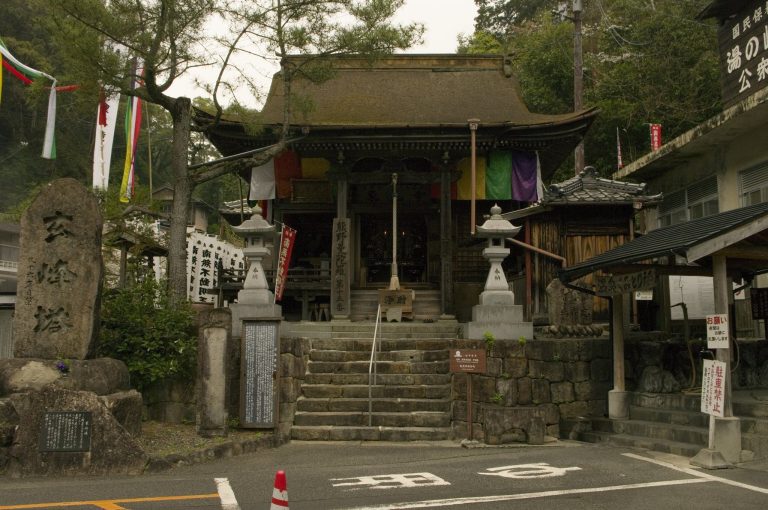
Takahara Kumano Shrine stands within the Takahara settlement on a ridge above the left bank of the Tonda River, beside the Kumano Kodo Nakahechi route. Its surviving principal building is a compact Kasuga-zukuri sanctuary with a strongly projecting gabled front and a roof covered in hinoki bark.
Main Sanctuary
The main sanctuary was reconstructed in 1532. It is regarded as the oldest building along the Nakahechi route. Later repairs altered the building over time, but its structural framework and the small shrine cabinet in the inner sanctuary retain features associated with early Muromachi-period construction.
Sacred Devotional Object
The shrine’s object of worship is a sacred kakebotoke, a Buddhist-Shinto devotional object historically used in the combined worship of Buddhist and Shinto divinities. Its inscription identifies the enshrinement of Wakaoji from Kumano and records the event on April 27 in the tenth year of the Oei era, providing an important connection between the surviving shrine tradition and its medieval foundation.