Tatsuoka Castle: A Bakumatsu Star Fort in Japan


Site at a Glance
- Rating
- 3.9
- Popularity
- Very Low
- Country
- Japan
- Primary era
- Modern
- Eras represented
- Modern
- Civilizations
- Tokugawa
- Site type
- Military
- Remains
- Castle
On this page10 sections
History
Tatsuoka Castle is a pentagonal star fort in Saku, Japan, built during the Bakumatsu, the final years of the Tokugawa shogunate, between 1863 and 1867. It served as the primary fortress of Tatsuoka Domain, which was ruled by the Ogyū-Matsudaira clan, and was one of only two star fortresses in Japan, together with Goryōkaku in Hakodate.
The Ogyū-Matsudaira relocation
The Ogyū-Matsudaira were a cadet branch of the Matsudaira clan and had previously governed Okutono Domain in Mikawa Province. After the Perry Expedition and the arrival of foreign warships placed pressure on Japan’s policy of national isolation, Matsudaira Norikata was appointed Obangashira, a high-ranking office responsible for commanding shogunal troops, in 1863. He was 24 years old and had studied rangaku, or Western science and technology learned through Dutch sources.
Norikata regarded the Okazaki area as vulnerable because of its coastal position. He therefore moved his seat to the clan’s inland holdings in Saku, where Tatsuoka Castle was built. The domain’s limited resources prevented the construction of a large fortress. Norikata’s status also allowed him to build only a fortified administrative residence, or jin’ya, rather than a formal castle with a tenshu, the principal tower of a Japanese castle.
Short military life
Construction began in 1863 and finished in 1867, but the castle remained in use only until 1868. Its military value was limited by the large daimyō residence at the centre, which restricted the depth of the defensive system. A nearby hill outside the fortification exposed its interior to artillery fire, and financial constraints meant that only the southwestern battery received cannon.
Demolition and preservation
After the Meiji Restoration, the castle was demolished in 1872 and the land returned to agricultural use. Taguchi Elementary School was later established within the surviving moat remains. The ruins became a National Historic Site in 1934, and the castle was included in the Continued Top 100 Japanese Castles list in 2017. Tatsuoka Castle stands in a rural area of southern Saku, at the eastern edge of Nagano Prefecture, on a side route of the Nakasendō linking Shinano, Kai, and Kōzuke provinces.
Remains
Star-shaped fortification
Tatsuoka Castle formed a compact pentagonal star fort, with each side measuring approximately 200 meters. A narrow moat about five meters wide surrounded the earthwork. Gun emplacements occupied the five projecting points, while gates stood on the northern and eastern sides. The southwestern point contained the only battery equipped with cannon. A large daimyō residence occupied the centre of the fortification, creating the principal internal focus of the site.
Surviving and relocated structures
Kitchen building
Most of the original buildings have disappeared. The kitchen is the sole original structure to survive. It was later used to store farm implements and was moved within the castle grounds in 1929, where it became part of the elementary school.
Relocated buildings
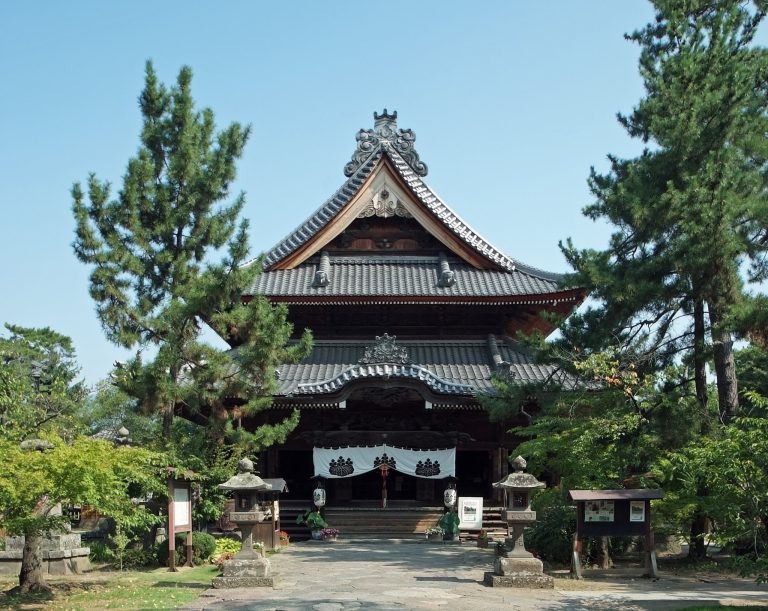
The former daimyō residence was moved to a temple in Saku and now serves as its Hondō, or main hall. The East Gate was relocated to Yakashi-ji Temple, while the Yakui Gate was transferred to a private house in Saku. These buildings preserve elements of the castle beyond the surviving moat and earthworks.
Goryōkaku Deai no Yakata
In front of the former main gate, the museum called Goryōkaku Deai no Yakata displays materials associated with Tatsuoka Castle. Its exhibits provide a material record of the fortress and its brief use during the final years of the shogunate.