Usui Sekisho: An Edo-Period Checkpoint on Japan’s Nakasendo


Site at a Glance
- Rating
- 3.7
- Popularity
- Low
- Country
- Japan
- Primary era
- Early Modern
- External website
- Open
- Eras represented
- Early Modern
- Civilizations
- Tokugawa
- Site type
- Military
- Remains
- Fort
On this page16 sections
History
Usui Sekisho is an Edo-period checkpoint in Japan, located at Yokokawa in Annaka, Gunma, between Matsuida-juku and Sakamoto-juku on the Nakasendo. The Nakasendo was an inland highway linking Edo with Kyoto through central Honshu. During the Edo period, Usui Sekisho was regarded as one of the major checkpoints, alongside Hakone on the Tokaido and Fukushima on the Nakasendo.
Early origins and medieval use
The origins of the checkpoint are traditionally placed in 899, during the reign of Emperor Daigo, whose rule lasted from 897 to 930. A decree of the Council of State is said to have established Usui-zaka together with the Ashigara checkpoint in Sagami. A further decree issued in 900 recorded the checkpoints and required travelers to carry permits for passage. It stated that the surrounding area subsequently became peaceful and disorder diminished.
In the medieval period, a temporary guard post was established near the former checkpoint location in present-day Yokokawa. The site therefore retained a role in regulating movement before the early-modern checkpoint took its more permanent form.
Formation of the early-modern checkpoint
The early-modern checkpoint is traditionally said to have begun in 1590, when Tokugawa Ieyasu ordered Ii Naomasa, lord of Minowa Castle, to establish a checkpoint at Usui Pass. In 1592, Ina Tadatsugu and Okubo Nagayasu administered a checkpoint at Yokokawa village.
During the Osaka Winter Campaign of 1615, Ii Naokatsu placed a temporary guard post in the Sekichohara area. In 1622, while Tokugawa Hidetada, the second Tokugawa shogun, was traveling to Kyoto, the checkpoint was moved from there to the more defensible terrain of Kamiyokokawa. It was initially called the Yokokawa Checkpoint and took the name Usui Sekisho in July 1708.
Ii Naokatsu was appointed to supervise the checkpoint in 1616. Thereafter, successive lords of the Annaka Domain were responsible for its security. The staff included senior and ordinary guards, hereditary dōshin constables, attendants, and guards at the west gate. A dōshin was a lower-ranking samurai official who commonly performed policing and guard duties. Senior and ordinary guards originally traveled from Annaka for their duties, but residences were built inside the checkpoint from 1693 onward. The hereditary dōshin constables and west-gate guards remained in place despite changes in the Annaka lordship.
Control of passage
As a sekisho, a checkpoint for inspecting travelers, goods, weapons, and travel documents, Usui Sekisho enforced the Tokugawa policy known as “incoming guns and outgoing women.” This policy restricted firearms entering Edo and controlled women leaving the city, helping the shogunate monitor potential threats and political movement. Women departing Edo without authorization were checked through official permits issued by the shogunate’s Edo office, while women living near the checkpoint received special consideration in passage procedures.
Several recorded cases show the severity of these controls. Saji Hyoe was caught at Kawakubo near present-day Hara while evading the checkpoint. He was sent to Edo and died in prison, after which his head was displayed at the riverbed west of the checkpoint. In 1731, Chotaro of Sakamoto-juku crossed the mountains at a woman’s request. He was placed in a cage and sent to Edo, where his sentence is not known.
An Edo man named Chohei crossed the mountains to the right of the checkpoint while accompanying a woman. He was also accused of gambling and theft and was crucified. In 1801, Gibei absconded with a woman, received judgment at the Edo prison on November 23, and was crucified at Yokokawa on November 27.
Between 1804 and 1818, Fujita Daisuke crossed both Usui and Fukushima checkpoints with a woman from Oshu and later committed theft in Kyoto. He was crucified, while only a notice describing his offense was erected at Usui Sekisho.
In December 1830, the monk Sokai of Echigo crossed the mountains with two Edo palanquin bearers and a courtesan from the New Yoshiwara. One bearer, Hachigoro, escaped. The courtesan was sentenced to servitude, while the other bearer, Gohei, died in prison. Gohei’s salted corpse and Sokai were publicly crucified at the riverbed east of Yokokawa village.
The Okada Tokusaemon case
On March 17, 1753, Okada Tokusaemon, a twenty-two-year-old Edo ronin, attempted to return to his native Echigo by disguising himself as a falconer. A ronin was a samurai without a lord. Checkpoint officials became suspicious and refused him passage. Tokusaemon then enlisted Heizo and Bunzo, horse handlers from Sakamoto, concealed a sword and a short sword among loads on a horse, and tried to pass as a horse handler.
The three men and two other horse handlers suspected of involvement were arrested. Tokusaemon received a sentence of aggravated banishment on July 2. This was a severe form of Edo-period exile. Heizo was exiled to Miyakejima in May and was not allowed to return until February 1789, in the thirty-sixth year.
Abolition and preservation
Usui Sekisho was abolished on February 2, 1869. Dismantling of its gates, guardhouses, walls, and other structures began on April 9 of the same year. The remains were designated a cultural property of Gunma Prefecture on January 14, 1955, and the site also became part of the nationally designated Nakasendo Historic Site. A reconstructed east gate was completed in January 1959 under the design of Fujishima Kaijiro, a University of Tokyo professor and Doctor of Engineering. The Usui Checkpoint Historical Museum stands within the grounds.
Remains
Usui Sekisho stood at Yokokawa between Matsuida-juku and Sakamoto-juku, with its checkpoint buildings arranged along the Nakasendo. The east and west gates were approximately 52 ken 2 shaku apart, or about 92 meters. The east gate was administered by the Annaka Domain, while the west gate was controlled by the shogunate and known as the Tenka Gate.
Gates and internal buildings
Inside the checkpoint, guardhouses and the residences of senior and ordinary guards stood along the north side of the road. The ground beneath them was raised by stone retaining walls, giving the internal buildings a defined position beside the route.
East gate
The original checkpoint buildings no longer survive, but the reconstructed east gate incorporates original components, including pillars, door leaves, and foundation stones. The reconstruction stands on the site of the former guardhouse rather than at the exact historical position of the gate.
West gate
The west gate formed the shogunate-controlled entrance to the checkpoint and was called the Tenka Gate. Its position marked the western limit of the regulated passage between the two gates.
Observation and passage-control features
Domine Guard Post
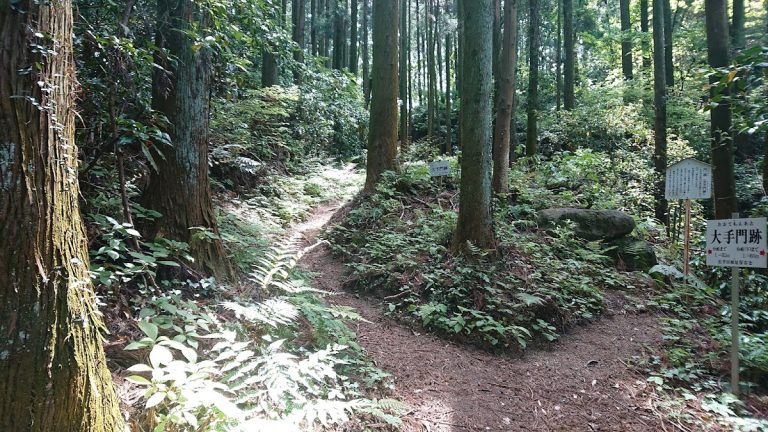
On the route from Sakamoto-juku toward Usui Pass, the Domine Guard Post stood midway up Mount Haneishi as a distant observation post belonging to Usui Sekisho. Two dōshin constables and two attendants staffed it. Besides surveillance, they rechecked departing women, people who had gone insane, wounded people, prisoners, severed heads, and corpses. The duty diary for 1775 contains about one entry per day.
Ojigi Stone
The Ojigi Stone was the place where travelers bowed to checkpoint officials, presented their travel permits, and received permission to continue. It therefore formed part of the formal process by which passage through Usui Sekisho was authorized.
Punishment sites
Western riverbed
At the riverbed west of the checkpoint, the head of Saji Hyoe was displayed after he was sent to Edo and died in prison. The place served as a public display point connected with punishment for evading the checkpoint.
Eastern riverbed
At the riverbed east of Yokokawa village, Gohei’s salted corpse was displayed and the monk Sokai was publicly crucified after their illegal crossing. These remains and execution sites reflect the severe penalties applied to those who violated the checkpoint’s controls.