Karasuyama Castle: A Mountain Stronghold and Domain Seat in Japan
Site at a Glance
- Rating
- 3.9
- Popularity
- Very Low
- Country
- Japan
- Primary era
- Early Modern
- External website
- Open
- Eras represented
- Medieval, Early Modern
- Civilizations
- Tokugawa
- Site type
- Military
- Remains
- Castle
On this page10 sections
History
Karasuyama Castle is a Japanese mountain castle in Nasukarasuyama, Japan, built in 1418 by Nasu Sukeshige of the Lower Nasu family. It became the family’s residence and later served as the seat of the unified Nasu clan through the Sengoku period, an era of prolonged civil warfare that lasted from the fifteenth to the late sixteenth century.
The Nasu stronghold
The Lower Nasu family held Karasuyama until its extinction in 1514. The castle then remained the seat of the wider Nasu clan, whose rivals repeatedly tested its defenses. The Satake clan and other enemies attacked the castle and its surrounding town in battles fought in 1563, 1566, and 1567. Fighting also took place at Kirigasawa. Despite these assaults, Karasuyama was never captured.
The Nasu position changed during Toyotomi Hideyoshi’s campaign against Odawara in 1590. The Nasu supported the Hojo side and were dispossessed after Hideyoshi’s victory. He divided their holdings and temporarily assigned their ancestral castle to Oda Nobukatsu, a son of Oda Nobunaga. Nobukatsu held Karasuyama for about two months under an arrangement described as either exile or confinement within his residence.
Karasuyama Domain in the Edo period
In 1591, Narita Ujinaga received the domain with an income of 20,000 koku, a historical measure of assessed agricultural production used to indicate a domain’s fiscal scale. After his death in 1596, his brother Narita Nagatada succeeded him. Under the Narita family, Karasuyama became the administrative center of Karasuyama Domain at the beginning of the Edo period, which followed the establishment of the Tokugawa shogunate in the early seventeenth century.
Naritada’s death in 1617 led to two succession disputes within several years, after which the Narita family was dispossessed. Matsushita Shigetsuna then entered the domain but was transferred four years later. The Hori family followed, and Hori Chikayoshi’s successor was transferred after forty-five years. In 1672, Itakura Shigemori, a senior Tokugawa official, became lord and began improving the castle town. His successor, Itakura Shigetane, continued the work after Shigemori’s death in 1673, but the family was transferred in 1681.
The Nasu family returned to the lordship after an interval of about ninety years, when Nasu Sukemi entered from Nasu Domain. He was not a direct descendant of the earlier ruling line, but had been adopted into the Nasu family because he was the maternal uncle of the fourth Tokugawa shogun, Tokugawa Ietsuna. In 1687, during the rule of Sukemi’s adopted heir, the Nasu family was dispossessed after the Karasuyama succession dispute.
Nagai Naoyoshi then became lord, but he was transferred after fifteen years. Inagaki Shigetomi and his successor, Inagaki Akikata, ruled next, and the Inagaki family was also transferred after fifteen years. In 1725, Okubo Tsuneharu entered Karasuyama. No further transfer followed, and successive members of the Okubo family governed the domain until the end of the feudal system. By the late Edo period, the castle served as the seat of a branch of the Okubo clan.
Abandonment and later remembrance
Karasuyama Domain sided with the imperial cause during the Boshin War, the 1868–1869 civil conflict in which forces supporting restored imperial government defeated the Tokugawa shogunate. The fighting did not reach the castle. Karasuyama was abandoned in 1869 when the Meiji government implemented the return of feudal domains and registers. Heavy snow caused the San-no-maru palace to collapse in 1872, and an accidental fire destroyed the remaining castle buildings in 1873.
The castle site is designated as a national historic site. Its former rear gate and the foundation stones of the main gate are also municipal tangible cultural properties. Karasuyama later became associated with Matsutaro Kawaguchi’s historical novel The Snake Princess, published in 1946, as well as with a film of the same name and the television period drama New Snake Princess. The character known as the Snake Princess was modeled on Oshi-ga-no-kata, the fourth daughter of Okubo Tadatsune.
Remains
Mountain fortifications
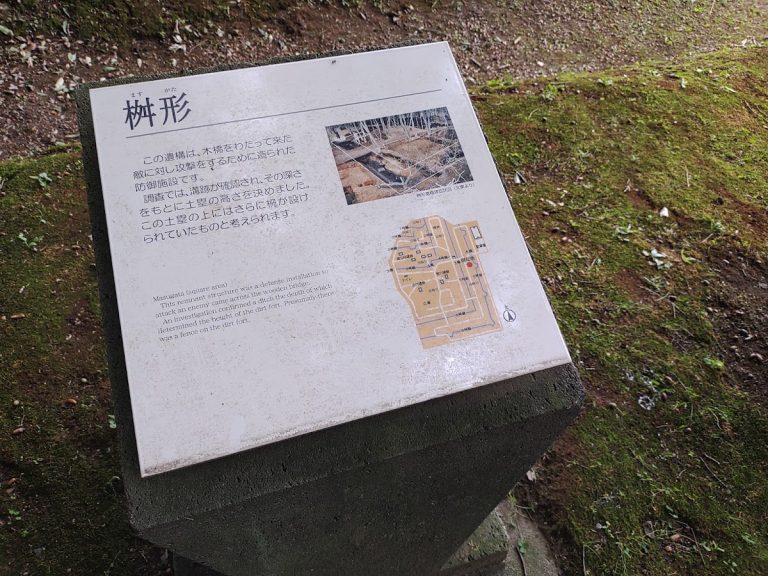
Karasuyama Castle occupies Mount Hakkōzan at an elevation of approximately 200 meters. Its mountain form was compared with a reclining ox, giving the castle the alternative name Gagyū Castle. The upper mountain was arranged around the main enclosure and second enclosure as a complex of five fortified sections and three enclosures. Clay walls, earthen ramparts, dry moats, and stone walls formed the defensive system, with masonry concentrated in the enclosures and along the principal approaches.
The castle buildings, including the main daimyo residence and most of the gates, were reconstructed in 1659. A daimyo was a powerful territorial lord who governed a domain under the Tokugawa shogunate. The rebuilt complex therefore reflects the castle’s continuing administrative use during the Edo period as well as its earlier military role.
Eastern enclosure
San-no-maru Palace
Hori Chikayoshi added a third enclosure at the eastern foot of the mountain in 1659. It contained the lord’s palace, known as the San-no-maru Palace, together with a Tamon turret. A Tamon turret was a long, multi-storey defensive structure that could include a covered fighting platform and storage space. The palace later collapsed under heavy snow in 1872, while the eastern enclosure formed part of the castle’s lower administrative area.
Walls and approaches
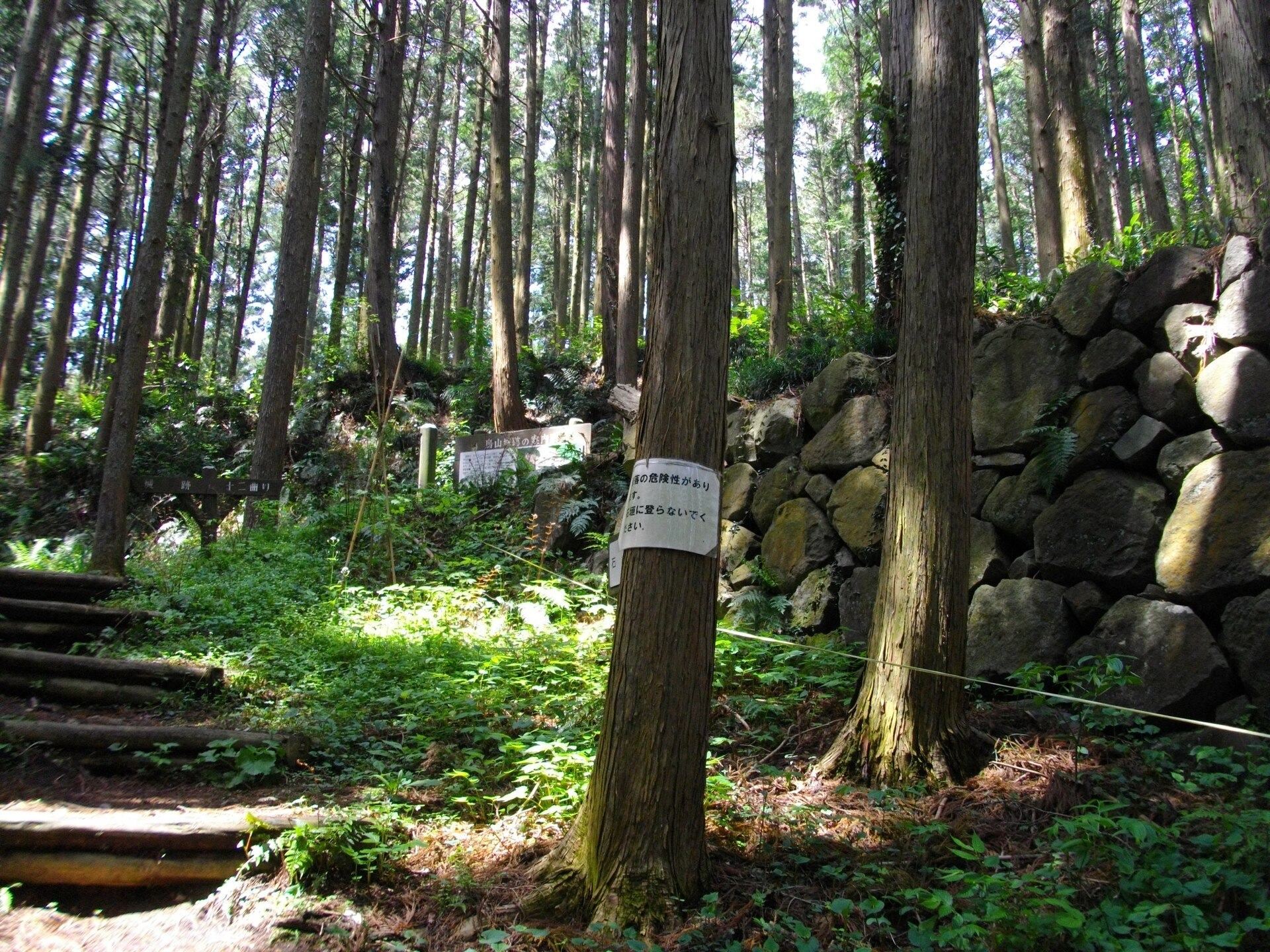
Stone walls and earthen ramparts survive within the park that now occupies the site. Their placement in the enclosures and along the principal approaches preserves elements of the castle’s defensive organization. The surviving walls and earthworks are in relatively good condition and convey the arrangement of the mountain stronghold and its lower enclosure.
Surviving gate
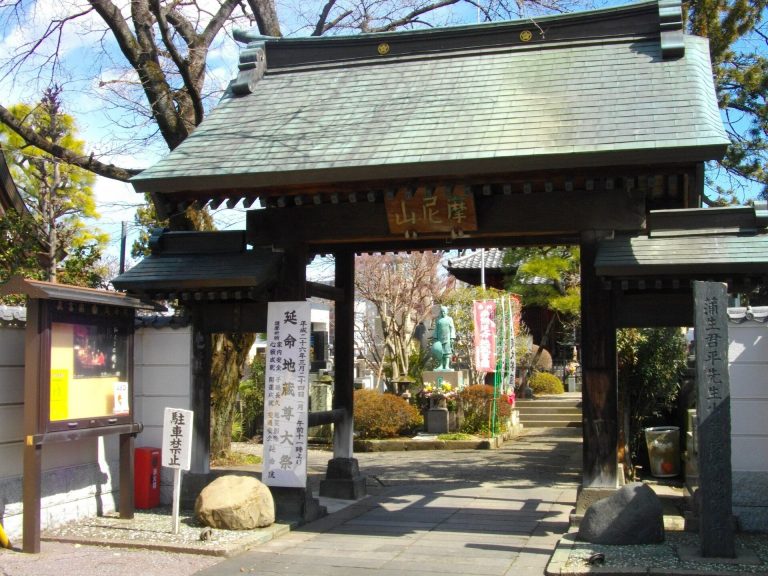
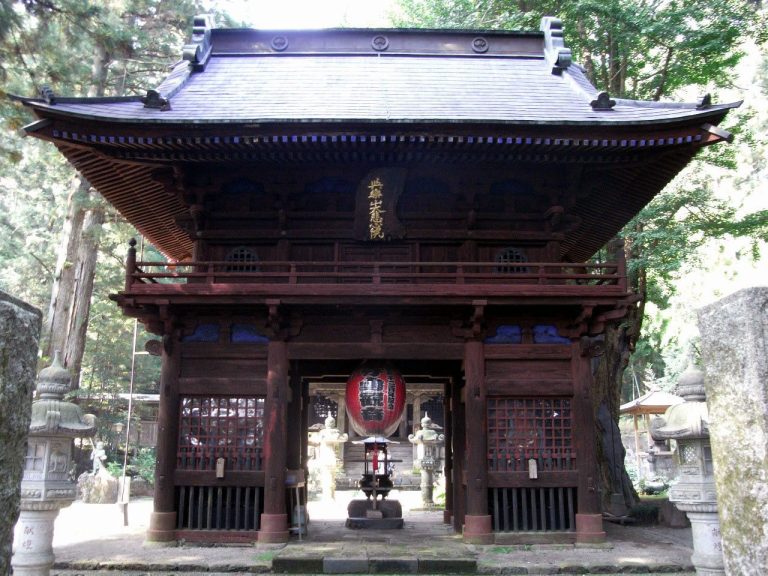
The former rear gate, called the Kaminaga Gate, was relocated from its original position and survives outside the castle’s historic grounds. Together with the foundation stones of the main gate, it represents the surviving material associated with the castle’s entrances after the destruction of its buildings in the nineteenth century.