Tobiyama Castle: A Medieval Stronghold of the Haga Clan


Site at a Glance
- Rating
- 4
- Popularity
- Low
- Country
- Japan
- Primary era
- Medieval
- External website
- Open
- Eras represented
- Medieval
- Civilizations
- Ashikaga shogunate
- Site type
- Military
- Remains
- Castle
On this page13 sections
History
Tobiyama Castle was a medieval Japanese castle in Utsunomiya, Japan, built by the Haga clan during the late thirteenth century as a hirayama castle, a stronghold on a hill or river terrace. Traditionally attributed to Haga Takatoshi, a retainer of Utsunomiya Kagetuna, it was said to have been constructed during the Einin era, around 1293 to 1298. The castle served as the residence and principal stronghold of the Haga, powerful retainers of the Utsunomiya clan, until its destruction and abandonment from 1590 onward.
The Haga Stronghold
The Haga clan claimed descent from the Kiyohara clan and had become vassals of the Utsunomiya by the eleventh century. While based at Tobiyama, the family reportedly used the surname Kiyohara. This tradition has been linked with the later place-name Kiyohara in eastern Utsunomiya, although the connection remains uncertain. The Haga and Mashiko clans formed the Kisei Ryoto, an allied grouping of warrior families associated with the Utsunomiya.
The Haga family gained considerable influence and received appointments as deputy governors of Kozuke and Echigo Provinces. During the Nanboku-cho period, the fourteenth-century conflict between rival Northern and Southern Imperial Courts, the clan became involved in regional warfare. Tobiyama Castle was captured by forces supporting the Southern Court on at least one occasion.
In 1341, a Haga leader supported Utsunomiya Ujitsuna when he seized Utsunomiya Castle and joined the Northern Court. Kasuga forces subsequently captured the castle. After their leader was compelled to leave and fight in Hitachi, the Haga leader retook Utsunomiya Castle. During the Kannō Disturbance, a wider conflict within the Ashikaga political order that began in 1349, the Utsunomiya fought for Ashikaga Takauji and received appointments connected with the governorships of Kozuke, Shimotsuke, and Echigo, while the Haga served as deputy governors.
The lord of Tobiyama Castle was later killed after Haga leaders and Utsunomiya Ujitsuna rebelled against Ashikaga Motouji, the Kamakura kubo, or military governor of the eastern region. Their forces were defeated at Iwadeyama in Musashi Province. These events reflected the close but often unstable relationship between the Utsunomiya house and its powerful Haga retainers.
Conflict between the Utsunomiya and Haga
The two houses continued to struggle for control during the sixteenth century. In the Utsunomiya Disturbance of 1512, Utsunomiya Shigetsuna suppressed the Haga and arranged for his brother, Utsunomiya Okitsuna, to succeed to the clan. In 1526, Okitsuna exiled Utsunomiya Tadatsuna, became head of the Utsunomiya clan, and installed Haga Takatsune as head of the Haga. Haga Takakatsu had first been forced to commit suicide.
In 1536, Haga Takatsune forced Utsunomiya Okitsuna to commit suicide and installed Utsunomiya Naotsuna as head of the Utsunomiya clan. Five years later, Naotsuna defeated Takatsune and appointed Haga Takasada, the son of Mashiko Katsumune, as head of the Haga. The succession disputes tied Tobiyama to the wider contest for authority within the Utsunomiya domain.
After Utsunomiya Naotsuna was killed while fighting the Nasu clan in 1549, Haga Takateru took control of Utsunomiya Castle. Takateru had been under Nasu protection since 1541. In 1555, Haga Takasada killed Takateru after Takateru had retreated to Moka Castle and supported Utsunomiya Hirotsuna, the son of Naotsuna.
Rebuilding and Destruction
In 1557, Utsunomiya Hirotsuna and Haga Takasada received 5,000 men from Satake Yoshiaki. They defeated Mibu Tsunao and recovered Tobiyama Castle. The stronghold was then rebuilt and used as an outlying guard castle for Moka Castle.
During the Sengoku period, the later medieval era of prolonged warfare among regional lords, Tobiyama served as a forward defensive position in the alliance between the Utsunomiya and Satake against the Later Hōjō clan, a major power in the Kantō region. Toyotomi Hideyoshi, the military ruler who unified much of Japan, destroyed the Hōjō during his 1590 campaign against Odawara. The resulting Utsunomiya Settlement ordered the destruction of unnecessary secondary castles, including Tobiyama. The castle was demolished and abandoned from 1590 onward, and Hideyoshi later confiscated the Utsunomiya and Haga holdings in 1597.
Archaeology and Preservation
Excavation before development revealed that the castle stood above an earlier ninth-century settlement, making Tobiyama a multi-period archaeological site. An ink inscription referring to a beacon station showed that facilities for signal fires existed in eastern Japan. The ruins were designated a National Historic Site on March 8, 1977. Utsunomiya began developing the area as a historic park in 2000, and Tobiyama Castle Historic Park opened in March 2005. Part of the archaeological area was damaged by house construction, while other portions were restored or left undeveloped.
A history museum beside the park displays artifacts found at the site and presents the history of Tobiyama Castle, the Haga and Utsunomiya clans, and the surrounding regions.
Remains
Tobiyama Castle occupied a river terrace on the east bank of the Kinugawa River. Its rectangular plan extended approximately 240 meters from east to west and 420 meters from north to south, while the surviving remains cover about 14 hectares. The western and northern sides were defended by steep cliffs along the Kinugawa and its tributaries, with a height difference of approximately 25 meters. Two earth ramparts and two dry moats enclosed the eastern and southern sides. Excavation established that the double moat system reached about 8 meters in depth.
Enclosures, Ramparts, and Moats
The castle was arranged in three concentric enclosure zones and seven kuruwa, fortified areas within a castle. The northwest enclosure formed the main bailey and was divided by moats into five sections. Another enclosure lay to its south, while a long, narrow enclosure extended around the eastern and southern sides. Five yagura, defensive tower or watchtower platforms, stood along the outer moat.
Earth ramparts and moats surrounded each enclosure. The inner moat was approximately 15 meters wide and 4 meters deep, while excavated sections produced widths of about 15 to 17 meters. The outer enclosure had higher ramparts and deeper moats than the older inner and middle baileys. Openings in the ramparts allowed defenders to fire against attackers from the side. Together, the compacted earth walls and dry defensive ditches form the principal surviving fabric of the castle.
Castle Buildings and Reconstructed Features
Internal Buildings
No internal castle buildings remain intact, but archaeological investigations within the seven enclosures found post-in-hole buildings, whose wooden posts were set directly into the ground, along with gates and medieval pit buildings. These structures have been interpreted as soldiers’ quarters and storehouses. The smallest northern enclosure is thought to have contained the lord’s residence, although that identification remains an interpretation.
Park Reconstructions
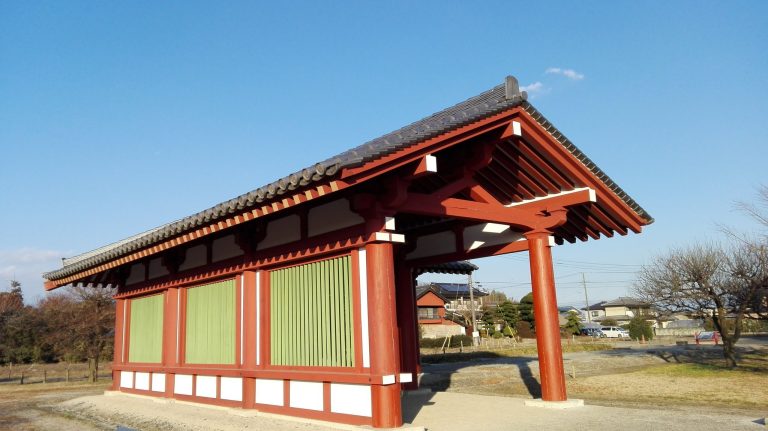
The historic park includes reconstructed earth ramparts and dry moats, a wooden bridge at the main entrance, and a reconstructed post-in-hole building interpreted as a soldiers’ lodging facility. It also contains a reconstructed umadashi, a projecting defensive enclosure positioned before a castle gate. These features represent parts of the castle’s defensive and operational arrangement.
Earlier Settlement and Finds
Ninth-Century Settlement
Below the medieval castle layer, excavation uncovered an early Heian-period settlement dating to the ninth century. Twelve pit-dwelling structures formed part of this earlier occupation. In the center of the settlement, a pit dwelling with walls standing above ground level produced an ink-written pottery vessel bearing an inscription meaning “beacon station.” The vessel connects the settlement with facilities used for signal fires.
Medieval Artifacts
Objects associated with the medieval castle include Tokoname and Seto ceramics, iron kozane armor scales, and bits. These finds accompany the excavated gates, buildings, ramparts, and moats in explaining the military use of Tobiyama and the successive occupations preserved beneath its remains.