Ōta Shrine: A Mountain Shinto Shrine in Hokkaido


Site at a Glance
- Rating
- 4.4
- Popularity
- Low
- Country
- Japan
- Primary era
- Medieval
- External website
- Open
- Eras represented
- Medieval, Modern
- Civilizations
- Japanese
- Site type
- Religious
- Remains
- Sanctuary
On this page11 sections
History
Ōta Shrine is a Shinto shrine in Japan, located at Setana in Hokkaido and traditionally founded during 1441–1443. Built on the steep slopes of Ōta Mountain above the Sea of Japan, it is regarded as the westernmost shrine on Hokkaido proper and as one of southern Hokkaido’s five sacred sites. The shrine enshrines Sarutahiko Okami, a deity associated with guidance, crossroads, and the safe passage of travelers.
Foundation and maritime devotion
In 1454, Takeda Nobuhiro and others landed at Ōta and bestowed on the shrine the honorific title “Great Gongen of Ōta.” A gongen was a Buddhist-Shinto religious title for a deity understood as a local manifestation of a Buddha or bodhisattva. After this recognition, the shrine was venerated for protection at sea and divine protection. Its former official status was that of a village shrine.
The shrine remained connected with religious activity on the mountain. During the 1660s, Enku, a Buddhist monk and sculptor from Mino Province, is traditionally said to have visited the area, practiced there, and carved numerous Buddhist images. Sutras were deposited at the shrine in 1704. In 1789, the travel writer and scholar Sugae Masumi climbed Ōta Mountain and left a written record of his visit.
Buddhist images and changing interpretations
The mountain’s Buddhist associations were also linked to Mokujiki, an itinerant Buddhist monk and sculptor who visited Ezo, the historical Japanese name for the northern lands later known as Hokkaido and surrounding regions, with his disciple Mokujiki Hakudo from June 1778 until May 1780. Mokujiki began making Buddhist images in Ezo. One theory holds that he visited Ōta Shrine and began this work after seeing images attributed to Enku. No surviving historical document directly records Mokujiki mentioning Enku or Enku’s images, however, and alternative interpretations remain.
Hakudo’s account of his life describes a visit to Ōta Shrine and his seeing numerous Buddhist images there. A 2004 investigation concluded that early Buddhist images in Ezo formerly attributed to Mokujiki, including images at Monshoan, were made by Hakudo. The investigation thus placed greater emphasis on Hakudo’s own role as a maker of Buddhist images while leaving the proposed connection between Mokujiki and Enku uncertain.
Separation of Buddhist and Shinto worship
In 1871, a government edict separating Buddhism and Shinto changed the arrangement of worship at Ōta. A Dainichi Hall was built at the foot of Ōta Mountain, and the Buddhist images dedicated at the shrine were transferred there. These included an image of Dainichi Nyorai, the Japanese Buddhist manifestation of Mahavairocana, the cosmic Buddha, as well as other Buddhist statues.
A mountain fire in 1922 destroyed the honden, the shrine’s principal sacred building, together with the Buddhist images then associated with the site. The honden was rebuilt after the fire, and a nyonin-do, a hall historically associated with women’s worship at a sacred site, was newly constructed. Ōta Shrine has continued to be regarded as a place of religious importance in southern Hokkaido, particularly through its associations with maritime safety and pilgrimage.
Remains
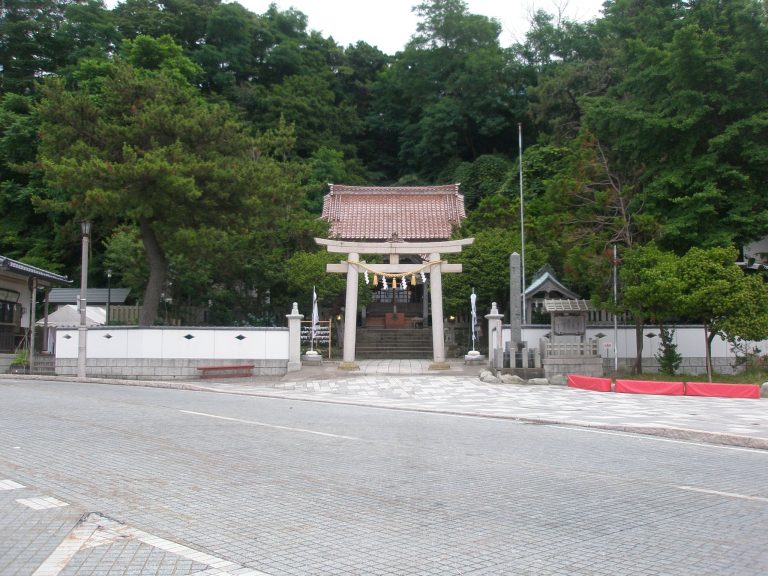
Ōta Shrine’s buildings are dispersed across the steep mountainside of Ōta Mountain above the Sea of Japan. The approach moves from a torii along Hokkaido Route 740 up a long stone staircase and then along a rough, heavily vegetated mountain path. The honden occupies a hollow in the cliff, while the Dainichi Hall stands separately at the mountain’s foot.
Mountain shrine complex
Approach and mountain path
The approach begins at a torii, the ritual entrance gate of a Shinto shrine, beside Hokkaido Route 740. A long stone staircase rises at an average slope of about 45 degrees before giving way to an uneven mountain path with rough footholds. Ropes installed along both sides are necessary for climbing and descending. A large rock bearing Buddhist images stands along the route, and the nyonin-do is also positioned on the mountain approach.
Honden and cliff access
At the end of the path, a cliff at least 7 meters high blocks the final ascent. Iron rings and ropes installed on the cliff provide the means of reaching the honden, which is built in a hollow in the rock face. The present honden follows the destruction of the earlier building in the 1922 mountain fire.
Religious halls
Nyonin-do
The nyonin-do was constructed after the 1922 fire. It is located along the mountain route and forms part of the surviving religious complex between the lower approach and the honden.
Dainichi Hall
The Dainichi Hall stands at the foot of Ōta Mountain. Built in connection with the 1871 separation of Buddhist and Shinto worship, it received the Buddhist images removed from Ōta Shrine, including the image of Dainichi Nyorai and other Buddhist statues.