Nomi Shrine: A Historic Shinto Shrine in Takatsuki, Japan


Site at a Glance
- Rating
- 4.1
- Popularity
- Low
- Country
- Japan
- Primary era
- Early Modern
- External website
- Open
- Eras represented
- Medieval, Early Modern, Modern
- Civilizations
- Japanese, Tokugawa
- Site type
- Religious
- Remains
- Sanctuary
On this page12 sections
History
Nomi Shrine is a Shinto shrine in Takatsuki, Japan, founded at the end of the ninth century during the reign of Emperor Uda, who ruled from 887 to 897. It began after an epidemic in the region was said to have subsided following a divine revelation, which led to the enshrinement of Gozu Tenno, a plague-protection deity identified with Susanoo. A shrine building was then erected, creating the original Gozu Tenno Shrine.
Origins and connection with Takatsuki Castle
When Takatsuki Castle was built at the end of the tenth century, the shrine was revered as a guardian of the castle. This association linked the religious institution with the political and military center of the surrounding area.
In the sixteenth century, Takayama Ukon became lord of Takatsuki Castle. A daimyō who had converted to Christianity, he destroyed the shrine buildings situated within the castle and confiscated the shrine estate because of his faith. The shrine buildings were rebuilt in 1619 by Matsudaira Ienobu, a lord of Takatsuki during the early seventeenth century.
Renaming and changing status
In 1868, a state policy separating Shinto and Buddhism reorganized religious institutions and required Shinto deities to be distinguished from Buddhist figures and institutions. Under this policy, the principal deity’s name was changed from Gozu Tenno to Susanoo. Nomi no Sukune was enshrined alongside Susanoo, and the shrine took the name Nomi Shrine. Nomi no Sukune is a legendary figure associated with the origins of sumo and with ancient Japanese burial traditions.
Nomi Shrine has been regarded as one candidate for the Nomi Shrine listed in the Engishiki, a tenth-century compilation that included laws, administrative procedures, and shrine listings. A shrine recorded in that register was called a Shikinaisha, and the small-ranked category was the lower of its two rank classes. In 1871, Nomi Shrine was classified as a small-ranked Shikinaisha and as a prefectural shrine on the grounds that it belonged to the Engishiki tradition. The identification was questioned, however, and the shrine was downgraded to village-shrine status in November 1872. It is also described as a former village shrine.
One historical interpretation regards the connection with the ancient Nomi Shrine as a later attempt to associate the institution with Nomi no Sukune. Under that interpretation, Nomi Shrine at Kamigū Tenmangū, also in Takatsuki, is the descendant shrine of the ancient institution.
The Nagai family and the shrine precinct
The precincts include Nagai Shrine, a lord-sponsored shrine established in 1793 by Nagai Naoyuki, the ninth lord of Takatsuki. It was founded to enshrine Nagai Naokiyo, the first lord of Takatsuki under the Nagai family, and was originally called Naokiyo Shrine. By the end of the Edo period, it was known as Naokiyo Gongen.
The Nagai family governed Takatsuki from 1649 until the domain system was abolished in 1871. Their development of the area contributed to the formation of the modern urban center. In 1848, during the rule of the eleventh Takatsuki lord, Nagai Naoteru, Nagai Shrine’s main hall was repaired, while its worship hall and four-legged gate were built. A four-legged gate is supported by four subsidiary posts in addition to its principal structural supports.
The precincts also contain Kojima Shrine, Shisha Myōjin, Takatsuki Ebisu Shrine, and Gokoku Shrine. Shisha Myōjin was formed during the Taishō period by combining Fukujin Shrine, Inari Shrine, Iwa Shrine, and a shrine for ancestral spirits. Takatsuki Ebisu Shrine was established in 1956 as a branch of Nishinomiya Shrine. Gokoku Shrine commemorates Takatsuki’s war dead from the Satsuma Rebellion, the First Sino-Japanese War, the Russo-Japanese War, the Second Sino-Japanese War, and the Pacific War.
The four-legged gate of Nagai Shrine was repaired in 2010, while the shrine buildings were damaged by the Northern Osaka Earthquake on June 18, 2018. These later events form part of the modern history of a precinct whose institutions have repeatedly been altered by changes in religious policy, local lordship, and urban development.
Remains
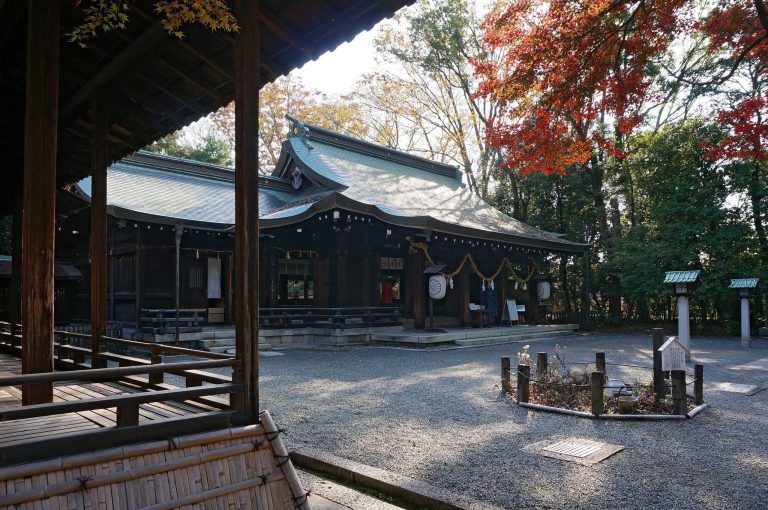
Nomi Shrine’s precincts are in Nomi-chō, Takatsuki, Osaka Prefecture, and contain the principal shrine together with Nagai Shrine and several subsidiary shrine buildings. The surviving architectural and material features reflect different periods, from the nineteenth-century construction and repair of Nagai Shrine to twentieth- and twenty-first-century buildings elsewhere in the precinct.
Nagai Shrine
Main hall and worship hall
Nagai Shrine’s main hall, worship hall, and four-legged gate belong to the nineteenth-century phase associated with Nagai Naoteru. The main hall was repaired in 1848, and the worship hall was built in the same year. The shrine is distinguished by clematis motifs, which appear both as its crest and as architectural ornament. The main hall and worship hall are associated with four ridge plaques and a votive picture depicting Takatsuki Castle. Seventeen additional items connected with Nagai Naokiyo are preserved at the Shiroato History Museum in Takatsuki.
Four-legged gate
The four-legged gate is a separate historic structure from Nagai Shrine’s main and worship halls. Built in 1848, it was repaired in 2010 and remains part of the shrine’s architectural group. Its form uses four subsidiary posts in addition to the principal structural supports, giving the entrance its characteristic name.
Subsidiary shrines
Kojima Shrine and Shisha Myōjin
Kojima Shrine stands within the Nomi Shrine precincts, although its foundation date is unknown. Its buildings were newly constructed in 2021. Shisha Myōjin represents the Taishō-period combination of four earlier religious sites: Fukujin Shrine, Inari Shrine, Iwa Shrine, and a shrine devoted to ancestral spirits.
Takatsuki Ebisu Shrine
Takatsuki Ebisu Shrine was established in 1956 as a branch of Nishinomiya Shrine. Its present shrine building dates from 1966 and forms part of the group of subsidiary buildings within Nomi Shrine’s precincts.
Gokoku Shrine
Gokoku Shrine commemorates Takatsuki’s war dead from the Satsuma Rebellion, the First Sino-Japanese War, the Russo-Japanese War, the Second Sino-Japanese War, and the Pacific War. The precinct’s associated religious figures also include Ichikishimahime, Ōnamuchi, Iwanagahime, Amenokoyane, Hiruko, and the spirits of those war dead, alongside the principal deities Susanoo and Nomi no Sukune.