Tekturmas Mausoleum: A Historic Shrine in Taraz, Kazakhstan


Site at a Glance
- Rating
- 4.7
- Popularity
- Low
- Country
- Kazakhstan
- Primary era
- Medieval
- Eras represented
- Medieval, Modern
- Civilizations
- Mongolian
- Site type
- Religious
- Remains
- Tomb
On this page8 sections
History
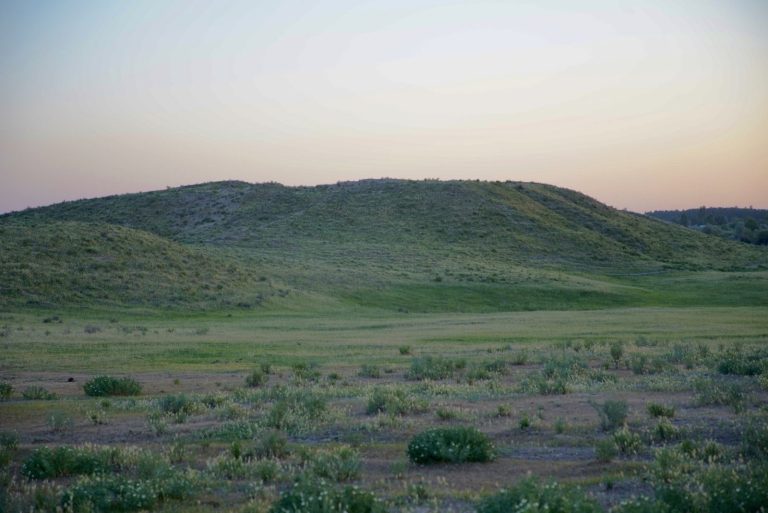
Tekturmas Mausoleum is a fourteenth–fifteenth-century tomb monument in Kazakhstan, standing on Tekturmas Hill at the southeastern edge of Taraz beside the Talas River. Local tradition associates it with Sultan Mahmud Khan, also known as Tekturmas-ata, who was revered as a saint and credited with helping spread Islam in the region.
Origins and sacred traditions
The architect and builder of the mausoleum are unknown. One local tradition places its construction in the fourteenth century, while archaeologist Mikhail Masson proposed a fifteenth-century date after examining a surviving ornamented terracotta tile. Traditions in Kazakh literature portray Tekturmas as a holy figure. One legend also describes him as the commander of an army during the time of Karakhan, a ruler associated with local historical tradition.
The mausoleum stood within a multi-period necropolis whose burials reflect several religious communities. Investigations around the hill found Zoroastrian ossuary burials, in which cleaned bones were placed in containers, as well as medieval Christian and Muslim graves. Vasily Kallaur studied the monument at the end of the nineteenth century, and G. I. Patsevich examined it in 1939–1940.
Damage, destruction, and rebuilding
The mausoleum was damaged in 1864 during the Russian imperial capture of Aulie-Ata, the historical name of Taraz used in the nineteenth century. Kokand forces shelled a river crossing near the elevation occupied by the Zaachuy detachment under Mikhail Chernyaev, a Russian imperial military commander. Chernyaev referred in his notes to the grave of a saint named Tek-Turmas, from whom the surrounding heights were said to have taken their name.
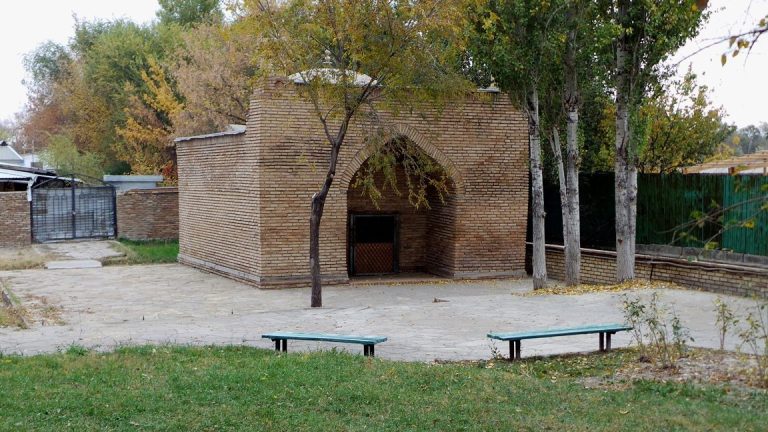
By 1935 the original building had been extensively ruined and was dismantled to its foundations for building material. Local residents erected a small structure beside the saint’s grave, allowing the ziyarat, a devotional visit to a sacred tomb or shrine, to continue. The site received state protection in 1982 as a monument of history and culture of republican significance in the Kazakh Soviet Socialist Republic, a high-level cultural-heritage status it retains in Kazakhstan.
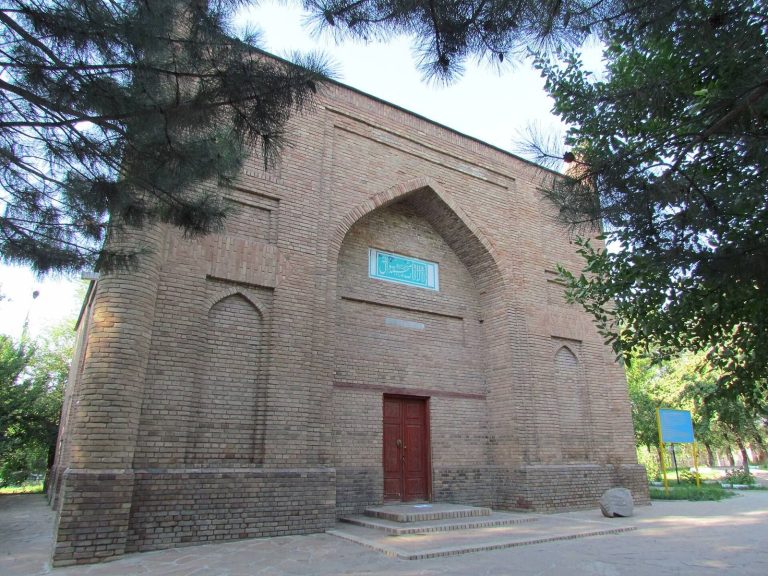
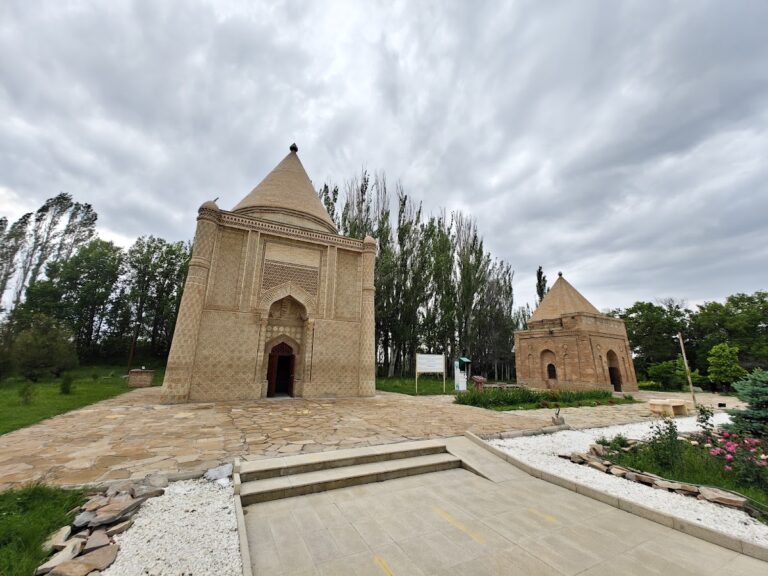
For Taraz’s 2,000th anniversary celebrations in 2001, a new mausoleum was erected on the site of the destroyed mazar, a shrine or tomb associated with a revered person. A further reconstruction followed in 2002, based on an old photograph. These interventions created a modern interpretation of the earlier monument rather than preserving the original building intact.
Remains
Mausoleum structures
Earlier domed building
Photographs from the 1890s show the earlier mausoleum as a four-sided, domed building made of fired brick. Pilasters terminated its corners, and traces of plaster survived on the walls. Its entrance was a west-facing arched opening directed toward Taraz. The surviving ornamented terracotta tile formed the basis for Masson’s proposed fifteenth-century date.
Modern reconstruction
The building standing on the hill today resulted from the reconstructions of 2001–2002. It follows the earlier mausoleum as an interpretive reconstruction, while its facade articulation was described as considerably less expressive than that of the predecessor shown in nineteenth-century photographs.
Necropolis and devotional structure
The surrounding necropolis contains burial remains from multiple periods. Zoroastrian ossuaries preserve the skeletal remains of members of that religious community, while medieval Christian and Muslim graves represent later phases of burial at the site. Beside the saint’s grave stands the small devotional structure erected after the original mausoleum was dismantled, maintaining the place’s local ritual association.