Deggaron Mosque: An Early Islamic Religious Monument in Uzbekistan
Site at a Glance
- Rating
- 4.8
- Popularity
- Very Low
- Country
- Uzbekistan
- Primary era
- Medieval
- Eras represented
- Medieval, Modern
- Civilizations
- Karakhanid
- Site type
- Religious
- Remains
- Mosque
On this page11 sections
History
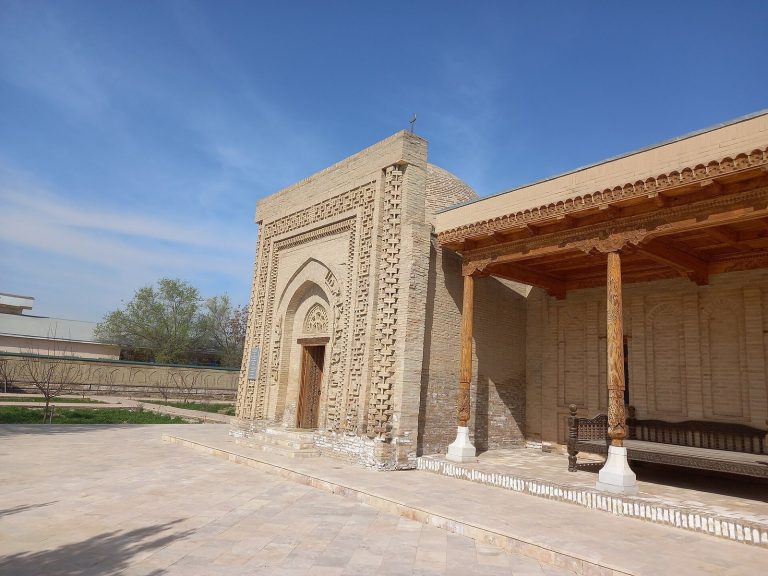
Deggaron Mosque is an early Islamic religious monument in Uzbekistan, near Hazara village in the Karmana area of Navoiy Region, commonly dated to the eleventh or twelfth century. It is regarded as one of the country’s earliest surviving Islamic religious buildings, although earlier interpretations place its construction in the seventh to ninth or eighth to ninth centuries. The mosque has also been associated with the Karakhanid period, when this Turkic Muslim dynasty ruled much of Central Asia from the tenth to the early thirteenth century.
Earlier settlement and changing interpretations
The mosque was built over an earlier structure generally dated to the eighth or ninth centuries. Archaeologists found remains of walls belonging to an ancient settlement around the building. The site stood within a fortified village on the left bank of the Zarafshan River, in an area that had previously been strongly defended. After drought led to the settlement’s abandonment, Hazara village moved to a location somewhat farther from the mosque.
The name Deggaron refers to the pottery production that flourished in the area during the Middle Ages. The word means “potter,” linking the monument’s name with the craft activity associated with the surrounding community. The mosque’s construction has also been connected with the growth of craft production and trade in Hazara. Its architectural form has been interpreted as reflecting traditions associated with Zoroastrianism, an ancient Iranian religion whose sacred buildings sometimes used roofed central spaces supported by internal pillars. This comparison concerns the building’s form rather than its Islamic function.
Archaeological investigation
An Italian expedition prepared topographic plans of the site in 1910. The Russian archaeologist Vasiliy Shishkin dated the mosque to the eighth or ninth centuries and reported that representatives of the State Hermitage and an Uzbek antiquities-preservation committee identified it in May 1934. Alexander Yakubovsky, an archaeologist and historian, began investigating the building’s history in 1939. In 1946, the Penjikent archaeological expedition, an archaeological project focused on ancient Penjikent and its surrounding region, continued the study under Yakubovsky’s leadership.
Yakubovsky considered Deggaron Mosque older than the Ismail Somoni Mausoleum in Bukhara, a prominent tenth-century funerary monument associated with the ruler Ismail Somoni. Later interpretations placed Deggaron Mosque in the eleventh century or later, leaving its precise construction date unresolved.
Repair and continued religious association
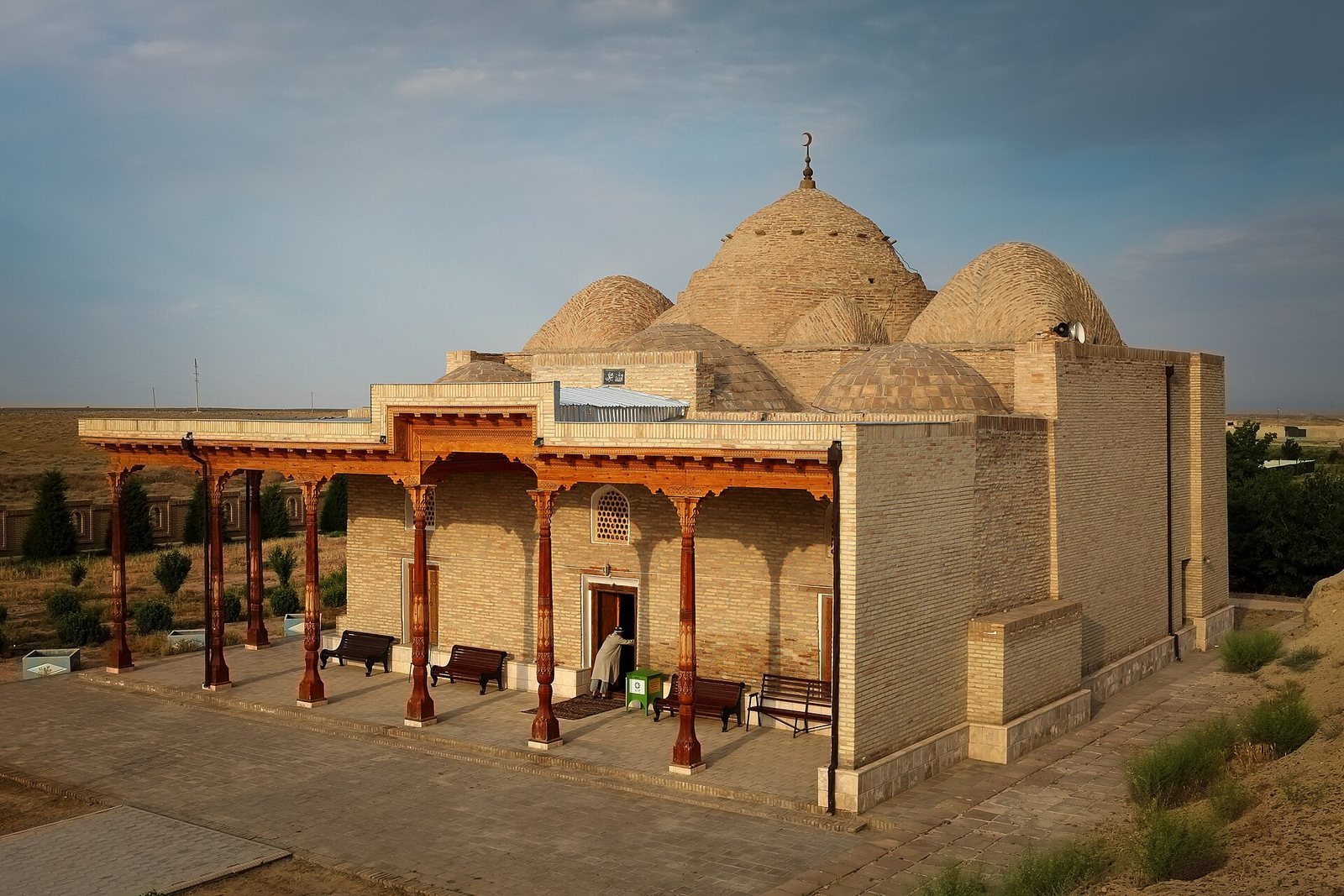
During the Soviet period, the mosque deteriorated and required repair. Restoration took place in 1975 with the participation of craftsmen from Hazara, and a front veranda was added in an effort to recover the building’s earlier appearance. A museum was later created inside the mosque, displaying old equipment and other archaeological and historical artefacts.
The mosque has since been restored and remains active. The surrounding historical complex includes a local-history museum, a khanaka, or Sufi religious and residential complex, and the tombstone of Sheikh Arif Deggaroni, regarded as one of the teachers of Bahauddin Naqshband, the fourteenth-century Sufi figure associated with the Naqshbandi tradition. A Deggaroni foundation operates under the administration of Navoiy Region. The site is maintained by the government of Uzbekistan and has been considered for inclusion on the UNESCO World Heritage List.
Remains
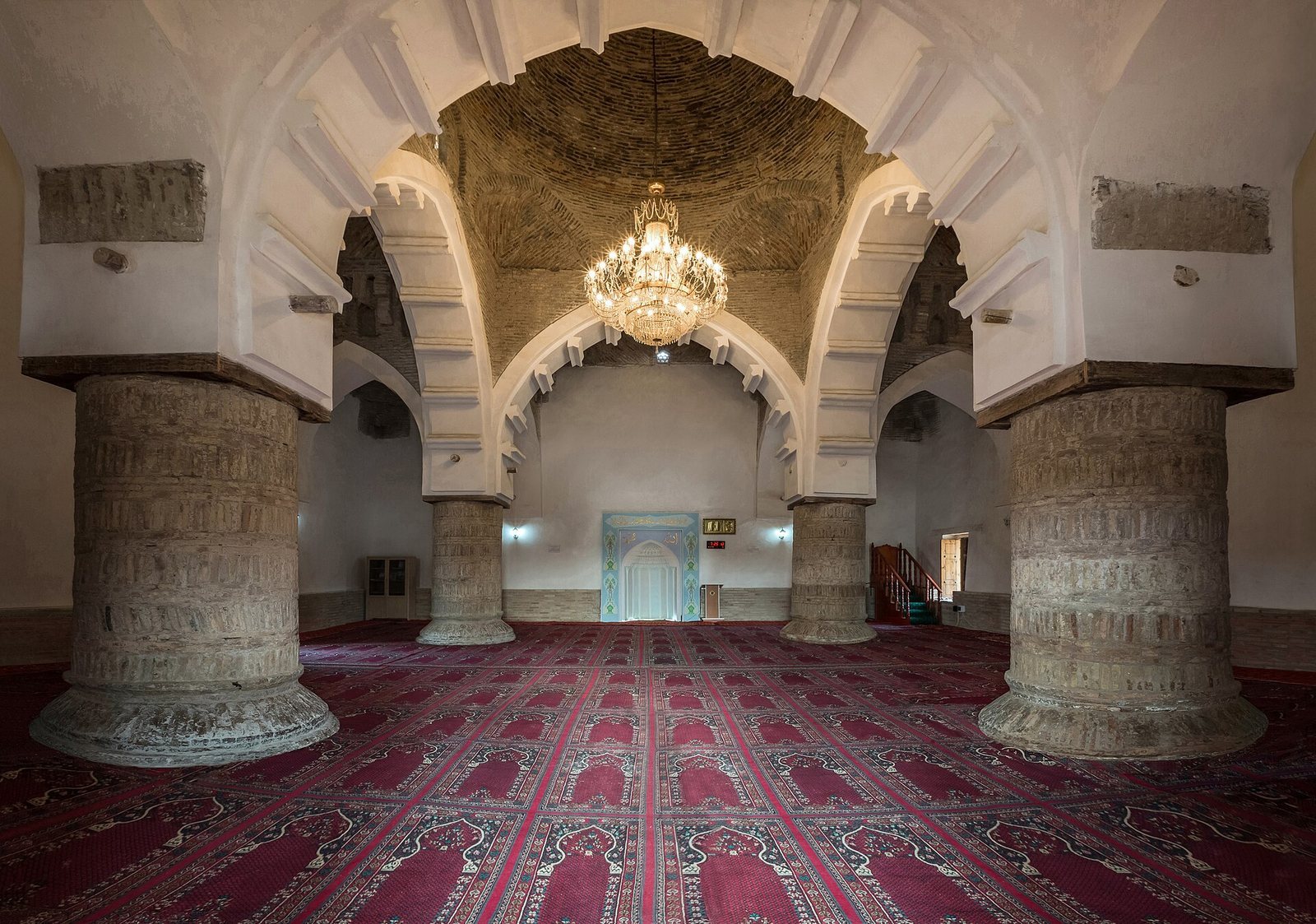
Deggaron Mosque has a roughly cubic exterior and a central-domed, nine-part interior. Four large pillars divide the prayer hall into nine sections, while a group of nine domes forms the roof. The mosque’s principal walls consist mainly of unfired mud brick faced with fired brick. Its interior supports and domes preserve a construction system that gives the building its distinctive central arrangement.
Prayer hall and domes
Four supporting pillars
The four interior pillars stand on a limestone foundation and are made of fired brick. Each is approximately 128 centimetres in diameter. They support pointed arches, together with the surrounding walls, and divide the prayer space without intervening walls. The arches beneath the central dome carry ganch ornament, made from a fine gypsum-based plaster used for moulded and carved decoration in Central Asian architecture.
Nine-domed roof
The middle section is covered by the largest dome, approximately 3 metres in diameter, while the other eight sections have smaller domes. All nine are balhi domes, a type associated with Central Asian architectural traditions. The arrangement of a central dome resting on four pillars has been considered unusual in Islamic architecture and compared with centralised plans found in Zoroastrian temples and some early Christian churches. Similar multi-domed arrangements are identified at the eleventh- to twelfth-century mosque in the Hakim al-Tirmidhi complex, the tenth- to eleventh-century Chor Sutun Mosque in Termez, and the twelfth-century Magoki Attari Mosque in Bukhara.
Verandas and associated remains
Porches and later additions
A two-tier wooden ayvan, meaning a roofed, open-sided porch, originally adjoined the mosque and was removed during the first restoration. During the twentieth century, framed verandas were attached to the southern and eastern sides of the prayer hall. The southern veranda had a single row of columns, while the eastern veranda was twice as wide and had two rows. An inscription on one column recorded rebuilding in 1910. These verandas later fell into ruin, while the 1975 restoration added a front veranda in an effort to recover the building’s earlier appearance.
Settlement walls and historical complex
The mosque stands beside the remains of the walls of the ancient settlement that surrounded it. The wider historical complex contains a khanaka, a local-history museum, and the tombstone of Sheikh Arif Deggaroni. The museum inside the mosque contains old equipment and other archaeological or historical artefacts, placing the surviving building within the material history of the Hazara area.