Dalverzin Tepe: An Ancient Graeco-Bactrian and Kushan City in Uzbekistan
Site at a Glance
- Rating
- 4.5
- Popularity
- Very Low
- Country
- Uzbekistan
- Primary era
- Classical
- Eras represented
- Classical
- Civilizations
- Greco-Bactrian, Kushan
- Site type
- City
On this page9 sections
History
Dalverzin Tepe is an ancient archaeological site near Denau in Uzbekistan’s Surxondaryo Region, on the northern bank of the Amu Darya. The Graeco-Bactrian Kingdom, a Hellenistic state formed in Bactria after the breakup of Alexander the Great’s empire, founded it as a settlement in the 3rd century BC. The site began as a small fortified town organized around a central citadel and later became a major urban centre during the Kushan period.
Graeco-Bactrian Foundation
The original settlement was a compact fortified town with its buildings arranged around a citadel. Its foundation placed Dalverzin Tepe within the Hellenistic political and cultural world of Bactria, although the settlement later developed through distinctly Central Asian historical phases.
Kushan Expansion
From the 1st to the 3rd centuries AD, Dalverzin Tepe grew and prospered under the Kushan Empire, a major Central Asian power that supported Buddhism and long-distance cultural exchange. During this period, the citadel was rebuilt and the city’s defensive walls were strengthened, with the fortifications becoming twice as thick. The settlement contained administrative-military, residential, religious, and manufacturing areas. Galina Pugachenkova proposed that Dalverzin Tepe may have been the original capital of the Kushan Empire.
Religious activity formed an important part of the Kushan city. It included two Buddhist temples and two temples dedicated to local goddesses. Manufacturing also had a defined place in the urban plan, including a potters’ quarter on the outskirts. The city’s coins and inscriptions reflect the variety of traditions present during this period. Copper and gold coins dating from the 1st to the 7th centuries AD depict deities and bearded kings. Most inscriptions use Greek and Indian languages, while some employ an otherwise unknown language written in Greek script.
Hephthalite Rule and Abandonment
Dalverzin Tepe came under Hephthalite control in the 5th and 6th centuries. The Hephthalites, sometimes called the White Huns, were a Central Asian power that ruled parts of the region during this period. By then, the city and its temples were already in decline. The thick city walls were used largely for burials, indicating a change in the way the former urban complex was occupied. After the Muslim conquest in the 8th century, Dalverzin Tepe was completely abandoned.
Excavation and Archaeological Interpretation
The Soviet archaeologist L. I. Al’baum discovered Dalverzin Tepe in 1949. Galina Pugachenkova led excavations during the 1960s and 1970s, followed by further work directed by B. A. Turgunov in the 1980s. The first Buddhist complex was excavated in 1967 and 1968. Turgunov later discovered a second Buddhist complex, whose temple has been dated by floor samples to AD 320–410, although its structure remains unclear. These excavations revealed the city’s religious buildings, workshops, sculptures, coins, ceramics, and a major gold treasure.
Remains
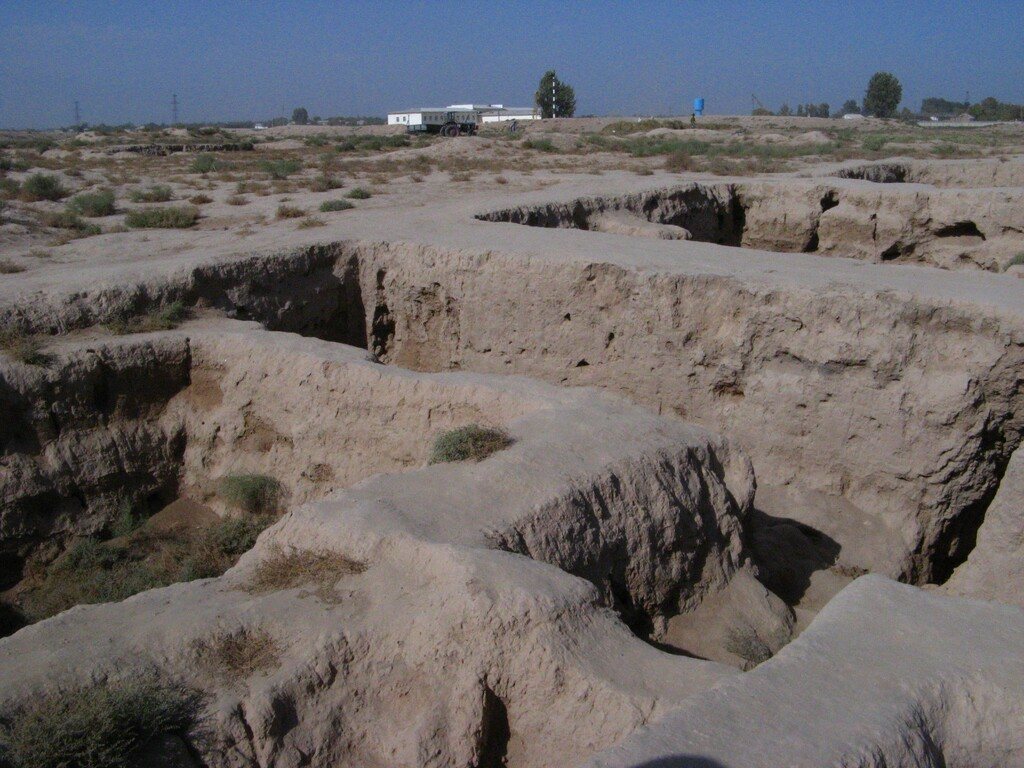
Dalverzin Tepe was a rectangular city measuring approximately 650 by 500 metres in the early Kushan period. A central citadel stood at the centre, while other buildings were arranged in parallel rows around it. Distinct administrative-military, residential, religious, and manufacturing zones formed the wider urban layout. Buildings were generally made from unbaked clay bricks, with wooden beams supporting their roofs. An underground network of qanats, or water channels that carry water from elevated sources to settlements, supplied each house.
Residential and Manufacturing Areas
Larger houses contained a columned entrance, a vestibule, living and working rooms, and a domestic sanctuary. These elements show how residential buildings combined household, productive, and religious functions. On the city’s outskirts, the potters’ quarter contained workshops and kilns, creating a separate manufacturing area within the settlement’s broader plan.
Buddhist Complexes
The first Buddhist complex included a large platform that may have supported a stupa, a Buddhist monument commonly associated with relics, worship, and ritual movement around a solid domed or mound-like structure. A corridor and several rooms surrounded the platform. The rooms contained fragmentary sculptures of bodhisattvas, Buddhist beings who postpone final liberation to aid others, together with figures of secondary deities.
The two Buddhist complexes yielded numerous sculptures made from unbaked clay, then covered with plaster and painted. Their styles combine two influences. One is associated with Gandharan art, a Buddhist tradition from the region of northern Pakistan and eastern Afghanistan that combined South Asian, Iranian, and Hellenistic elements. The other is a more locally rooted Graeco-Iranian tradition. Many of the figures are dressed in ways similar to sculptures from Khalchayan, an ancient site in southern Uzbekistan known for its pre-Islamic sculpture.
Gold Treasure and Other Finds
A gold treasure found in one of the buildings in 1972 dates mainly to the 1st century AD and was buried in the early 2nd century AD. It is described as the largest gold treasure discovered in Central Asia, consisting of 115 objects with a combined weight of 36 kilograms. Most of the treasure comprised circular and parallelepipedic ingots, along with jewelry and other decorative objects. Many ingots carry Kharoshthi inscriptions, using an ancient script employed in the northwestern Indian subcontinent and nearby Central Asian regions. The inscriptions record weights and refer to Mitra, an Indo-Iranian deity associated with agreements, contracts, and social order.
The treasure also contained locally made and imported gems, complete sets of Kushan ceramics, and jewelry associated with the Kushan Empire. The jewelry mainly reflects styles found in Gandharan art. Two small clay figurines, an elephant and a bull, date to the 1st or 2nd century AD. They have been hypothesized to be chess pieces, which, if correct, would place examples of the game approximately 400 years earlier than the previously assumed date for its invention.