Khujand Fortress: A Historic Defensive Stronghold in Tajikistan



Site at a Glance
- Rating
- 4.6
- Popularity
- Low
- Country
- Tajikistan
- Primary era
- Medieval
- Eras represented
- Classical, Medieval
- Civilizations
- Sogdian
- Site type
- Military
- Remains
- Fort
On this page7 sections
History
Khujand Fortress is a historic defensive stronghold in Khujand, Tajikistan, whose earliest surviving ruins date from the fourth or fifth century AD. Built as part of the city’s initial fortification, it occupied a strategic position beside the Syr Darya and later became associated with the defense of Khujand during the Mongol invasion. The city’s importance also reflected its origins as Alexandria Eschate, meaning “the furthest Alexandria,” founded by Alexander the Great, and its position on the Silk Road, the network of trade routes linking China, Central Asia, the Middle East, and Europe.
Early Fortification and Regional Rule
The first fortress consisted of a defensive wall and a moat, a ditch constructed around a fortification. This early stronghold was later destroyed and rebuilt during the sixth or seventh century, a period when Khujand experienced successive changes of rulers. Arab conquests brought Islam to the region at the end of the seventh century, adding another major phase to the city’s changing political and religious history.
Khujand later prospered under the Khwarazm-Shahs, rulers of Khwarazmia from the Anushteginid dynasty. The city’s location on long-distance trade routes helped sustain its wealth and political importance before the expansion of the Mongol Empire into Central Asia.
The Mongol Campaign and Timur Malik
After Mongol merchants were attacked in Khwarazmia, Chinggis Khan, the founder and first great khan of the Mongol Empire, began a campaign against the region in 1219. During a major battle near Khujand, the city’s inhabitants sought refuge in the fortress with Timur Malik, its governor.
The river and the fortress offered strong protection. Approximately 20,000 Mongol besiegers forced 50,000 prisoners of war to build a bridge across the Syr Darya toward the stronghold. Timur Malik repeatedly disrupted the work from the river with a flotilla of six boats, using bombardment against the Mongol forces.
As the bridge approached completion, Timur Malik evacuated the population and fled with his followers along the Syr Darya. He repeatedly ambushed those pursuing him before escaping. The Mongols subsequently destroyed the fortress. Its reconstruction date remains uncertain: it may have been rebuilt soon after the destruction or only during the fifteenth century.
Restoration and Historical Interpretation
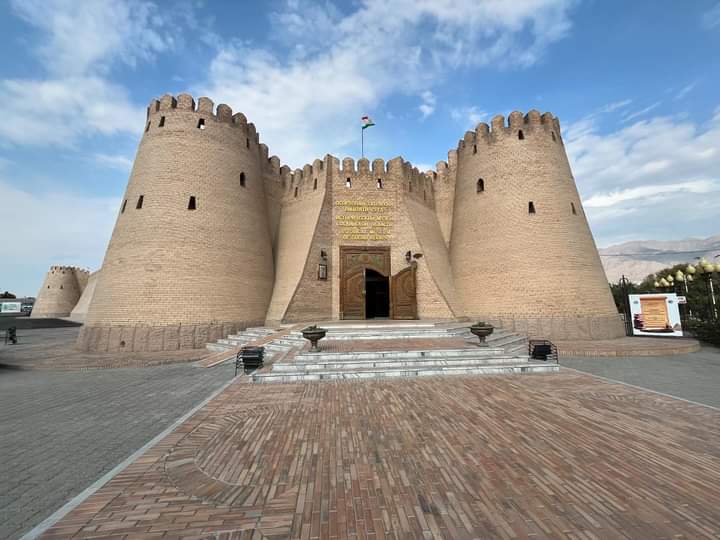
In 1999, the eastern part of the fortress was restored. It now houses the Historical Museum of Sughd, a historical region corresponding broadly to northern Tajikistan and adjacent Uzbekistan. The museum presents themes including Alexander the Great’s foundation of the city, Timur Malik’s defense of Khujand, and the region’s traditional crafts. Timur Malik is regarded as a national hero in Tajikistan.
Remains
Early Defensive Works
The earliest physical remains belong to a fortification established in the fourth or fifth century AD. Its basic defenses were a wall and a moat, forming a fortified enclosure beside the Syr Darya. The river itself contributed to the site’s defensive setting, linking the constructed defenses with a natural barrier.
Restored Eastern Section
The eastern section was restored in 1999 and contains the Historical Museum of Sughd. This surviving part of the fortress presents the site through exhibits on Khujand’s foundation as Alexandria Eschate, the defense led by Timur Malik, and traditional crafts from the surrounding region.