Macuteo Obelisk: An Egyptian Monument at Rome’s Pantheon
Site at a Glance
- Rating
- 4.6
- Popularity
- Very Low
- Country
- Italy
- Primary era
- Early Modern
- Eras represented
- Bronze Age, Early Modern
- Civilizations
- Egyptian, Papal States
- Site type
- Civic
- Remains
- Obelisk
On this page11 sections
History
The Macuteo obelisk is an ancient Egyptian monolith in Rome, Italy, made on the orders of Pharaoh Ramses II. It was originally erected at Heliopolis, where it stood before a temple of Ra and formed a pair with the granite stump now called the Matteiano obelisk in the sanctuary of Amun-Re. The monument has also been regarded as a Roman-period work, like the obelisk in Piazza Navona.
From Heliopolis to Imperial Rome
During the Roman imperial period, the obelisk was transported to Rome for the Iseum Campense, a sanctuary dedicated to Isis, the Egyptian goddess whose worship spread widely through the Roman world. Its movement from Heliopolis placed an Egyptian monument within one of Rome’s religious settings associated with Egyptian worship, near the Pantheon.
Rediscovery and Relocation
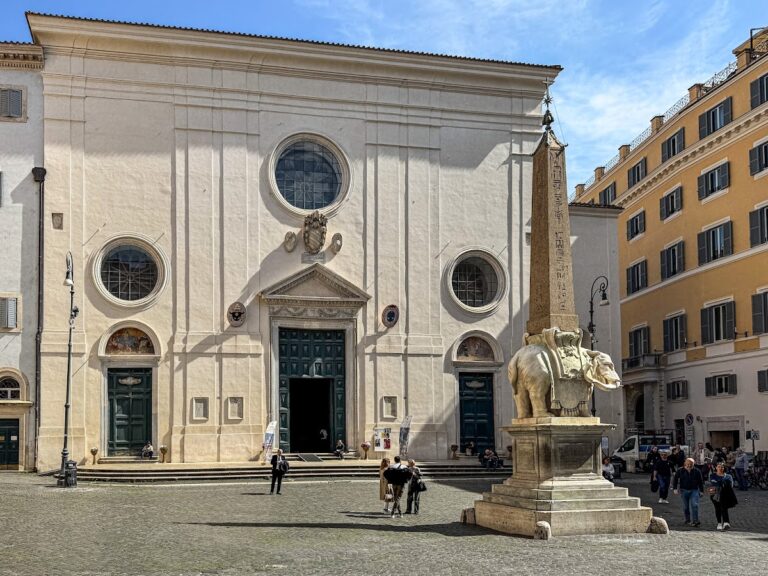
After the fall of the Western Roman Empire, the obelisk was toppled and buried. It was rediscovered beneath the apse of Santa Maria sopra Minerva in 1374. By the middle of the fifteenth century, it had been re-erected in Piazza di San Macuto, near Sant’Ignazio. This location gave it the historical name Obelisco Macuteo, a name that is now used less frequently.
The Fountain in Piazza della Rotonda
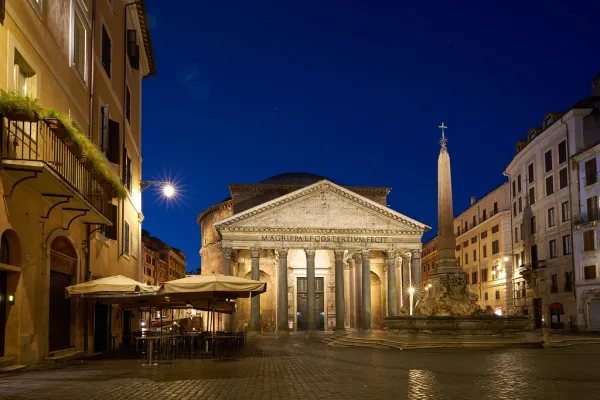
The fountain in Piazza della Rotonda was completed in 1575 as a public fountain for drawing water. It was created after the restoration of the Aqua Virgo, an ancient Roman aqueduct that supplied the area around the Campus Martius and was restored for Renaissance public fountains. The fountain initially had no connection with the obelisk.
In 1570, Pope Gregory XIII commissioned eighteen new public fountains to distribute water from the restored aqueducts and entrusted their design and execution to Giacomo della Porta. Leonardo Sormani, a sculptor and stonecutter, carried out the Pantheon fountain according to della Porta’s design. In 1711, Pope Clement XI ordered its reconstruction to harmonize it with the Pantheon. Filippo Barigioni designed this late Baroque version, incorporating the obelisk as its central element.
The fountain underwent a major restoration in the 1880s. Prolonged erosion by water had damaged the original Baroque sculptures, which were removed and placed in the Museum of Rome at Palazzo Braschi. Luigi Amici made replacement copies for the fountain, while the granite obelisk remained in place.
Remains
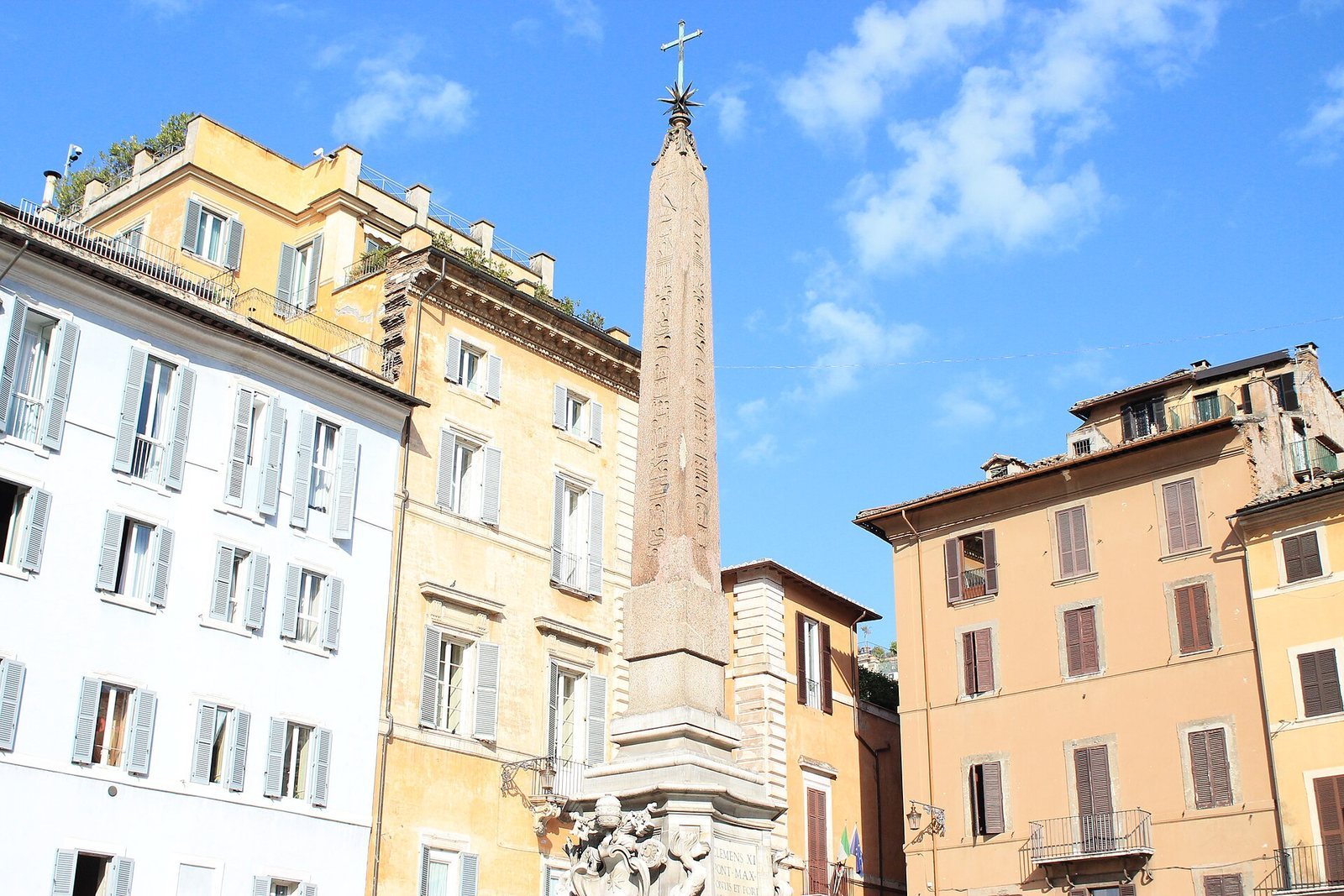
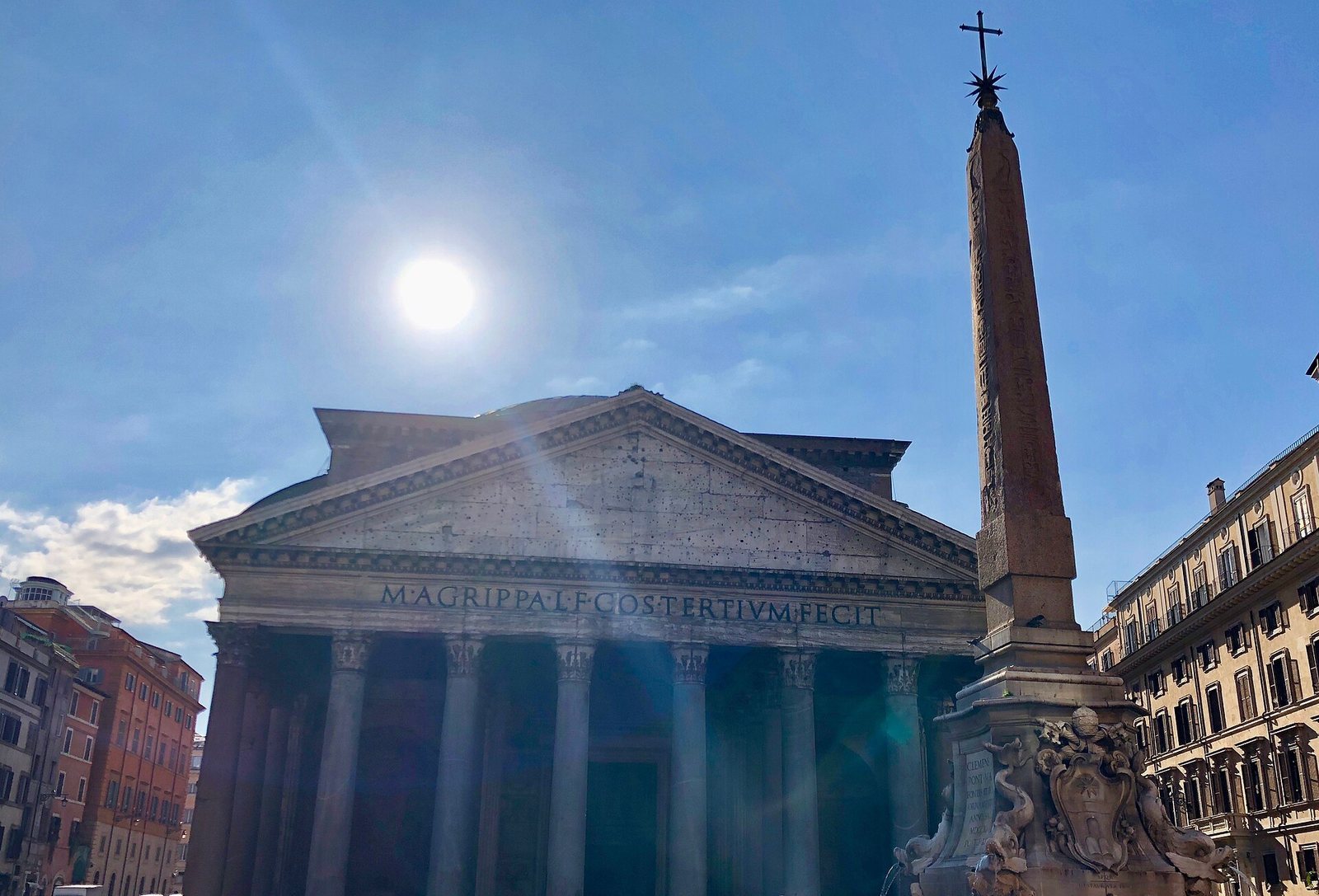
The obelisk stands at the center of the Renaissance-to-Baroque fountain in Piazza della Rotonda, directly in front of the Pantheon. Its red granite shaft rises 6.34 metres, while the complete monument, including its base, reaches 14.52 metres. The obelisk’s former association with the granite Matteiano obelisk survives through their shared origin in the sanctuary of Amun-Re at Heliopolis.
The Egyptian Obelisk
Pyramidion and Inscriptions
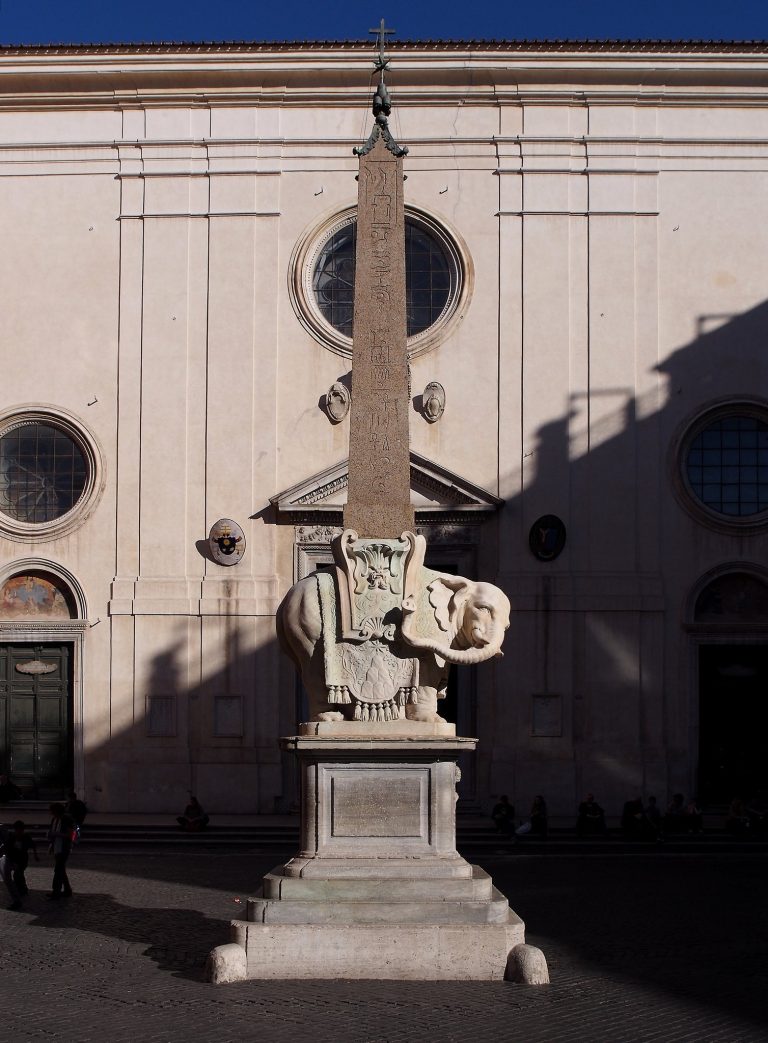
The pointed upper section, called a pyramidion, contains two name cartouches of Ramses II. A well-preserved hieroglyphic inscription of the pharaoh is also carved on the monument. When the obelisk was incorporated into the fountain, the inscription could not yet be read because Egyptian hieroglyphs were deciphered only in the nineteenth century.
The Fountain Structure
Pedestal and Water Outlets
The obelisk rests on a specially designed pedestal decorated with four sculpted dolphins, ornamental faces called mascarons, the papal coat of arms, and explanatory inscriptions. Water originally issued from the mouths of the dolphins and mascarons into a large stone basin. The basin also contained two symmetrical groups of fountain mascarons.
Basin and Water Supply
The original fountain, built in 1575, consisted of a stone basin approximately 3.5 to 4 metres high. Its form was adapted to the irregular slope of the piazza, with five steps leading to it from the south and two from the north. A terracotta conduit connected the fountain to the Aqua Virgo, allowing residents of the surrounding district to collect drinking water.
Surviving Sculptures
The original Baroque sculptures are preserved in the permanent exhibition of the Museum of Rome at Palazzo Braschi. Copies made by Luigi Amici occupy their former positions in the fountain, while the ancient granite obelisk continues to form its central vertical element.