Boboli obelisk: An Ancient Egyptian Monument in Florence
Site at a Glance
- Rating
- 4.3
- Popularity
- Very Low
- Country
- Italy
- Primary era
- Bronze Age
- Eras represented
- Bronze Age, Classical, Modern
- Civilizations
- Egyptian, Grand Duchy of Tuscany, Roman
- Site type
- Civic
- Remains
- Obelisk
On this page7 sections
History
The Boboli obelisk is an ancient Egyptian monument in Florence, Italy, made around the reign of Ramesses II in the thirteenth century BC. It is the only ancient obelisk in Tuscany. Carved from granite quarried at Aswan, it was probably produced at Heliopolis, an Egyptian religious centre associated with Atum, the creator deity. Its original location and exact date of erection remain unknown.
Egyptian origins
The inscriptions on the monument name Ramesses II, a pharaoh of Egypt’s Nineteenth Dynasty, beneath a winged solar scarab. They present him as a powerful king and son of Tum and Atum, and describe him as beloved by Tum and Ra, the Egyptian solar deity. These religious references connect the obelisk with the cult traditions of Heliopolis.
Transfer to ancient Rome
In the first century AD, the Roman emperor Domitian transferred the obelisk from Egypt to Rome. Domitian, who ruled from AD 81 to 96, placed it in the Temple of Isis in the Campus Martius, the Field of Mars, a district of ancient Rome filled with religious, civic, and monumental buildings. Three other Egyptian obelisks from the same temple complex remain in Rome.
From the Villa Medici to Florence
During the sixteenth century, Cardinal Ferdinand I de’ Medici acquired the approximately six-metre-high obelisk in Rome and installed it in the gardens of the Villa Medici on the Pincian Hill. Its solar symbolism, gilded orb, ancient bronze turtles, and association with the Campus Martius gave the monument particular meaning for the Medici family. It was later incorporated into a Roman fountain, following the treatment of other ancient obelisks, and this changed some of the symbolic associations Ferdinand had valued.
In June 1788, Grand Duke Peter Leopold of Lorraine transferred the obelisk to Florence during the relocation of transportable possessions from the Villa Medici, which had passed to the state after the end of Medici family ownership. Weighing about nine tonnes, it travelled by sea to Livorno and then overland to Florence, arriving in October after a journey of roughly four months. The orb and turtles were sent overland in advance.
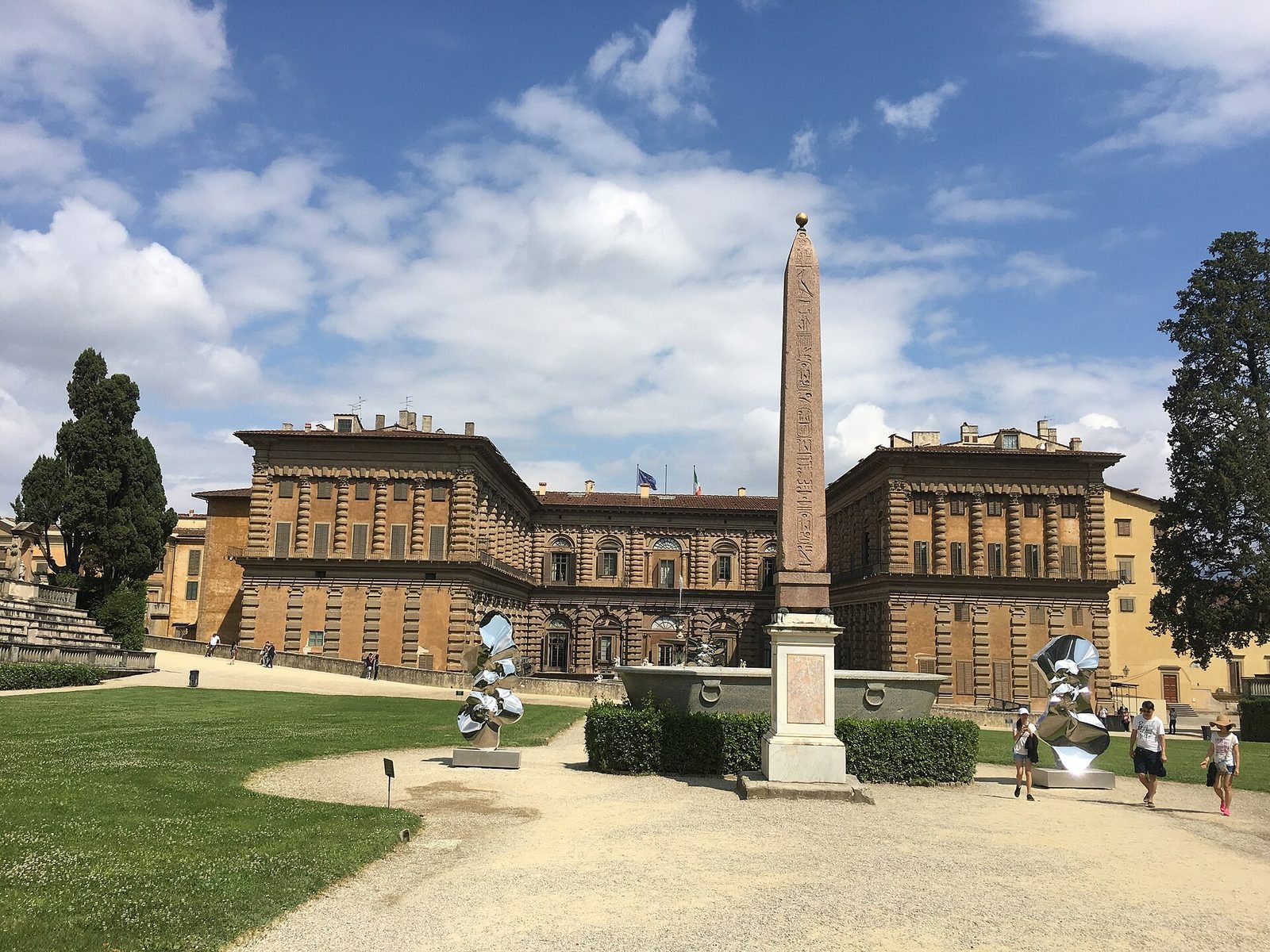
Several Florentine sites were considered for the monument, including locations near the Ponte Vecchio, the Basilica of San Lorenzo, the Viottolone, the Colonnade Hemicycle, and the statue of Dovizia. The chosen position was near the centre of the Boboli Gardens’ Amphitheatre, on the principal axis extending from the Pitti Palace. The obelisk was erected there in 1790. The setting may have been influenced by the amphitheatre’s perceived resemblance to a Roman circus and by a mistaken sixteenth-century belief that the monument had come from Rome’s so-called Circus of Flora.
The ancient Roman granite basin associated with the obelisk at the Villa Medici was also brought to Florence. In late 1840, it was placed before the obelisk in a fountain arrangement designed by Pasquale Poccianti. The resulting composition combined white, pink, and grey stone with bronze elements. The arrangement was later reduced to its present form, probably in the early twentieth century.
Remains
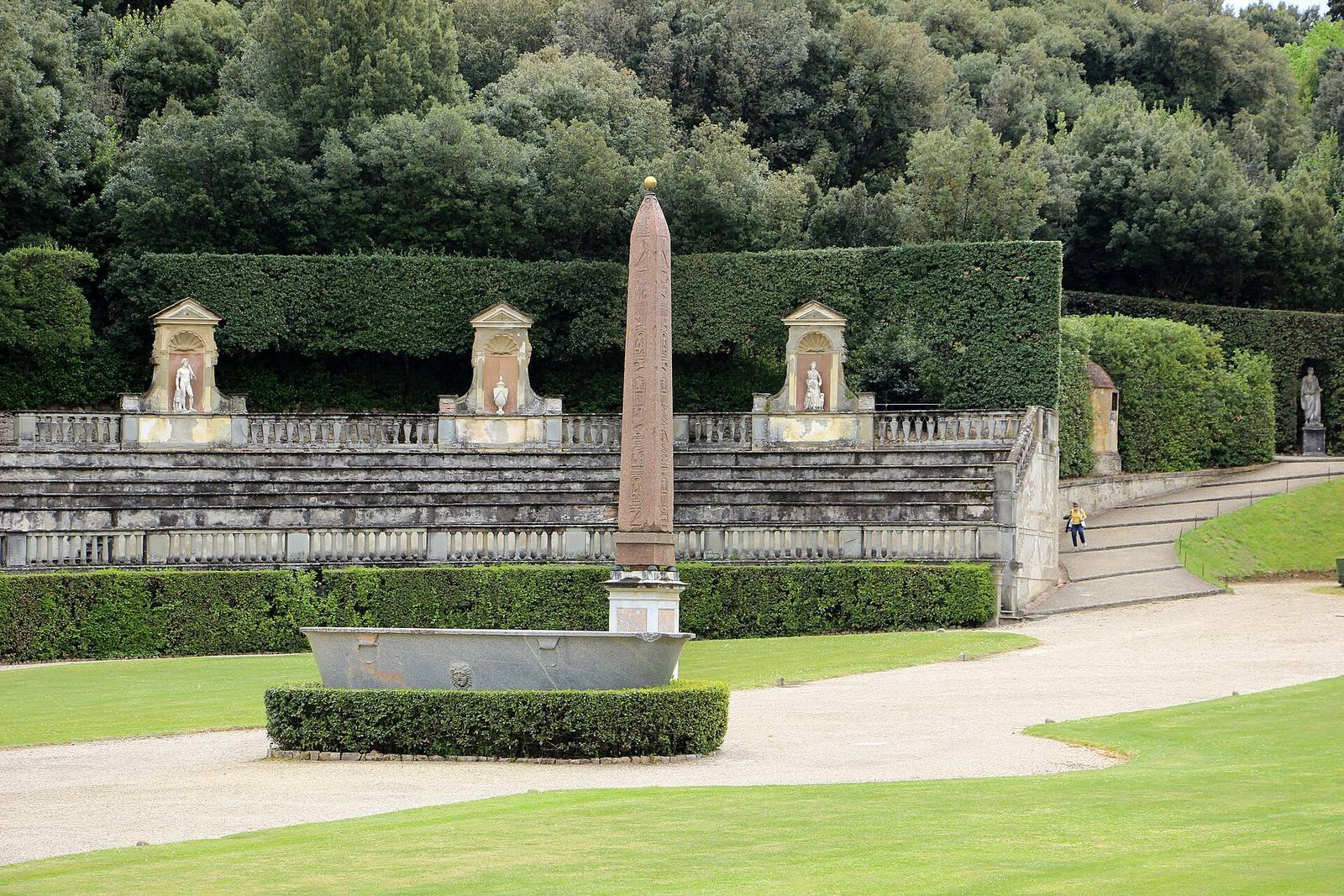
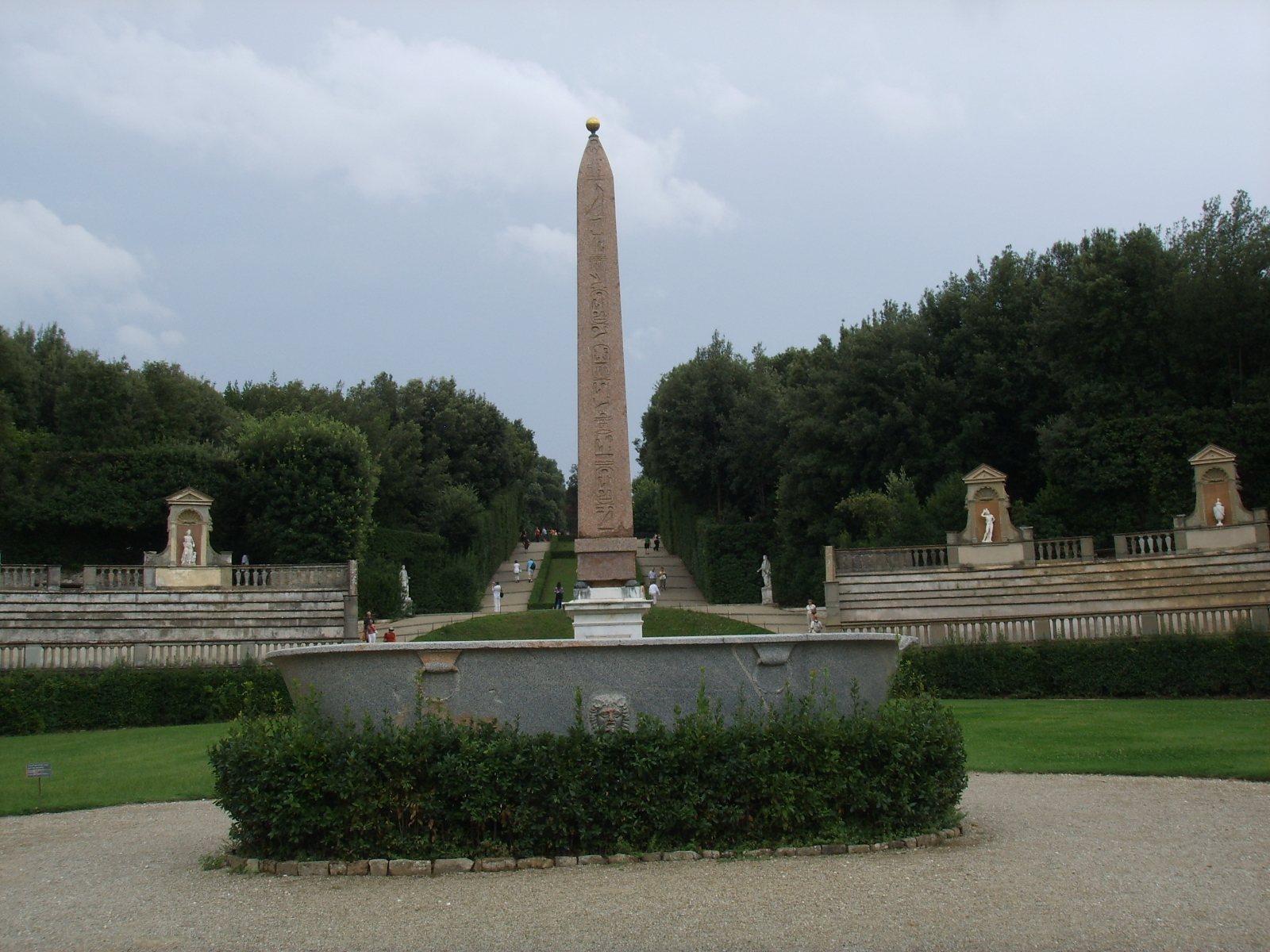
The surviving ensemble occupies the central area of the Boboli Gardens’ Amphitheatre, aligned with the garden’s main axis from the Pitti Palace. Its materials and colours combine red Egyptian granite, grey granite, marble, and bronze. The obelisk stands above a designed base, while the large basin lies in front of it as the principal surviving element of the former fountain composition.
The obelisk and its supports
Carved from red granite quarried at Aswan, the obelisk measures 6.34 metres high. Its four sides carry Egyptian inscriptions and religious imagery, including the name and titles of Ramesses II beneath a winged solar scarab. A gilded solar orb crowns the monument. The orb belonged to the Roman arrangement and was already associated with the obelisk before its journey to Florence.
Four small ancient bronze turtles support the base. They were also part of the Roman arrangement and reached Florence before the obelisk itself. The marble base is attributed to a project by Gaspare Maria Paoletti. It had initially been prepared for a position on the lawn of the Columns, rather than for the obelisk’s eventual site in the Amphitheatre.
The granite basin and fountain
In front of the obelisk is a grey granite basin carved from a single block. It measures 7.18 metres in length and may have originated in Roman baths in the Campus Martius. It is described as the largest surviving basin from the ancient world. Poccianti’s fountain design raised the obelisk 2.50 metres above ground level and placed the basin on an oval stepped base with projecting sections at the front. That base has since been dismantled.
A fountain once rose from the base and released water into the basin below, forming part of a sequence of fountains arranged along the garden’s principal axis as viewed from the palace. Two symmetrical bronze figures formerly connected with the arrangement are now preserved in Florence’s Bargello National Museum, the national museum of sculpture and decorative arts.