Xrobb l-Għaġin Temple: A Megalithic Temple in Malta


Site at a Glance
- Rating
- 4.7
- Popularity
- Low
- Country
- Malta
- Primary era
- Stone Age
- External website
- Open
- Eras represented
- Stone Age
- Civilizations
- Maltese Temple Culture
- Site type
- Religious
- Remains
- Temple
On this page6 sections
History
Xrobb l-Għaġin Temple is a ruined megalithic temple in Malta, within the limits of Marsaxlokk. Built by prehistoric communities between 3600 and 3000 BC during the Ġgantija phase of Maltese prehistory, it formed part of the tradition represented by Malta’s Megalithic Temples. Earlier remains in the area date to around 4000 BC.
Discovery and excavation
The site was discovered on 10 April 1913 by Carmelo Rizzo, an architect in Malta’s Department of Public Works, during a visit with the archaeologist Themistocles Zammit. Zammit and A. V. Laferla excavated it between December 1914 and January 1915, exposing the core of the stone-built temple.
A second excavation followed in May 1915 under the archaeologist Thomas Ashby, who later prepared a brief but detailed report. By then, coastal erosion had already destroyed parts of the building, and the surviving structure appeared close to collapse. The exact location was subsequently lost, and the ruins were presumed to have disappeared. In 2002, the site was described as destroyed.
Rediscovery and protection
Field inspections carried out between 2012 and 2015 by archaeologists Ruben P. Borg and Reuben Grima established the temple’s exact location again. Several megaliths that Ashby had recorded in 1915 were found at the site.
On 7 February 2015, further megaliths were identified in a nearby gully. They may belong to another prehistoric structure, possibly a monumental retaining wall along the gully, although the wall could instead be later construction made with stones taken from the temple. This uncertainty forms part of the ongoing interpretation of the remains.
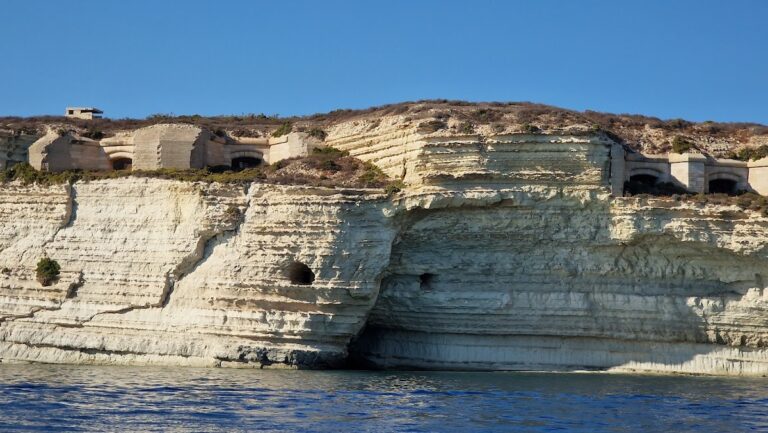
The remains were included on Malta’s Antiquities List of 1925. They lie within Xrobb l-Għaġin Nature Park, managed by Nature Trust Malta. Coastal erosion continues to affect the site, which stands at the edge of an undercut cliff, where the sea has worn away the base and left the overlying rock unstable. In 2017, Malta’s environment and culture ministries announced an inter-ministerial committee to safeguard the temple remains.
Remains
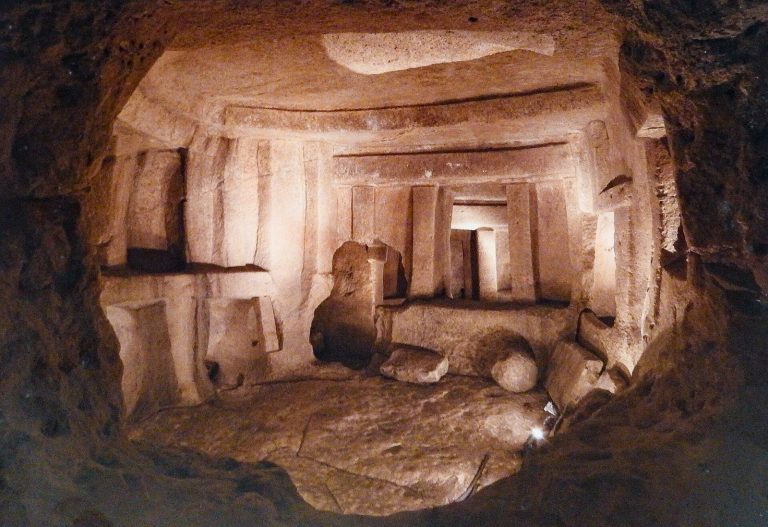
The temple followed a typical megalithic plan, a prehistoric arrangement built substantially from large stones, with two rounded apses and a central niche. A paved court stood before the building, with an entrance facing southeast. Because the temple occupied a steeply sloping site, its builders created an artificial terrace in front of it to compensate for the gradient.
Temple structure
Limestone formed the temple’s main construction material. The surviving structure is highly fragmentary and has been damaged by coastal erosion. The megaliths located in the rediscovered area include stones associated with the structure exposed during the 1914 to 1915 excavations.
Finds and nearby megaliths
Excavations produced a clay bowl, slingstones, and a decorated slab that formed part of a niche. These objects are now displayed at the National Museum of Archaeology in Valletta and provide material evidence for the temple’s prehistoric use.
The additional megaliths found in the gully may represent a separate retaining structure or may have been reused from the temple. Their precise relationship to the temple remains uncertain.