Kanuni Sultan Süleyman Bridge: An Ottoman Crossing at Büyükçekmece


Site at a Glance
- Rating
- 4.7
- Popularity
- Low
- Country
- Turkey
- Primary era
- Early Modern
- External website
- Open
- Eras represented
- Early Modern
- Civilizations
- Ottoman
- Site type
- Infrastructure
- Remains
- Bridge
On this page6 sections
History
Construction under Suleiman and Selim II
The Kanuni Sultan Süleyman Bridge is an Ottoman stone bridge in Türkiye, crossing Büyükçekmece Lake where it meets the Marmara Sea on Istanbul’s European side. Built on the commercial route connecting Istanbul with Europe, it addressed the difficulty of moving Sultan Suleiman the Magnificent’s army across the lake–sea junction by raft.
Suleiman, also known as Suleiman I, ordered the bridge while leaving for the Szigetvár campaign, an Ottoman military expedition in 1566 that included the siege of Szigetvár. Construction began in 1566, but the sultan died during the siege. His son and successor, Sultan Selim II, completed the bridge in 1567. The work was designed and built by Mimar Sinan, the foremost architect and chief imperial architect of the Ottoman Empire during the sixteenth century. Sinan is traditionally credited with describing it as the masterpiece among his works.
The recorded construction cost was 114,073,850 akçe, an Ottoman silver currency. The completed bridge formed part of the transport network serving the route west from Istanbul and gave the crossing a permanent structure at a difficult point in the landscape.
War and restoration
On 8 September 1915, during the First World War, men from the British submarine HMS E2 landed near the bridge intending to blow it up and disrupt Ottoman logistical lines. Ottoman patrols captured them and took them prisoner.
The bridge was restored between 1986 and 1989. It is regarded as a symbol of the Büyükçekmece district.
Remains
Stone bridge across the lake junction
The surviving bridge is a stone masonry arch structure approximately 636 metres long and 7.17 metres wide. It is divided into four separate sections containing 28 arches, with three shallow islands distributed along its length. The crossing lies between Büyükçekmece and Mimarsinan, approximately 36 kilometres from central Istanbul.
During construction, large pumps drained the lake water, allowing the builders to work at the junction with the Marmara Sea. Approximately 40,000 cubic metres of stone were used in the bridge. A white-marble inscription in Arabic calligraphy occupies the centre. Karahisarî Hasan Çelebi produced the calligraphy, and the text identifies the bridge as the work of Sultan Selim Han, son of Sultan Suleiman Han, while giving the date 1567.
Structures at the entrance
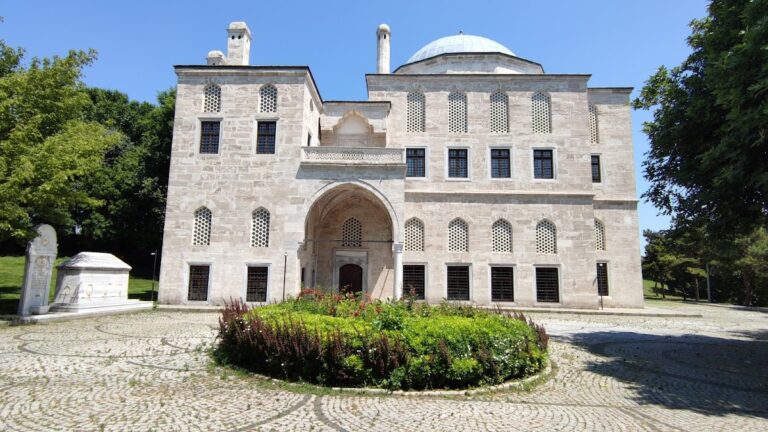
The area at the bridge’s entrance contains the Sokullu Mehmet Pasha Mosque, Kurşunlu Inn, and the Suleiman I Fountain. Together with the bridge, these structures form the surviving architectural setting of the crossing.