Santa Caterina: A Baroque Sanctuary in Varazze, Italy


Site at a Glance
- Rating
- 4.7
- Popularity
- Very Low
- Country
- Italy
- Primary era
- Early Modern
- External website
- Open
- Eras represented
- Early Modern, Modern
- Civilizations
- Genoese, Italian
- Site type
- Religious
- Remains
- Sanctuary
On this page9 sections
History
Santa Caterina is a Roman Catholic sanctuary in Varazze, Italy, associated with Catherine of Siena and consecrated in 1658 as a Baroque religious building. Its origins lie in a vow made during the plague, when Catherine’s visit and prayers became connected with the town’s hope for deliverance.
Catherine of Siena and the first chapel
On 3 October 1376, Catherine of Siena, a fourteenth-century Italian Dominican tertiary, mystic, and Catholic saint, reached Varazze while returning from Avignon. She visited places associated with Blessed Jacopo da Varagine, a medieval archbishop of Genoa traditionally linked with The Golden Legend, a widely circulated collection of saints’ lives. Troubled by the devastation caused by the plague, Catherine prayed at a Marian shrine and asked for the city’s deliverance. She also obtained a promise from the town elders that they would build a church dedicated to the Holy Trinity.
When the plague suddenly ended, the people of Varazze fulfilled the vow. A small chapel was completed in 1377 at the location indicated by Catherine, with its entrance facing the seashore. This chapel established the devotional site later associated with her memory.
Rebuilding and consecration
After Catherine’s canonization, Varazze’s General Parliament decreed on 27 April 1625 that 29 April should be observed as a public holiday and sought approval for a special devotion to her. The town, municipality, and population increasingly supported the rebuilding of the sanctuary. On 16 February 1630, the pope established Catherine’s feast for 30 April rather than 29 April.
The authorities first decided to renovate the old chapel on 5 December 1645. Its small and deteriorated condition led them to resolve on 8 December 1652 to replace it with a new chapel. The new building was erected on the present site, oriented toward the settlement rather than the sea, with its entrance on the western side. It was blessed in October 1658 and later enriched by the people of Varazze.
Relic, privileges, and continuing devotion
In 1743, the sanctuary received a relic of Catherine of Siena’s body. Thieves stole it on 8 June 1993. A small bell tower and bell were added in 1760, when the chapel still stood in a rural setting.
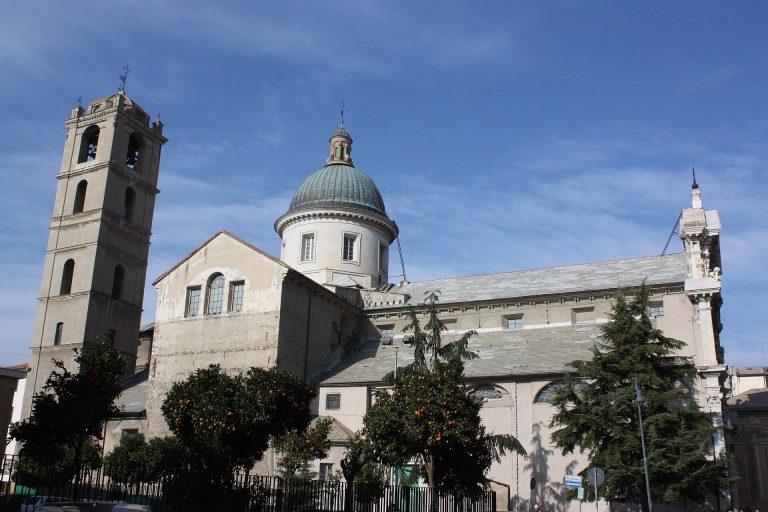
On 18 June 1867, Pope Pius IX granted a plenary indulgence, meaning the remission of the temporal punishment associated with already forgiven sins, to those who fulfilled the prescribed religious conditions and visited the parish church of Sant’Ambrogio on Catherine’s feast or during the following seven days. The sanctuary belongs to the Diocese of Savona-Noli and received its present facade between 1938 and 1940.
Varazze continues to mark Catherine’s feast with an annual votive procession. A votive procession is a religious procession made in fulfillment of a vow. The route runs from the collegiate parish of Sant’Ambrogio through the historic center to the sanctuary. It takes place in both the morning and afternoon because the wooden case used in the procession is kept at the town parish and must return there. Adverse weather has sometimes required the return procession to occur on another day so that the civic vow could be completed.
Remains
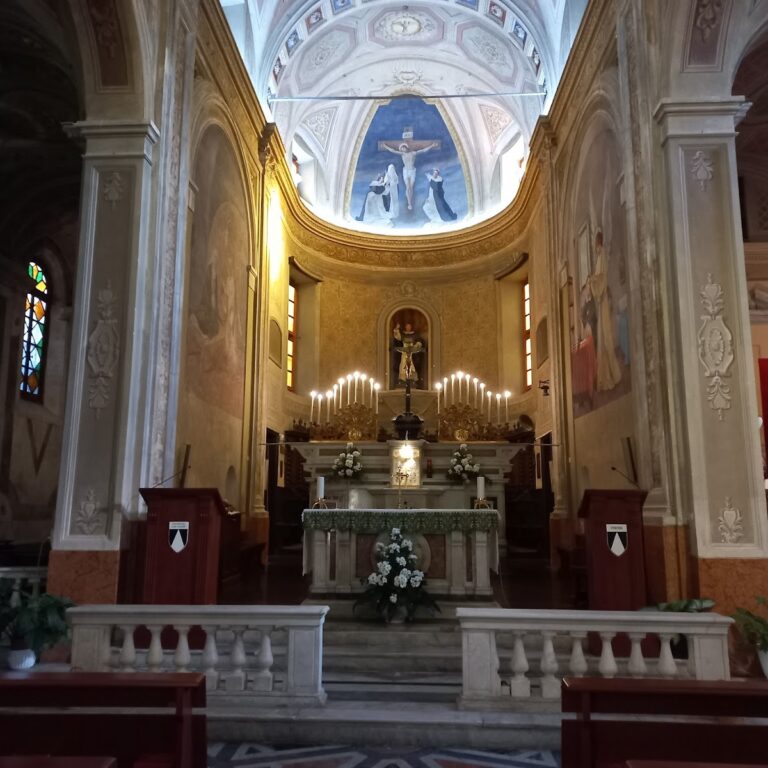
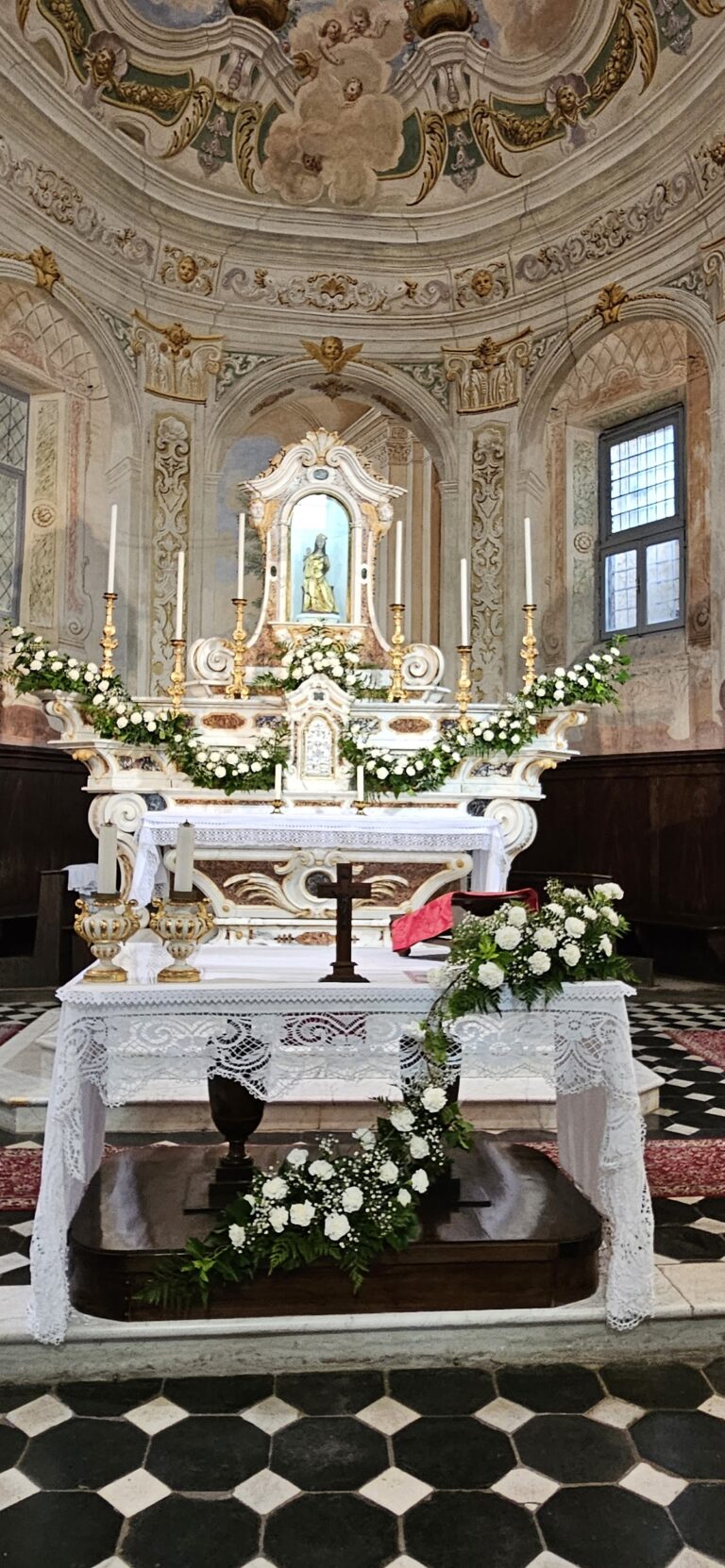
Santa Caterina stands in Piazza Santa Caterina along the Via Aurelia in Varazze, in Savona Province. It is a modest-sized, richly decorated church with a single nave. The present structure is the seventeenth-century replacement chapel, positioned toward the settlement and entered from the west. Its exterior facade was completely remade between 1938 and 1940, while the windows and rose window were later enhanced with polychrome stained glass.
Interior paintings and decoration
Nave frescoes
The walls carry nineteenth-century frescoes illustrating episodes from the life of Catherine of Siena. Four further frescoes on the nave walls were produced between 1890 and 1892. Their subjects include Catherine’s attempt to persuade Pope Gregory XI to return the papal seat from Avignon to Rome, and the scene of her death. Gregory XI was the pope who returned the papal court to Rome, an episode represented in one of these paintings.
Altar and presbytery paintings
Above the altar hangs an oil painting on canvas made in 1870 by Francesco Gandolfi of Chiavari. Gandolfi also painted the Holy Trinity medallion on the vault, as well as scenes of Catherine’s arrival in Varazze and the population’s oath to build the chapel. The last two scenes are located on the presbytery walls.
Vault decoration
The vault contains Luigi Gainotti’s depiction of the Mystical Marriage of Saint Catherine. Gainotti was a pupil of Nicolò Barabino. Additional decorative frescoes were produced by Luigi De Servi and Sante Bertelli, contributing to the sanctuary’s richly painted interior.