Church of Corpus Christi (Jablunkov): Parish Church in Czechia


Site at a Glance
- Rating
- 4.6
- Popularity
- Very Low
- Country
- Czechia
- Primary era
- Early Modern
- External website
- Open
- Eras represented
- Early Modern, Modern
- Civilizations
- Habsburg, Holy Roman Empire
- Site type
- Religious
- Remains
- Church
On this page8 sections
History
The Church of Corpus Christi (Jablunkov) is a Roman Catholic parish church in Jablunkov, Czechia. Built as a masonry church in 1620 in the Renaissance style, it replaced a medieval wooden church and later acquired Baroque, Neo-Gothic, and Modernist elements. It serves the Roman Catholic Parish of Corpus Christi in the historical region of Cieszyn Silesia.
Medieval origins and the Reformation
A wooden church stood at Jablunkov during the medieval period. In the sixteenth-century Reformation, Protestants took control of the building. It was permanently returned to Catholic use in 1615, but burned four years later in 1619.
The replacement masonry church was erected on the same site in 1620. Its furnishings included a wooden tower and three bells. The church received its dedication to Corpus Christi in 1652. Corpus Christi is a Catholic feast centred on the Eucharist, traditionally observed through liturgy and processions. At Jablunkov, the dedication led to an annual procession and solemn services in June. The church was consecrated in 1679.
Expansion and eighteenth-century changes
A Chapel of Our Lady of Sorrows was added in 1709. It included a crypt where the Jesuit missionaries Leopold Tempes and František Streich were buried. Jesuits belong to the Society of Jesus, a Catholic order founded in the sixteenth century that became prominent in missionary work and the Catholic Reformation. During the 1908 renovation, the crypt was filled in and the two missionaries’ remains were moved to the cemetery.
The church’s original wooden tower was replaced with a masonry tower in 1788, and a new clock was installed at the same time. This alteration gave the church a more durable vertical landmark while preserving the building’s role as a place of Catholic worship.
Nineteenth- and early twentieth-century remodelling
New altars were produced in 1878, followed by the acquisition of new organs in 1886. The interior was renovated in 1908, when new pews were installed and the windows above the altar received stained glass. The roof was also covered with asbestos cement, a cement-based material reinforced with asbestos fibres that was once widely used for roofing.
A more extensive remodelling took place in 1932. The architect and engineer Jaroslav Oplt of Brno designed a new Modernist chancel, the part of a church containing the main altar and reserved for clergy and liturgical functions. The work also introduced a reinforced-concrete coffered ceiling, formed from recessed decorative panels. In the same year, the old rectory on the parish square was demolished, and a replacement was built beside the Łomna River.
War damage and later conservation
During the Second World War, German authorities confiscated the church bells. Replacement bells were installed on 7 August 1945 and remained in use until 13 July 2011. They were then replaced by bells dedicated to Saint John Paul II, Our Lady of Fatima, and Saint Hedwig.
A major modernization in 2011 repaired the roof and added a new roof structure to the tower. The work also included copper sheeting, new windows and doors, and repairs to the plasterwork.
Remains
Church building and tower
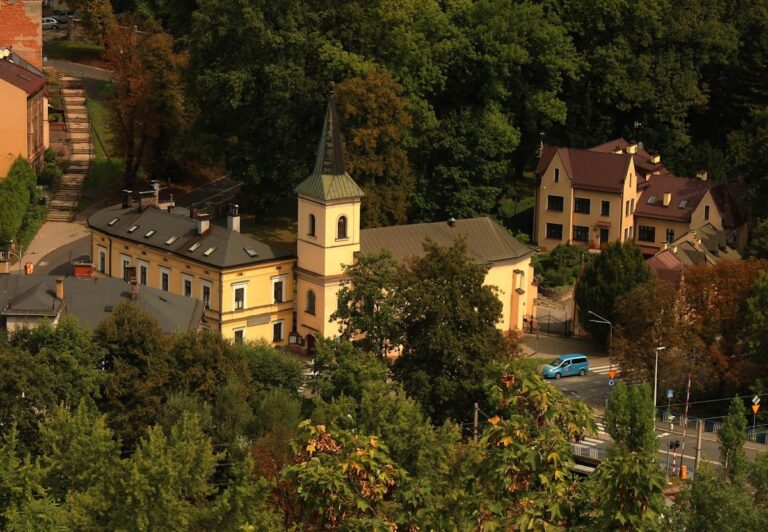
The surviving church is a masonry structure whose architectural character combines Baroque and Neo-Gothic elements with the earlier Renaissance foundation and the Modernist changes of 1932. Its single masonry tower rises 41 metres and contains a clock. The tower replaced the wooden structure in 1788, while later roof work gave it a new roof structure and copper sheeting.
Chapel and interior features
The Chapel of Our Lady of Sorrows remains an associated part of the church. Added in 1709, it formerly contained the burial crypt of Leopold Tempes and František Streich. The church interior includes the pews installed during the 1908 renovation, as well as stained-glass windows above the altar. The 1932 chancel and reinforced-concrete coffered ceiling express the building’s later Modernist phase, while the church’s bells now bear dedications to Saint John Paul II, Our Lady of Fatima, and Saint Hedwig.