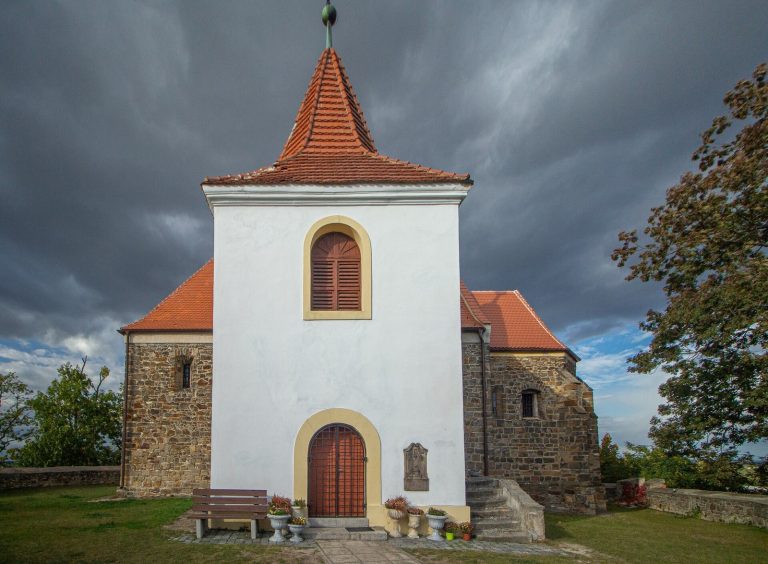
Basilica of the Assumption in Tismice: A Romanesque Filial Church in Czechia


Site at a Glance
- Rating
- 4.8
- Popularity
- Low
- Country
- Czechia
- Primary era
- Medieval
- External website
- Open
- Eras represented
- Medieval, Early Modern
- Civilizations
- Habsburg, Holy Roman Empire, Kingdom of Bohemia
- Site type
- Religious
- Remains
- Basilica
On this page13 sections
History
The Basilica of the Assumption in Tismice is a Roman Catholic filial church in Czechia, dedicated to the Assumption of the Virgin Mary. Built as a three-aisled Romanesque basilica at the end of the twelfth century, it belongs administratively to the Prague Diocese, the Czech Province, the Kolín Vicariate, and the Český Brod parish. A basilica is a church arranged around a central nave with lower side aisles. The reason for constructing such a substantial church at Tismice, which is not now a prominent settlement, remains unresolved.
Foundation and medieval changes
The church’s founder has not been established. Possible patrons include Prince Vladislav II, later King Vladislav I, one of his successors, and Prince Jindřich Břetislav, who was also Bishop of Prague. The building was created in the Romanesque period, a medieval style known for massive walls, rounded arches, and compact forms.
Almost the entire south wall collapsed during the fifteenth century. The church’s west facade and towers are also now dated to the end of that century. A Gothic side portal bearing the coat of arms of the Vrbík family of Tismice was inserted into the rebuilt south wall. Tradition holds that the family helped bring the church to completion.
Baroque transformation
After 1700, the church acquired a west entrance portal, a spiral staircase leading to the choir gallery, and a Baroque vault in the main nave. A choir gallery is an elevated interior platform used by singers or musicians. Between 1767 and 1775, at the initiative of Maria Theresa, Duchess of Savoy, the sacristy and choir gallery were built, the south tower was raised by one storey, and the windows and vault were altered. These interventions introduced later Baroque forms and decoration into the medieval structure.
The church’s cultural and religious history also includes the Tismice Madonna, a wooden Gothic statue that was stolen in 1990. A modern plaster copy now stands in the church, while the original plaster copy used to make it is exhibited at the Podlipanské Museum in Český Brod. The building is protected as a cultural monument.
Investigation and conservation
General reconstruction and archaeological investigation took place from 2008 to 2010. The collapsed south wall was rebuilt with new and reused stones, while the character of the Romanesque building was retained. The vault frescoes were restored in 2016 and 2017, preserving evidence of the church’s later decorative phases.
Remains
Exterior structure
Romanesque plan and eastern apses
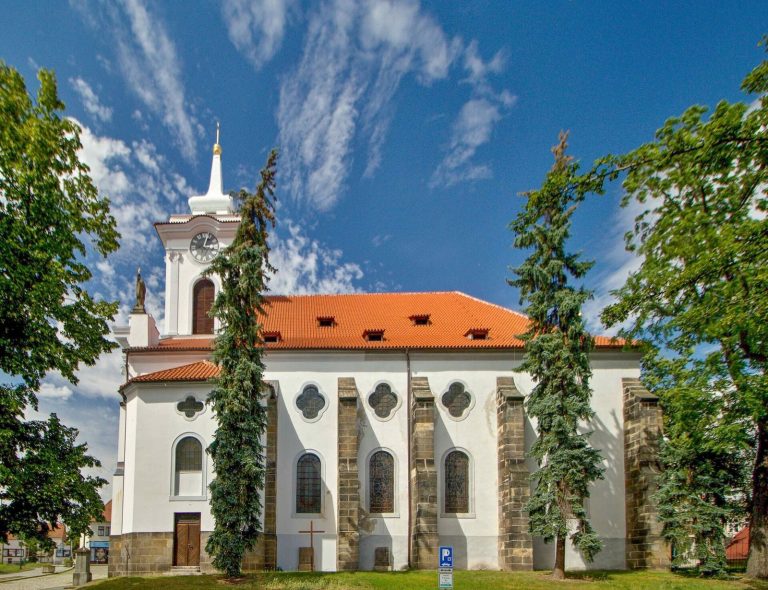
The unplastered basilica is constructed from sandstone blocks whose brown colouring changes through several shades of red. It measures 13.2 metres in length and 8.5 metres in width, with the altar oriented toward the east. The plan has three aisles, a two-towered west facade, and three apses on the eastern side. An apse is a semicircular or polygonal end of a church, usually positioned behind the altar.
The eastern apses retain their original windows, although the openings are now blocked. Their outer surfaces are articulated by pilasters, which are shallow vertical supports attached to a wall, and finished with an arcade frieze and cornice. A cornice is a projecting horizontal moulding. The side aisles rest alternately on piers and columns, whose capitals carry seventeenth-century garlands.
West facade and south entrance
The west facade is more restrained than the eastern apses. A Baroque entrance portal stands below a blocked original Romanesque window. The upper storey of the right-hand tower was added during later Baroque alterations, while the south tower was raised by one storey between 1767 and 1775.
The rebuilt south wall contains a Gothic side entrance portal from the second half of the fifteenth century. Its decoration includes the coat of arms of the Vrbík family of Tismice. The portal therefore preserves both a later medieval alteration and a connection with the family traditionally associated with the church’s completion.
Interior furnishings and decoration
Altars and baptismal font
The surviving furnishings are predominantly Baroque, with Rococo additions. The main altar dates from 1755, while the side altars and pulpit belong to the Rococo period, a later style noted for lighter and more elaborate decoration. A signed pewter baptismal font dates from 1786.
Tismice Madonna
The Tismice Madonna is an approximately 1.5-metre-high carved wooden Gothic figure of the Virgin Mary holding the Christ Child. It dates from around 1385. Tradition says that fleeing Carthusian monks gave the statue to the church in 1419. The Carthusians were members of a Roman Catholic monastic order combining communal worship with a strongly solitary religious life.
The statue formerly stood on the main altar. Maria Theresa of Savoy commissioned a Baroque altar around it in 1755. After the wooden original was stolen in 1990, a modern plaster copy was placed in the church, while the earlier plaster copy used as its model is held at the Podlipanské Museum in Český Brod.
Paintings, bell, and memorial stones
A fragmentary late Romanesque figure of a bishop is painted on the triumphal arch, the arch separating the nave from the sanctuary. Paintings above the altar and in the side apses were made between 1768 and 1775, and the vault frescoes underwent restoration in 2016 and 2017.
The left, or north, tower contains a bell dated 1442. Its inscription reads, “To the honour of God and the Virgin Mary.” Two tombstones dated 1582 and 1609, formerly associated with the church cemetery, were moved inside after the cemetery was abolished.
Cemetery entrance
A Madonna statue stands on the stone gate at the cemetery entrance. The access steps are decorated with a sculptural group of Saint John of Nepomuk dating from 1768 to 1775. Saint John of Nepomuk was a fourteenth-century Bohemian priest and martyr who became one of the principal saints associated with Bohemia.