St. George’s Church, Caransebeș: Romanian Orthodox Cathedral and Historic Monument
Site at a Glance
- Rating
- 4.7
- Popularity
- Very Low
- Country
- Romania
- Primary era
- Early Modern
- External website
- Open
- Eras represented
- Early Modern, Modern
- Civilizations
- Habsburg
- Site type
- Religious
- Remains
- Cathedral
On this page10 sections
History
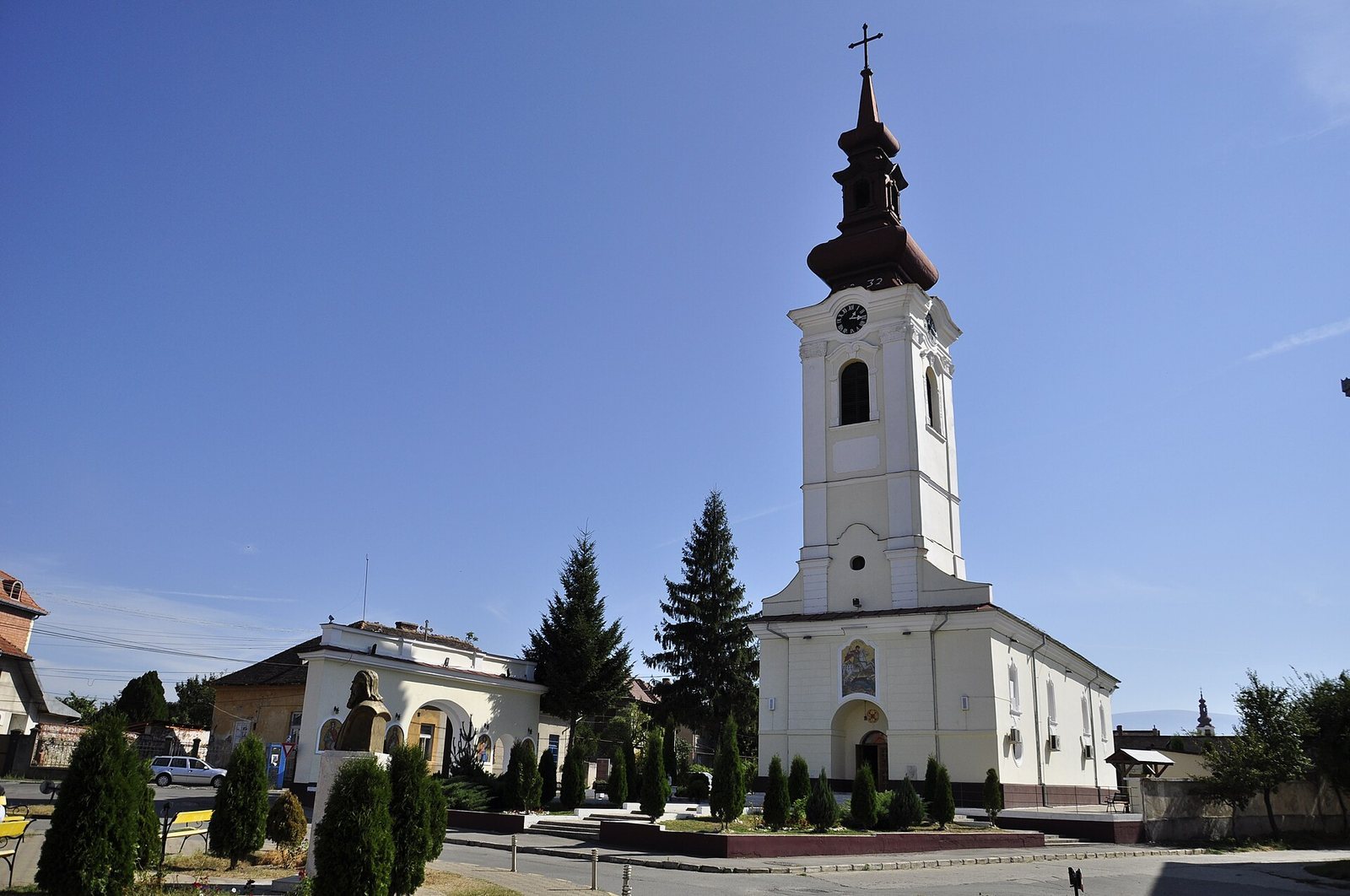
St. George’s Church, Caransebeș, is a Romanian Orthodox church in Caransebeș, Romania, dedicated to Saint George, a Christian saint traditionally associated with the defeat of a dragon and widely venerated in Eastern Orthodox Christianity. The present Baroque church was rebuilt in stone and brick between 1725 and 1757 on a site linked to a medieval monastery and later served as the cathedral of the Diocese of Caransebeș.
Medieval monastery and early records
Tradition identifies the site with a wooden monastery mentioned in 1444. A predecessor structure was built between 1444 and 1449, while the church’s first documentary attestation dates to 1581. The monastery is associated with the development of the first deacons’ school in the mountainous Banat region and with the city’s first library. Medieval and later references to the nearby “monks’ water” further connect the place with the former monastic community.
Eighteenth-century rebuilding and repair
The present stone-and-brick church replaced the medieval structure. Work began in 1725 and was completed in 1757. The building was described as a church in records from 1739 and 1744, and as a monastery again in 1752. Repairs followed in 1759. The church was damaged during the Austro-Turkish War of 1788–1791, a conflict between the Habsburg monarchy and the Ottoman Empire, and repairs culminated in a new consecration in 1796.
Nineteenth-century expansion and diocesan role
During the first decades of the nineteenth century, the church was enlarged by bringing the supports of the bell tower inside the nave. The same phase included interior painting, a stone-slab floor, and choir stalls for the singers. In 1865, St. George’s Church became the cathedral of the Diocese of Caransebeș, the principal church of the territory administered by its bishop. It retained that role until 2010, when a new cathedral opened.
Later painting, restoration, and protection
The interior was repainted in the early twentieth century by Dimitrie Turcu and later by Ioachim Miloia. A restoration took place in 1984–1985, followed by partial repainting in 1987. Further repairs were carried out between 2000 and 2008. During work in spring 2007, human bones were found in the churchyard while rainwater drainage was redistributed and the church grounds were enclosed. They probably date from the period when the monastery operated on the site.
The church is listed as a historic monument by Romania’s Ministry of Culture and Religious Affairs under code CS-II-m-B-11060 in the National Register of Historic Monuments. It also appears in the National Archaeological Record under code 51029.28.
Remains
Overall form
St. George’s Church is a Baroque hall church built of stone and brick. Its plan includes a vaulted nave, a polygonal apse, and a bell tower rising above the narthex, the entrance or vestibule area of the church. The apse forms the sanctuary’s terminating end and has several straight sides rather than a semicircular plan. The early-nineteenth-century enlargement altered the internal arrangement by placing the bell-tower supports within the nave. The floor from that period is paved with stone slabs, and four bells cast between 1817 and 1881 remain associated with the building.
Interior decoration and furnishings
Painted interior
The interior decoration developed in four painting stages carried out by different artists between 1757 and 1862. Some repainting followed damage caused by war, while later campaigns and restoration changed the decoration that survives inside the church. The sequence reflects the building’s continuing adaptation after its eighteenth-century reconstruction and subsequent repairs.
Iconostasis and commemorative stone
The iconostasis, the decorated screen separating the sanctuary from the nave in an Eastern Orthodox church, was painted in the Baroque style in 1863. Its icons were made in 1863–1864 by a Viennese academic painter. A commemorative altar stone bearing a Slavonic inscription dates to 1759 and probably marks the completion of the interior decoration.