St. Mary’s Church: A Romanesque Benedictine Complex in Zadar


Site at a Glance
- Rating
- 4.7
- Popularity
- Low
- Country
- Croatia
- Primary era
- Medieval
- External website
- Open
- Eras represented
- Medieval, Early Modern
- Civilizations
- Hungarian, Kingdom of Croatia, Venetian
- Site type
- Religious
- Remains
- Monastery
On this page13 sections
History
St. Mary’s Church is a medieval Benedictine church and convent in Zadar, Croatia, on the eastern side of the former Roman forum. The church belongs to the Romanesque period and was completed as a three-nave basilica around 1091–1092, within a convent founded in 1066 by the Zadar noblewoman Čika.
Foundation and Benedictine community
Čika was the maternal half-sister of Petar Krešimir IV, an eleventh-century king of Croatia. When she entered the convent, she brought two hymnals and a breviary. The hymnals have been lost, but the breviary survives in the Bodleian Library at Oxford. It contains literary compositions, illuminated miniatures, and musical notation for songs from Čika’s time.
After the death of her husband, Dobroslav, around 1072, Čika’s daughter Vekenega joined the convent. She became its head and later succeeded her mother as abbess. During the political changes in Croatia at the end of the eleventh century, Vekenega obtained financial support from Koloman, a Hungarian king who later ruled the Croatian-Hungarian realm and entered Zadar in 1102. This support enabled the completion of the church and the construction of new monastic buildings.
Vekenega’s building programme
Under Vekenega’s direction, the monastic chapter hall and a monumental Romanesque bell tower were erected. A chapter hall, also called a chapter house, was the room where the community met for governance, discipline, and the reading of religious texts. The tower bears Koloman’s name and the date 1105, while four capitals commemorate his name and his entry into Zadar in 1102.
Vekenega died on 27 September 1111. Her tomb was made in the chapter hall and remains there. Its Latin verses are regarded as outstanding examples of local Latin poetry. The convent archive also preserves a valuable group of charters that mention Croatian kings of the eleventh century.
Renaissance, Baroque, and wartime destruction
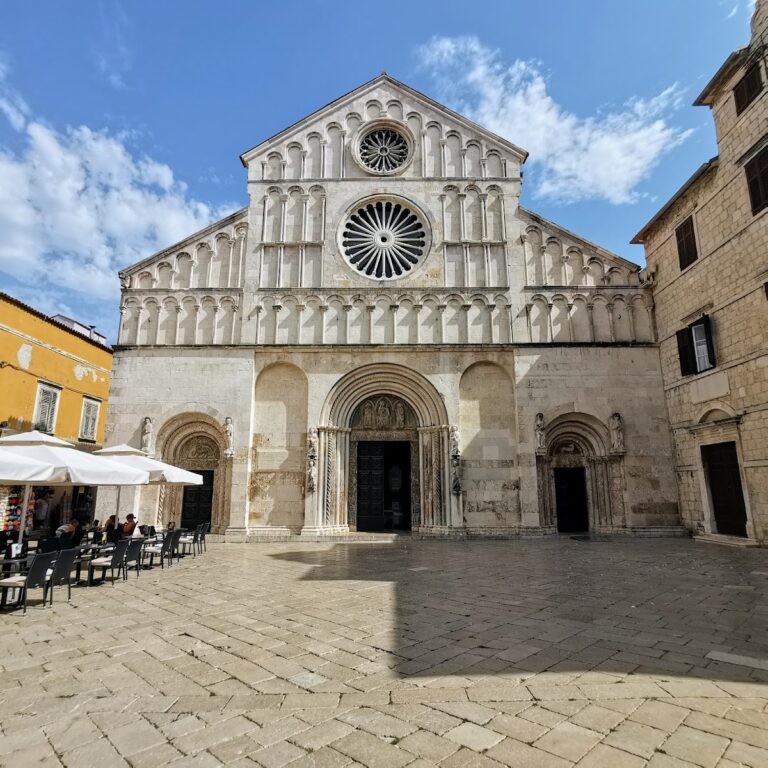
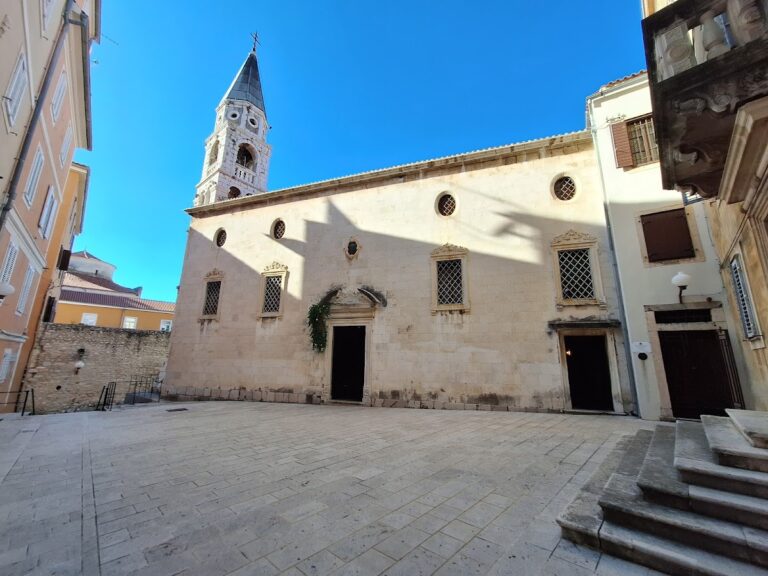
In 1507, Nikola Španić of Korčula built the church facade, the southern side wall, and the main portal in the Renaissance style. The interior was later enriched with elaborate Baroque stucco in 1744.
During the Second World War, Allied Anglo-American bombing destroyed the church and convent. The bell tower and chapter hall were also rebuilt during Zadar’s postwar reconstruction. The nuns returned to the reconstructed convent on 27 September 1970, restoring the community’s presence within the complex.
Collection and historical memory
The permanent exhibition The Gold and Silver of Zadar was established in 1967. It presents approximately 200 ecclesiastical objects associated with the Benedictine community, while the convent archive preserves written evidence connected with Croatia’s eleventh-century rulers. Together, these collections extend the history of the complex beyond its buildings to include manuscripts, charters, liturgical objects, and works of art.
Remains
The complex occupies the eastern corner of the former Roman forum and consists of St. Mary’s Church alongside the Benedictine convent. Its surviving and reconstructed elements bring together a three-nave Romanesque basilica, Renaissance exterior work, Baroque interior decoration, a Romanesque bell tower, and a vaulted chapter hall.
Church architecture and furnishings
Basilica and later additions
St. Mary’s is a three-nave basilica, a longitudinal church divided into a central nave and two side aisles. Its main medieval structure is Romanesque, an architectural tradition known for massive masonry, rounded arches, and vaulted spaces. The facade, southern side wall, and main portal were rebuilt in the Renaissance style in 1507. Inside, rich Baroque stucco from 1744 covers the church interior. The altar table bears an inscription naming Čika and Petar Krešimir IV, and a fifteenth-century Pietà, showing the Virgin Mary mourning over the dead Christ, is associated with the church.
Liturgical stone and sculpture
The church and its associated collection include stone objects from the twelfth and thirteenth centuries, among them a baptismal font, part of a cathedral ambo, and other stone fragments. An ambo was a raised structure or lectern used for readings in a church. The holdings also include numerous crosses and icons dating from the thirteenth century onward, together with Gothic sculptures.
Bell tower and chapter hall
Romanesque bell tower
The Romanesque bell tower bears the date 1105 and Koloman’s name. Four capitals are carved with his name, linking the tower’s decoration with his entry into Zadar in 1102. A chapel within the tower contains remains of twelfth-century wall paintings.
Chapter hall and tomb
The monastic chapter hall is a vaulted Romanesque space that contains Vekenega’s tomb. The tomb is decorated with Latin verse and remains in the room where the monastic community once met. Its inscription connects the physical building with the abbess who directed the complex’s major eleventh-century construction programme.
Ecclesiastical collection
The permanent exhibition contains approximately 200 objects associated with the Benedictine community. Among them is a cross-shaped reliquary from the seventh or eighth century, traditionally but incorrectly called Čika’s cross. A reliquary is a container for a relic. The collection also includes ninth-century reliquaries of Saints Arontius and James, silver hand-shaped reliquaries decorated with precious stones, and bust-shaped reliquaries, the earliest dating from the fourteenth century.
Other works include reliquaries shaped as hands, busts, and monstrances, as well as pacificals, canon tables, icon fittings, embroidery, church vestments, and lace. A monstrance is a vessel made to display a consecrated host, while a pacifical is a religious object presented for veneration or kissing. The exhibition also contains paintings by artists such as Vittore Carpaccio and Palma the Younger, preserving the artistic range of the convent’s ecclesiastical collection.