Church of Holy Cross: An Early Medieval Church in Nin, Croatia


Site at a Glance
- Rating
- 4.7
- Popularity
- Medium
- Country
- Croatia
- Primary era
- Medieval
- Eras represented
- Medieval
- Civilizations
- Unclassified
- Site type
- Religious
- Remains
- Church
On this page7 sections
History
The Church of Holy Cross is an early medieval Roman Catholic church in Nin, Croatia, built in the pre-Romanesque period around AD 800, at the turn of the eighth and ninth centuries. Its construction is attributed to Godepaj, a župan, or regional governor in medieval Croatian political organization. The church was erected over earlier Roman structures and is regarded as one of the most important surviving examples of early Croatian sacred architecture.
Foundation and early medieval use
A ninth-century Latin inscription on the church’s portal mentions the Croatian župan Godečaj, linking the building to the political elite of early medieval Nin. During the ninth century, the church probably served as the seat of the Bishop of Nin. It also served at times as a chapel for the bishops and, during the period of the Croatian Principality, as a court chapel associated with a nearby princely court.
The church’s former episcopal association gave rise to the traditional description “the smallest cathedral in the world.” This expression refers to its connection with the Bishops of Nin and its approximately 40-metre circumference. The building was probably never a cathedral in the strict sense, and it is not now a bishop’s residence.
Survival and modern interpretation
The Church of Holy Cross is regarded as a symbol of Nin and is described as the only church in the town to have survived in its original form. Its survival is considered exceptional because many early Christian, pre-Romanesque, and early Romanesque churches in the Lika and Zadar regions were destroyed, particularly during medieval conflicts and the Ottoman wars.
During the twentieth century, the southern wing was demolished and later reconstructed. A major conservation and structural-investigation campaign in 1969 revealed previously unknown architectural details, and the deteriorated original portal lintel was replaced. The church is listed in Croatia’s Register of Cultural Goods as cultural property Z-1195.
Since 2009, the church has hosted the Festival of the Sun and Light on the first day of summer. The event reflects an interpretation that the building’s unusual form was connected with solar observation. This theory, associated with the Croatian art historian Mladen Pejaković, holds that the church’s geometry may correspond to the Sun’s positions around the spring and autumn equinoxes and the solstices, allowing it to function as a kind of calendar or sundial.
Remains
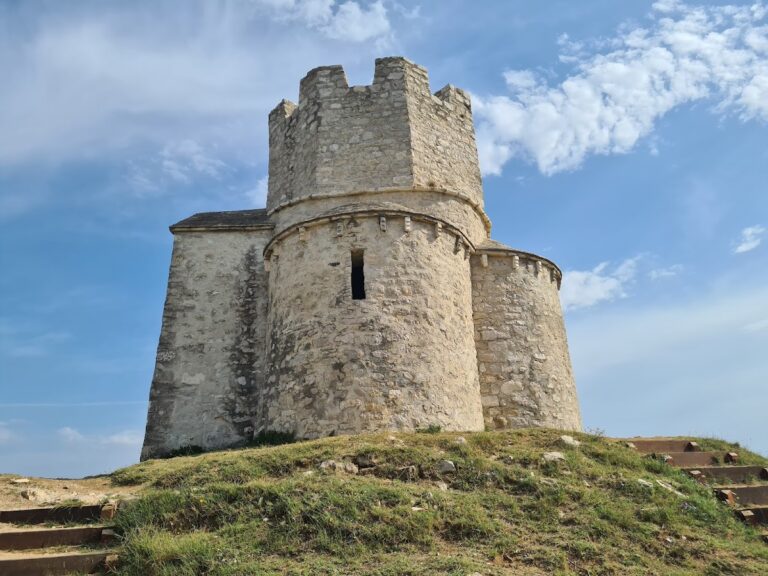
The stone church stands in central Nin near the parish church. It measures approximately 7.80 metres in length, 7.60 metres in width, and 8.20 metres in height. Its compact plan, projecting apses, high dome drum, and elongated dome create a strongly centralized composition characteristic of early medieval sacred architecture.
Cross-shaped plan and dome
The plan resembles an approximately equal-armed Greek cross formed by four rectangular arms. The entrance is on the west. At the centre, the crossing rises into a high dome drum, a raised structure supporting the dome, above which is an elongated and slightly irregular oval or ellipsoidal dome that narrows toward the top. The dome is the dominant element of the building’s composition.
The church’s irregular lines and slightly unbalanced elliptical form have been interpreted as deliberate rather than as the result of faulty construction. This geometric character is central to Pejaković’s solar interpretation, which connects the building’s orientation and shape with the annual movement of the Sun.
Apses and openings
The church has three apses, or sanctuary terminations. The main apse is contained within the building, while two lateral apses project beyond the outer wall line. Their vaults are half-domes supported by corner niches, and these supports also carry the central dome drum.
An opening is placed at the centre of the apse arch, while another occurs in the southern part of the dome drum. The tops of the side apses contain additional windows discovered during the 1969 conservation work. Traces of a larger window were also found in the dome drum. Shallow blind niches divide the upper exterior wall surfaces, the gables of the cross-arms, and the surface of the drum. A row of blind niches decorates the pediment.
Portal ornament and associated objects
Above the entrance is a carved stone lintel, or decorative band, with an interlaced-ribbon motif known as Croatian interlace or troplet. The lower part bears a ninth-century Latin inscription mentioning Godečaj. The lintel was replaced during the twentieth-century conservation campaign because the original had deteriorated.
A hexagonal stone baptismal font associated with Višeslav, an early medieval duke linked with Nin who ruled from 785 to 802, is believed to have been made for the church. Carved from a single block of limestone, it carries interlaced-ribbon ornament and a Latin inscription naming Višeslav. The original is held by the Archaeological Museum in Split, while a copy is displayed in the Archaeological Museum in Nin. Near the church stands a bronze statue of Gregory, the Bishop of Nin, created by the Croatian sculptor Ivan Meštrović.