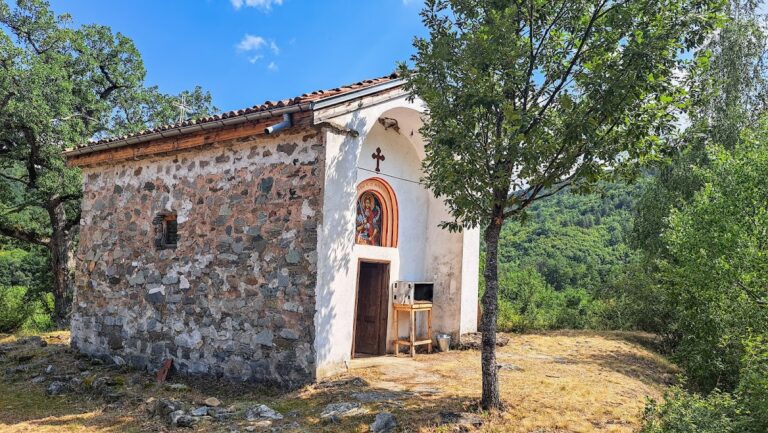
Church of the Holy Ascension, Kyustendil: A Serbian Victory Memorial in Bulgaria
Site at a Glance
- Rating
- 4.2
- Popularity
- Very Low
- Country
- Serbia
- Primary era
- Medieval
- External website
- Open
- Eras represented
- Medieval
- Civilizations
- Serbian
- Site type
- Religious
- Remains
- Church
On this page7 sections
History
The Church of the Holy Ascension, also known as Spasovitsa, was a Serbian medieval church near Kyustendil, Bulgaria, founded around 1330–1331 as an endowment of King Stefan Decanski. Construction began after 20 July 1331, close to the site of the Battle of Velbazhd, a major Serbian victory over Bulgarian forces. The church commemorated the victory and the kingdom’s deliverance from danger.
Foundation and Medieval Use
Stefan Decanski ruled as Serbian king from 1321 to 1331. The church may have been built at the place from which he watched the battle, although that identification remains uncertain. Its position was nevertheless very close to the battlefield. During the reign of his successor, Stefan Dusan, who became Serbian emperor in 1346, the church received its fresco decoration.
The building remained intact while the Dragas family, a late medieval ruling house based at Velbazhd, controlled the region. An early sixteenth-century chronicle still described it as undamaged. Damage occurred later, at an unknown date. The church continued to function at least until the Thirteen Years’ War in Hungary, and perhaps until the Great Turkish War, although its use during the latter conflict is uncertain.
Decline and Destruction
By the nineteenth century, the church survived to the height of its domes. Local tradition says that its bell was later taken to Kyustendil and placed in the town clock tower. The bell was said to bear the date 1429. People from nearby villages continued to gather at the church each year for the Feast of the Ascension, preserving its role as a religious and communal meeting place.
The Bulgarian army demolished the church down to its foundations in 1913 after its defeat at the Battle of Bregalnica, a conflict of the Second Balkan War. Following the Treaty of Bucharest, which ended that war, the remaining ruins were blown up amid local military dissatisfaction with the settlement and the arbitration associated with Tsar Nicholas II. During the First World War, the Bulgarian army’s principal headquarters in the Kyustendil area stood on the hill opposite the church site.
Remains
Hilltop Church Site
Church Layout
The church stood in the territory of Nikolichevtsi village, near Kyustendil, on a hill between the Struma River and its tributary Sovolštica. It was a single-nave building measuring about 12 metres in length and 8 metres in width. The nave, the principal interior space, carried a large dome and tower, while the narthex, an entrance vestibule, stood at the west end beneath two smaller domes. Entrances opened on the west and south sides.
Decoration and Surviving Evidence
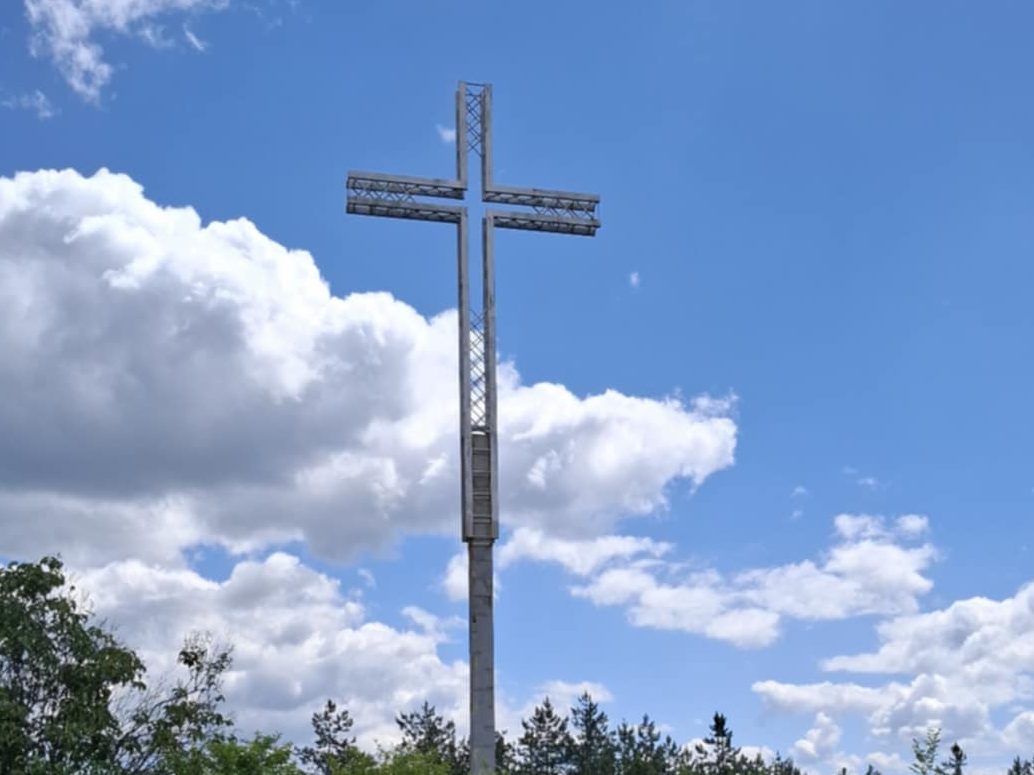
Frescoes decorated the church, whose medieval paintings were associated with the period of Stefan Dusan. Numerous peonies grew around the building, and local tradition connected them with the blood shed by Serbian and Bulgarian forces in the Battle of Velbazhd. The church was destroyed to its foundations in 1913, and explosives subsequently damaged the remaining ruins. Archaeological remains survive at the hilltop, beside which a 26-metre cross was erected in 2018.