Bahramiyah Mosque: An Ottoman Congregational Mosque in Aleppo


Site at a Glance
- Rating
- 4.9
- Popularity
- Very Low
- Country
- Syria
- Primary era
- Early Modern
- Eras represented
- Early Modern
- Civilizations
- Ottoman
- Site type
- Religious
- Remains
- Mosque
On this page5 sections
History
Ottoman construction
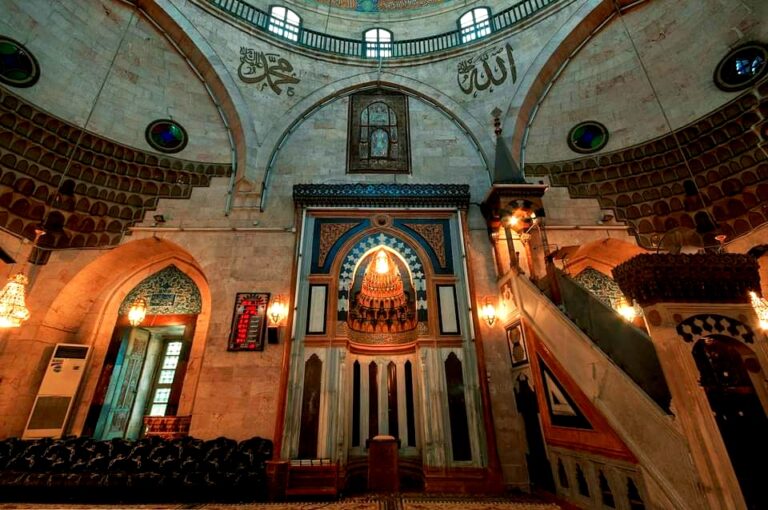
Bahramiyah Mosque, also known as Behram Pasha Mosque, is an Ottoman-period Islamic congregational mosque in Aleppo, Syria. Built in the Ottoman khanqah tradition, an institutional tradition associated with religious retreat, teaching, and Sufi practice, it was constructed between 1580 and 1583. Behram Pasha, the Ottoman governor of Aleppo, sponsored the mosque during the reign of Sultan Murad III, who ruled from 1574 to 1595.
Rebuilding and heritage
The mosque underwent repeated maintenance and alteration after its completion. Its minaret fell during the seventeenth century and was rebuilt in 1699. An earthquake that struck Aleppo in 1822 destroyed the dome, which was reconstructed in 1860. The mosque remains an active place of congregational worship.
Bahramiyah Mosque stands within the Ancient City of Aleppo, a UNESCO World Heritage Site since 1986. The cultural designation recognizes the area under criteria (iii) and (iv), and its 364-hectare property includes the Citadel of Aleppo and Al-Madina Souq. The property was listed as endangered from 2013 to 2020.
Remains
Layout and architectural form
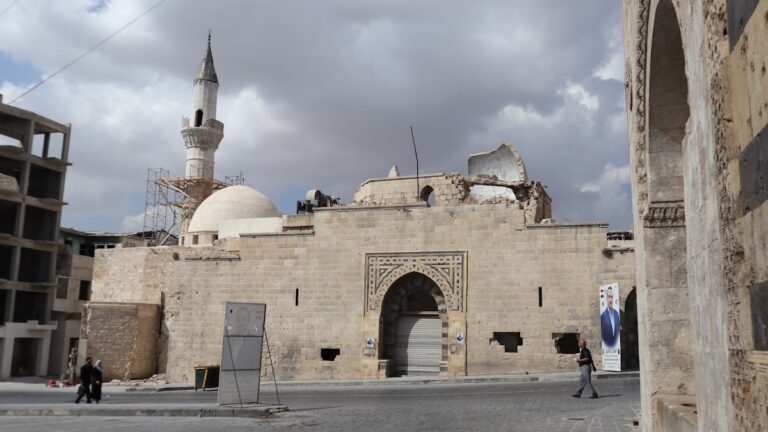
The mosque stands in the al-Jalloum district within Aleppo’s historic city walls, west of the Citadel and between the Antioch Gate and Khan al-Jumrok. Its Ottoman khanqah-style design is formed around a large central dome and a circular minaret. The structure has one dome and one minaret, and stone is its stated construction material.
A sahn, or courtyard, forms part of the mosque complex and provides the setting from which the building is viewed. The courtyard, central domed structure, and minaret together define the surviving architectural composition near the Antioch Gate.