Ermenek Great Mosque: A Karamanid Mosque in Türkiye


Site at a Glance
- Rating
- 4.8
- Popularity
- Very Low
- Country
- Turkey
- Primary era
- Medieval
- Eras represented
- Medieval
- Civilizations
- Unclassified
- Site type
- Religious
- Remains
- Mosque
On this page6 sections
History
Ermenek Great Mosque, also known as Ermenek Ulucamii, is a mosque in Ermenek, Türkiye, built in 1302 by Mahmud Bey of the Karamanids, a medieval Turkoman ruling house and principality in Anatolia. Its foundation belongs to the Karamanid period and places the building within the development of Turkish mosque architecture.
Karamanid foundation and later changes
Mahmud Bey’s role as ruler of the Karamanids is recorded in the inscription on the mosque’s original wooden doors. An expansion is associated with the date 950, while repairs are linked to 1125 and 1324. Because the first two dates precede the stated construction in 1302, their chronological relationship to the present mosque is uncertain. The building also underwent further alterations and repairs during the Ottoman period.
A wooden minaret was added after the original construction. This later addition forms part of the mosque’s surviving historical development, alongside the changes carried out during the Ottoman era.
Remains
Setting and prayer hall
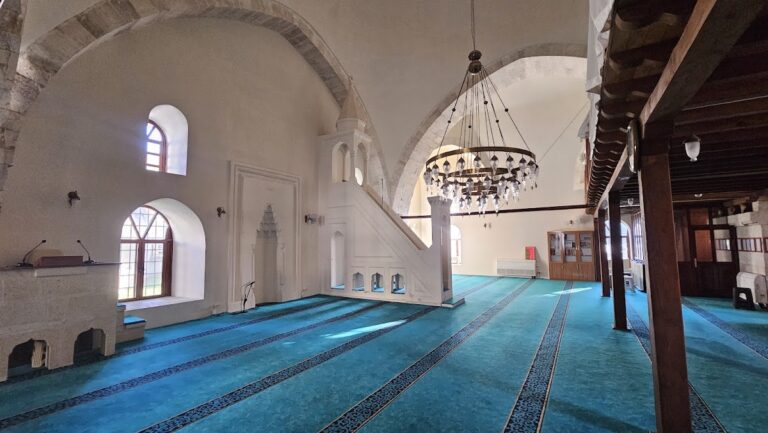
The mosque stands on a rocky outcrop on the outskirts of Ermenek Castle, overlooking the city of Ermenek. Its rectangular prayer hall is supported by pillars and follows a hypostyle plan, meaning that a large interior space is carried by columns or pillars. Three arched naves run across the hall from west to east. The mihrab, the prayer niche indicating the direction of prayer, occupies the south side.
Entrance gallery and wooden doors
A narthex, or entrance gallery before the main prayer space, lies between the outer doors and the prayer hall. The principal entrance and this antechamber are placed on the west side rather than the north side. The arrangement is described as the first example of a Turkish mosque to incorporate such a plan. The original wooden door wings stood between the antechamber and the prayer hall. Their inscription states that Mahmud Bey built the mosque in 1302 and is written in Sülüs, a formal calligraphic style used for monumental religious inscriptions. These fourteenth-century Karamanid doors were removed for preservation and are exhibited at the Sahip Ata Museum in Konya.
Later minaret
The mosque also retains a wooden minaret added after the building’s initial construction. It forms a later architectural element alongside the earlier prayer hall, western entrance arrangement, and preserved Karamanid door wings.