Truttenhausen: A Medieval Choir-Canons’ Foundation in France


Site at a Glance
- Rating
- 4
- Popularity
- Very Low
- Country
- France
- Primary era
- Medieval
- Eras represented
- Medieval, Early Modern
- Civilizations
- Holy Roman Empire
- Site type
- Religious
- Remains
- Monastery
On this page9 sections
History
Truttenhausen is a late twelfth-century choir-canons’ foundation in France, near Heiligenstein and partly within the commune of Obernai in the Mount Sainte-Odile massif. Herrade of Landsberg, abbess of Hohenbourg, and Günther of Vigenhegen established it between 1186 and 1190. The foundation supported the religious life of Hohenbourg and served travelers and pilgrims on the southern route to the mountain.
Foundation and religious purpose
Herrade directed the foundation and its construction, while the Augustinian canons of Marbach Abbey administered it and supplied its first community. Augustinian canons were religious clerics who lived communally under the Rule of Saint Augustine. Truttenhausen housed twelve members under a provost, the administrative and religious head of the chapter. Two canons served at Hohenbourg in alternation with Premonstratensians established at Saint-Gorgon in 1178. The complex also cared for poor and elderly people in an infirmary and offered a hospice for travelers and pilgrims.
The foundation grew considerably until the fifteenth century. Its early heads included Volmar in 1186. Wars and fires devastated it during the fifteenth and sixteenth centuries, after which the bishop of Strasbourg established religious from the diocese of Paderborn at Truttenhausen.
Reform and late-medieval rebuilding
In 1454 Truttenhausen joined the Windesheim Reform, a movement among Augustinian communities that called for stricter communal observance. Canons from Böddeken came to the foundation. Prior Jean Tulmann, associated with Truttenhausen from 1469, began a new church in 1467 and probably rebuilt the conventual buildings as well. The church was completed in 1490.
Destruction and later ownership
On Easter Day 1525, during the German Peasants’ War, insurgents looted the abbey. One of the early gatherings of peasant rebels took place near the village. After rebuilding, the abbey was destroyed by fire and did not recover. The religious community left the convent in 1555, although Heinrich Brantius still formally held the office of prior in 1611. The Armagnacs later completed the destruction of the remaining abbey buildings.
In 1648 the Landsberg family acquired the agricultural property and ruins and built a small manor residence. The estate has belonged to the von Türckheim family since 1800, and the family has regularly consolidated the property. The church has been listed as a Monument historique in France since 5 December 1984.
Remains
Church and early foundation
Twelfth-century foundation
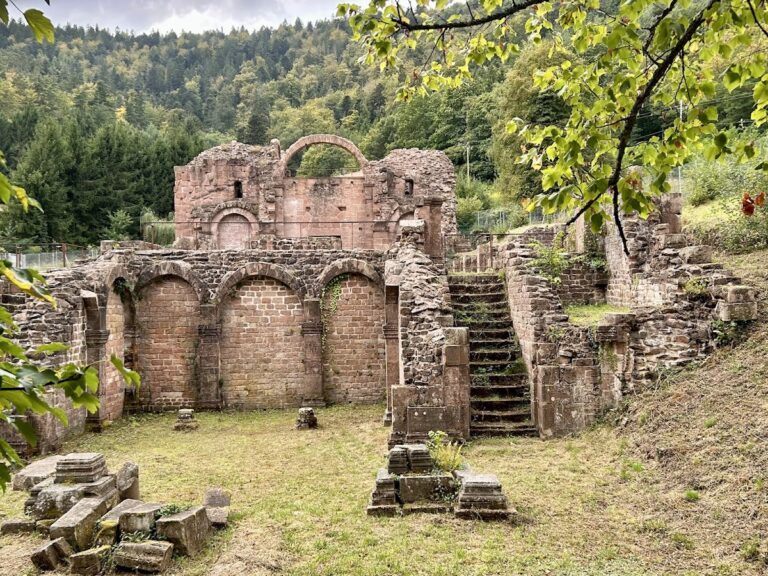
The original complex contained two sanctuaries, a chapel dedicated to the Virgin Mary and a conventual church dedicated to Saint Nicholas. A cloister and conventual buildings housed the twelve canons, while a hospice, a hospital for poor and elderly people, and a farm with its associated dependencies supported the foundation’s religious and charitable functions. Only a few partly engaged columns with sculpted capitals survive from the twelfth-century church.
Late-medieval church
The present church is the ruin of the rebuilding begun in 1467 and completed in 1490. Its surviving Late Gothic elements include the walls of the nave and choir. A porch tower retains a Romanesque base; the tower was remodeled in 1490 and covered during the nineteenth century.
Estate and landscape
The former agricultural property and ruins are accompanied by the small manor residence built by the Landsberg family after the 1648 acquisition. An English-style garden surrounds the domain, with mature trees that have stood there for centuries.