Exaltation of the Holy Cross Church in Lisewo: A Gothic Parish Church in Poland


Site at a Glance
- Rating
- 4.3
- Popularity
- Very Low
- Country
- Poland
- Primary era
- Medieval
- External website
- Open
- Eras represented
- Medieval, Early Modern
- Civilizations
- Crusader, Kingdom of Poland, Polish–Lithuanian Commonwealth, Teutonic Order
- Site type
- Religious
- Remains
- Church
On this page9 sections
History
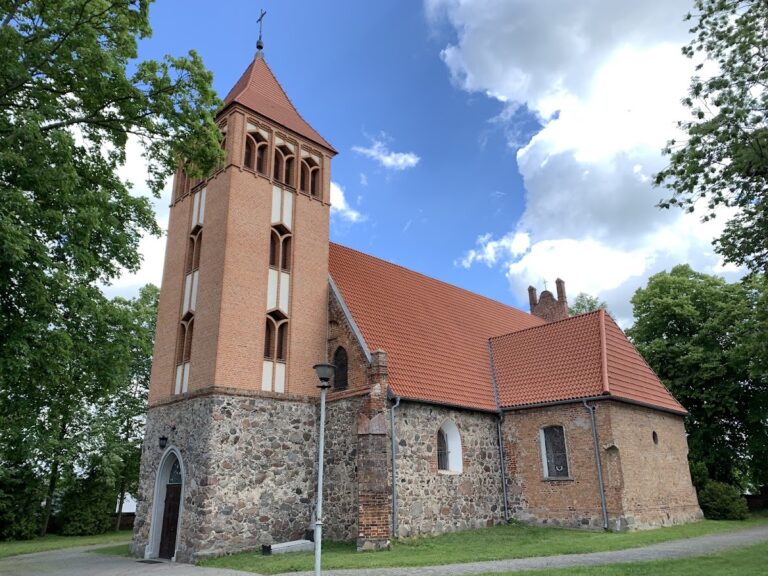
The Exaltation of the Holy Cross church in Lisewo, Poland, is a Roman Catholic parish church whose main structure was erected at the end of the thirteenth century in the Gothic style. It belongs to the parish of the same dedication within the Chełmno Deanery, an administrative subdivision grouping nearby parishes, in the Diocese of Toruń, the territorial jurisdiction governed by a bishop.
Medieval foundation and later additions
The church began as a medieval single-nave building. At the turn of the fifteenth and sixteenth centuries, a porch was added on the north side. In the eighteenth century, this porch was converted into a chapel, giving the building a later devotional space while retaining evidence of its earlier development.
The Kostka family and the tower
Between 1551 and 1585, the church acquired its tower through the efforts of Stanisław Kostka, Voivode of Chełmno. A voivode was a high-ranking regional governor in the Polish-Lithuanian political tradition. The three-storey tower brought Renaissance forms, influenced by classical antiquity, into the church’s predominantly Gothic architectural history.
The church also became the burial place of members of the Kostka family connected with Lisewo as starosts of Lipień. A starost was a royal or state official who administered a territorial district or estate. Those buried in the church included Stanisław Kostka, his son Jan Kostka, Castellan of Gdańsk and Voivode of Sandomierz, and another son, Stanisław.
The devotion to Our Lady of Lisewo
An image of Our Lady of the Snows by an unknown artist was placed in the church in the mid-seventeenth century. Our Lady of the Snows is a Marian devotional title associated with a traditional Christian account of miraculous snowfall connected with the dedication of a major church in Rome. Worshippers gathered before the image in prayer over successive centuries, and it became known locally as Our Lady of Lisewo.
On 7 October 2003, the image was solemnly crowned by Archbishop Marian Przykucki and Bishops Andrzej Suski and Józef Szamocki. The ceremony followed the reading of a telegram from Pope John Paul II, who had blessed the crowns on 16 July 2003.
Remains
The church is a single-nave Gothic building constructed from fieldstone and brick. Its exterior includes one tower, a stepped gable at the presbytery, and a Gothic portal forming the entrance. The tower has three storeys and combines Gothic and Renaissance forms. Its brick base appears approximately circular but is actually a sixteen-sided polygon, and it is finished with a brick, helmet-shaped roof.
Interior furnishings
Altars and chapel
The interior contains a Gothic altar cabinet, a Rococo high altar made in the second half of the eighteenth century, and Baroque side altars. The high altar was formerly located in the Franciscan church in Chełmno. The north-side porch, added around the turn of the fifteenth and sixteenth centuries, became a chapel during the eighteenth century.
Kostka family epitaph
A large alabaster epitaph to the Kostka family dates from 1591. An epitaph is a memorial monument or inscription commemorating a deceased person or family. This example was carved in the workshop of the van den Blocke family in Gdańsk and is decorated with a scene of the Last Judgment, the Christian doctrine of the final judgment of the dead.
Image of Our Lady of Lisewo
The image of Our Lady of the Snows remains a central devotional object within the church. Most of it is covered by silver robes made for Mary and the Christ Child in the mid-eighteenth century. The image’s later name, Our Lady of Lisewo, reflects its enduring place in the religious life of the church.