San Tomà, Venice: A Historic Roman Catholic Church in San Polo


Site at a Glance
- Rating
- 4.4
- Popularity
- Low
- Country
- Italy
- Primary era
- Early Modern
- External website
- Open
- Eras represented
- Medieval, Early Modern, Modern
- Civilizations
- Habsburg, Venetian
- Site type
- Religious
- Remains
- Church
On this page18 sections
History
San Tomà is a Roman Catholic church in Venice, Italy, dedicated to Saint Thomas the Apostle, one of the Twelve Apostles traditionally associated with doubting Christ’s Resurrection until seeing his wounds. The church was first erected in 973 in Venice’s San Polo district under the dedication of Saints Sergius and Bacchus, and its present form reflects successive rebuilding campaigns from the late medieval period through the eighteenth century.
Foundation and medieval rebuilding
Tradition attributes the late-tenth-century foundation to the Miani family, on land belonging to the Tonisto family. An adjoining convent was probably occupied by Benedictine nuns. The church underwent an initial rebuilding or renovation in 1395, a phase that established the orientation retained by the later building.
The sixteenth- and seventeenth-century church
In 1538 the church was rebuilt with three naves and rededicated to Saint Thomas. It was entrusted to secular clergy and became a parish church. A new facade followed in 1652, probably from an initial design by Baldassare Longhena, a leading Venetian Baroque architect, and executed by Giuseppe Sardi. Five statues were added at the top of the facade between the late seventeenth and early eighteenth centuries.
Eighteenth-century rebuilding
Because the building had become unstable, it was demolished and rebuilt from 1742 according to a design by Francesco Bognolo. The earlier sculptural decoration was repositioned on the new facade. Alvise Foscari, Patriarch of Venice, laid the foundation stone, linking the rebuilding to the church’s continuing ecclesiastical importance in the city.
Changes after the Venetian Republic
Following the fall of the Venetian Republic, San Tomà was reconsecrated on 11 September 1803. Giuseppe Maria Peruzzi, Bishop of Caorle and later Bishop of Chioggia, attended the ceremony, while Padre Vincenzo Zenier, the church’s rector, composed a commemorative text.
The parish function was transferred to the Frari in 1810, and San Tomà then remained closed for several years. In 1836 the church was granted to the Conventual Fathers, members of a branch of the Franciscan order. They added a chapel in 1840 for relics transferred from churches that had been suppressed.
San Tomà passed into state ownership in 1867 but continued to be accessible as an oratory. It is now used by the diocesan Neocatechumenal center of the Patriarchate of Venice for religious services and activities. The Neocatechumenal Way is a Roman Catholic formation and catechetical movement centered on community-based instruction and liturgical practice.
Remains
Layout and exterior
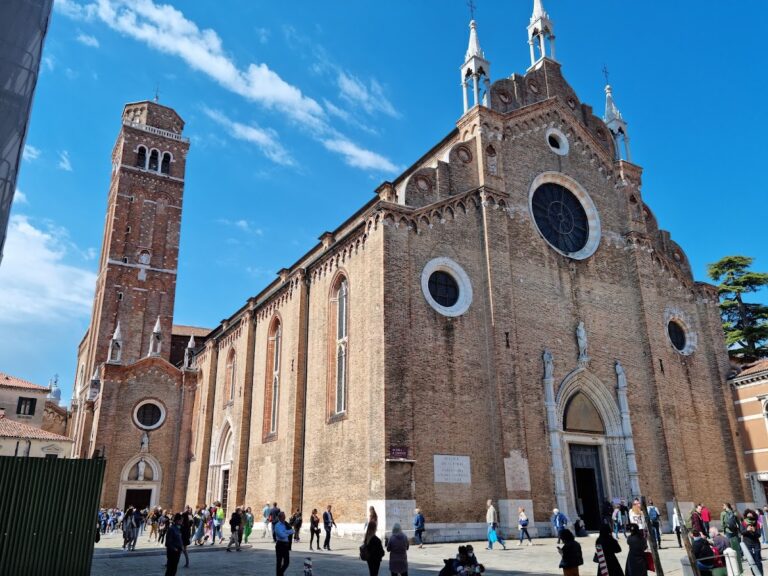
San Tomà stands on Campo San Tomà, on the eastern side of the square opposite the Scoletta dei Calegheri. The present church has a single nave and a classically styled facade, an arrangement shaped by the seventeenth- and eighteenth-century rebuilding phases. The truncated bell tower, which rises to 11 metres, was restored in 1809.
Facade sculpture and medieval remains
Pediment group
The facade pediment is crowned by a sculptural group representing the Incredulity of Saint Thomas, flanked by Saint Peter and Saint James. Francesco Cabianca made the works between 1696 and 1699, and they were reinstalled after the rebuilding that began in 1742.
Corner statues
Two further statues, Saint Mark and Saint Theodore, were made in 1706 and 1707 and are attributed to Paolo Callalo. They originally stood above the outer corners of the church’s side wings before being moved to niches in the rebuilt facade.
Priuli sarcophagus
Above the right-hand entrance is the sarcophagus of Giovanni Priuli, a fourteenth-century war hero and senator. It survives from a larger funerary monument dated 1375, and the carved figure rests his feet on a small dog.
Madonna relief
Set into the external left side is a large pointed-arch lunette, a half-moon-shaped relief panel, showing the Madonna venerated by members of a confraternity. The piece came from an unidentified late-medieval portal that was demolished and is also known as a representation of the Madonna della Misericordia.
Paintings and altars
Nave ceiling
The nave ceiling carries Jacopo Guarana’s fresco of The Martyrdom of Saint Thomas. Giuseppe Moretti’s quadratura, an illusionistic painting of architectural frames and perspectives, surrounds the scene and extends the impression of the interior structure into the painted surface.
Right-hand altars
The first altar on the right has an altarpiece of the Madonna and Saints by Vincenzo Guarana. The third altar contains The Visitation of the Virgin by Pietro Tantini, dated 1792.
Presbytery altar
In the presbytery, the main altar is devoted to Antonio Zanchi’s Incredulity of Saint Thomas. Marble statues of Saint Peter and Saint Thomas, made by Girolamo Campagna in 1616, flank the painting.
Altar from the Scoletta dei Calegheri
The second altar on the left originally belonged to the nearby Scoletta dei Calegheri. Its altarpiece, Saint Mark Healing the Shoemaker Anianus, was painted by Giovanni Fazioli in 1789 or earlier and replaced an earlier work by Palma the Younger.
Relic chapel
An elliptical-plan chapel was built beside the rear right side of the church in 1840. Its purpose was to house relics transferred from churches that had been suppressed, adding a nineteenth-century feature to the building’s sequence of alterations.